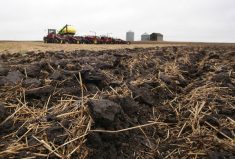
Seeding soybeans last year with a planter instead of an air drill resulted in slightly higher yields, but with a lot less seed, a study commissioned by the Manitoba Pulse Growers Association found.
“Use 15 per cent less seed and get another two-bushel (an acre) yield advantage you’re in pretty compelling territory to say, ‘I want to do it that way,’” said Brent VanKoughnet of Carmanbased Agri-Skills, who did the research.
However, like many Manitoba fields in 2010, VanKoughnet’s replicated trials struggled due to excess moisture. Under more normal conditions yields might be similar no matter which implement was used to seed, although using a planter would still use less seed, saving the farmer money.
Read Also
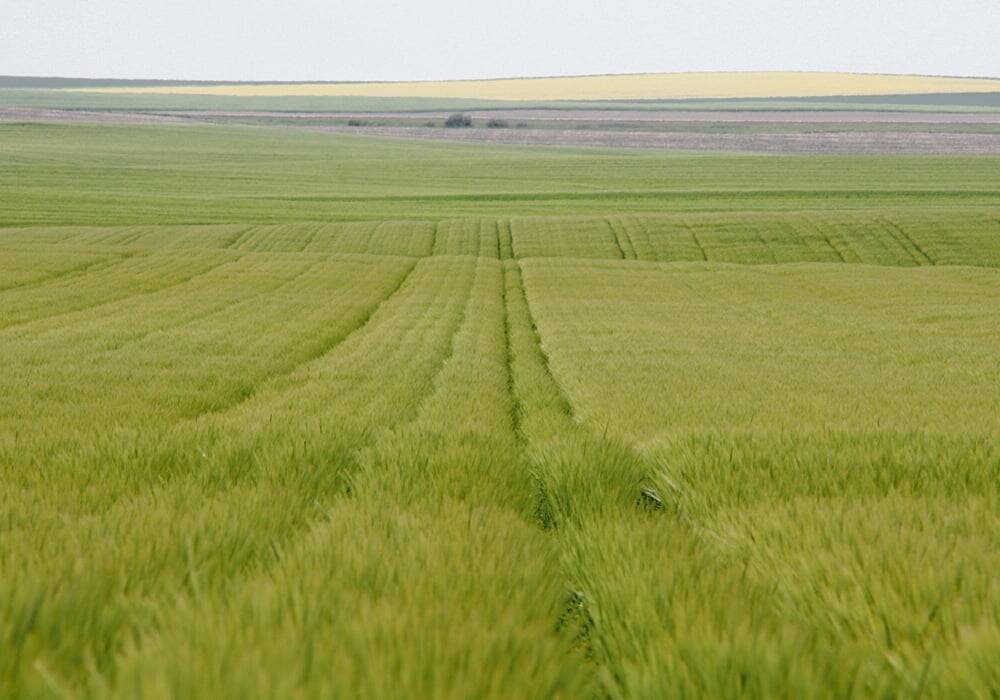
VIDEO: Manitoba farmer tests controlled traffic farming to fight soil compaction and flooding
Manitoba farmer Alex Boersch wants to improve the stability of his crop yields. He’s been experimenting with controlled equipment traffic on his fields
The seeding rate in one of the treatments with an air drill was 201,124 seeds an acre planted in 10-inch rows. The seeding rate in one of the treatments using a planter was 171,910 seeds an acre in 15-inch rows. That’s a 15 per cent difference.
Seventy-four per cent of the target plant stand was achieved with the air seeder and the crop yielded 29. 3 bushels an acre. Almost 92 per cent of the target plant stand was met with the planter and the crop yielded 33.4 bushels an acre.
“So when I do the math on that just in the cost of seed in the Roundup Ready II world (where seed will be more expensive) that’s a bushel (an acre),” VanKoughnet said. “There’s a bushel of yield that you’ve given up in cost just by having to plant that many more seeds.
“There’s no question that the planter had the best depth control and given the monsoon that came after… that alone was an advantage. It’s a bit difficult sometimes to tease out what was the equipment effect versus what was the width effect.”
The study compared two different air drills sowing seeds in eight-and 10-inch rows at three different rates – low, medium and high – against a planter used to seed soybeans in 15-inch rows, also with low, medium and high seeding rates. (See table)
A much higher percentage of the target plant stand was met with the planter (ranging from 91.5 to 95.1 per cent) compared to the air drills (74 to 82.5 per cent).
MOISTURE AFFECTED TESTS
VanKoughnet suspects the planter’s plant survival rate was higher because of better depth control. He also suspects there were some packing issues with the air drills, which under better growing conditions, might not be a problem.
“When you run an on-row packer on the row with a heavy air drill there’s a two-to three-inch hump between the rows,” he said. “When we got the heavy rains and winds, that soil washed flat and put another half to three-quarters of an inch of soil over top of the seed (making it harder for the seed to emerge).”
The shape of soybean plants is changing and that could mean row spacings might need to change, VanKoughnet said.
“The theory is the bushier plants will do better in a wider row spacing than the narrower plants would,” he said. “That’s why this year we’ll look at the bushier plant versus the more upright plant and do it in 30 inches versus 15 inches versus eight (inch rows). My hunch would be – and that’s the reason why you do research is to confirm hunches – there might be different recommendations by (plant) architecture when we’re done.”
Farmers might pick varieties partly on their type of seeding equipment.
“And that’s a whole new way of thinking, but it wouldn’t surprise me if we end up there,” VanKoughnet said.
Farmers shouldn’t stop growing soybeans just because they don’t have the right seeder, he said.
“This is about fine-tuning some performance and really having an eye on the overall economics on what works and what doesn’t,” VanKoughnet said.
Three or four years ago (when seed was probably a third of the cost it’s going to be for Roundup Ready II soybeans), bumping the seeding rate 20 per cent didn’t cost that much, he said.
“But the economics of these higher-yielding (higher-priced) varieties means you think about seed differently, VanKoughnet said. “The nuances of planters and 20 inches versus 15 versus 30, at those prices, that makes a big enough difference it’s worth investigating.” [email protected]
———
“Use15percentlessseedandgetanother two-bushel(anacre)yieldadvantage you’reinprettycompellingterritoryto say,‘Iwanttodoitthatway.’“
– BRENT VANKOUGHNET