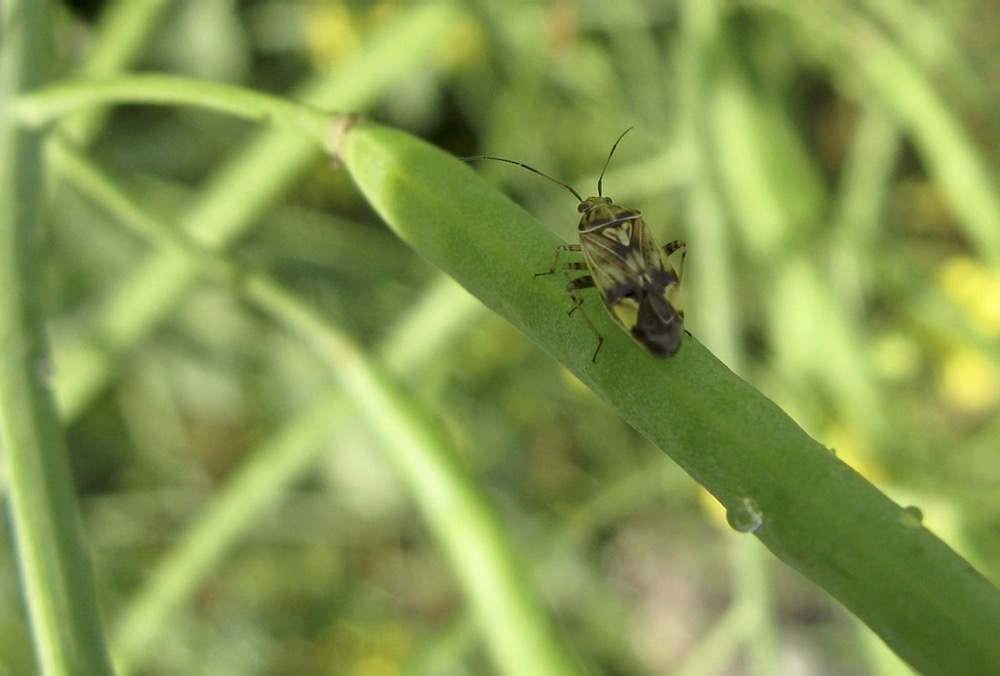
Canola growers should be keeping a different threshold in mind when it comes to gauging damage from Lygus bugs.
Provincial entomologist John Gavloski says the most recent research on Lygus bug damage pegs a threshold of 20 to 30 bugs per 10 sweeps of the scouting net, much higher than previously considered.
“It is something new,” he said. “People have been using the same thresholds for literally decades.”
Read Also
The looming threat of HPPD herbicide resistance
Group 27 herbicides are still working in Manitoba, so far, but weeds are beating them in other parts of North America, plus we have other resistance worries.
Why it matters: With canola prices high, many producers were tempted to adopt a lower threshold when it came to Lygus bugs this year, but research suggests that producers trying to control some of those lower populations may have been wasting their money.
The province’s website put that old threshold at 10 to 15 Lygus bugs per 10 sweeps. The province had previously operated under a series of chart values, which estimated economic thresholds based on an assumed loss of 0.1235 bushels per acre for every Lygus bug found in 10 sweeps.
“Which does work at certain levels,” Gavloski said. “but once the Lygus levels get low, the relationship isn’t totally linear.”
Instead, research out of Alberta suggests a sort of basement population when it comes to economic damage—If scouting shows less than 10 bugs in 10 sweeps, that population is not large enough to significantly hurt a field’s bottom line, regardless of canola price.
“Regardless of whether you have $10 per bushel canola or $20 or, theoretically, even $100, they’re not doing economic damage,” Gavloski said. “What people were doing with those tables is they were extrapolating. So they were saying, ‘Well, my threshold is going to be, say, 15 Lygus bugs in 10 sweeps at, say, $10 canola. If my canola is $20 a bushel, we’ll half that,’ which you can’t do. It doesn’t work.”
Canola’s current sky-high price encouraged that thinking, he added.
Adjusting for drought
Drought conditions do merit some consideration to the threshold. Drought stress will impact a plant’s ability to compensate for damage from the juice-sucking bugs, Gavloski acknowledged.
Still, he cautioned against dipping below the 20-30 bug recommended threshold.
“What we’re suggesting is, use the lower end of that range in dry conditions, somewhere between 20 in 10 sweeps,” he said.
The province estimates that it will take two to three weeks for Lygus bugs to go through their full five nymph stages this year, although weather will play a critical role in that timeline. Research done in 2012 on green beans found that Lygus bugs matured significantly faster under higher temperatures.
Advice for next year
Most canola crops in the province are likely past the point where they are susceptible, Gavloski said, although later stands that had to be reseeded earlier this year may still be in the danger zone.
“There could be some very late seeded fields that still are in that stage where the seeds are still forming and are quite juicy,” he said.
Canola is generally considered too mature for economic Lygus bug damage once seeds are hardened and pods are leathery.
According to the Aug. 17 provincial crop report, harvest in advanced canola crops had begun or was expected to start in the near future in most areas of the province.
About 35 per cent of those canola acres were in “good” condition, the report noted, ranging from 50 per cent in the Northwest to the Interlake, where only five per cent of acres were considered in “good” condition.