The Weather Vane is prepared by Daniel Bezte, a teacher by profession with a BA (Hon.) in geography, specializing in climatology, from the University of Winnipeg. Daniel has taught university-level classes in climate and weather and currently operates a computerized weather station at his home near Birds Hill Park, on 10 acres he plans to develop into a vegetable and fruit hobby farm.
Contacthimwithyourquestionsandcommentsat [email protected].
Read Also
Why is the sky blue?
The colour of the skies, on the Prairies and elsewhere, tells the story of the paths sunlight takes as it enters Earth’s atmosphere, Daniel Bezte writes.
———
Copyright 2011 Agriculture &Agri-Food Canada
Precipitation Compared to Historical Distribution (Prairie Region)
November 1, 2010 to January 20, 2011
Prepared by Agriculture and Agri-Food Canadas National Agroclimate Information Service (NAIS). Data provided through partnership with Environment Canada, Natural Resources Canada, and many Provincial agencies.
Record Dry
Extremely Low (0-10) Very Low (10-20) Low (20-40)
Mid-Range (40-60) High (60-80)
Very High (80-90)
Extremely High (90-100) Record Wet
Extent of Agricultural Land Lakes and Rivers
Produced using near real-time data that has undergone initial quality control. The map may not be accurate for all regions due to data availability and data errors.
Created: 01/21/11
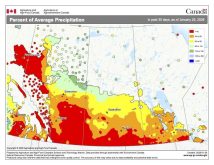
With all the talk about deep snow cover across the Prairies so far this winter, I thought we should take a look
at the amount of precipitation compared to historical averages. From the map you can see a good portion
of Saskatchewan and Alberta has experienced high to extremely high amounts of precipitation so far this
winter. Further east in Manitoba, amounts drop off, with a good portion of this region experiencing low to
record-low amounts.