kochia

Heading off Group 2-resistant weeds

It’s complicated, but picking the right rotation of crops and chemicals is key to avoiding multiple resistance

Many common crop rotations in Manitoba are selecting for Group 2 herbicide resistance, as well as pushing resistance to other herbicide groups, says a U.S. weed specialist. Jeff Stachler of Ohio State University’s Auglaize County Extension Office told the recent Manitoba Agronomists Conference that a good rotation, not just of crops, but also of herbicides

Data suggests there is most white mould suppression and increased yield when fungicides are applied at the R1 growth stage.

Soybean white mould control options limited

In contrast to canola, there are only four products registered

While many Manitoba growers are familiar with the extensive number of fungicides available for dealing with white mould (sclerotinia) in canola, they may not realize that there are a lot fewer options to treat this disease in soybeans. Only four foliar fungicides are registered for control or suppression of white mould on soybeans: Acapela (DuPont),


Most bee deaths from neonics in Canada have been in the intensive corn-growing areas of Ontario and Quebec.


No neonic ban expected in the West

In Ontario, the treatments won't be allowed in 2017 unless a demonstrated need exists

Restrictions on neonicotinoid-based pesticides in Ontario have generated concerns amongst grain farmers in the province, but Manitoba industry participants don’t expect similar policy to move west any time soon. Laws restricting neonicotinoid-pesticide use were introduced in July. The Grain Farmers of Ontario had hoped to enact a stay on the regulations through court proceedings, but


Martin Entz speaks about organic soybeans near Carman.

Higher seeding rate needed for organic soybeans

Transitioning to organic soybeans is possible with strategic planning

It’s a simple question, one that Martin Entz hopes producers will seriously consider. “Why not grow organic soybeans?” he asked producers gathered at the Ian N. Morrison research farm near Carman late last month for the Manitoba Pulse & Soybean Growers’ annual SMART Day. “Something farmers are always looking for is on-farm diversification, so we’ve

Greg Bartley takes producers through his research plots.

Black earth doesn’t equate to warmer soil temperatures

Spaces went fast for this year’s Manitoba Pulse & Soybean Growers SMART Day

Wagons were filled to capacity and then some at the Ian N. Morrison research farm near Carman late last month, as the Manitoba Pulse & Soybean Growers held its annual SMART Day for soybean producers and agronomists. “Programs like this are hugely beneficial, especially for guys like myself, who are just realizing that I know


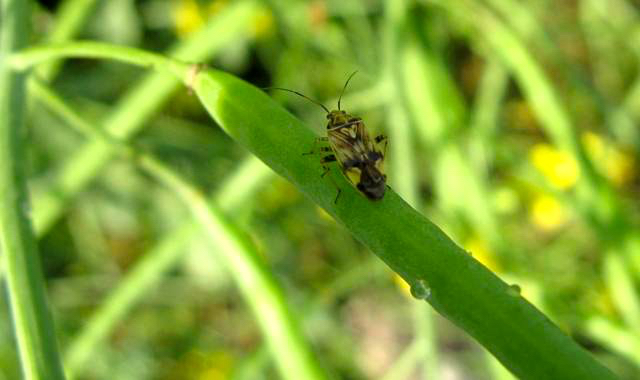
Lygus bug on a canola pod

Fusarium levels low, soybean aphid numbers increasing

Manitoba crop insect and disease update for August 4, 2015

Plant Pathogens: Levels of fusarium head blight are being reported as low in many areas. Increased levels of mycosphaerella are being reported in later seeded field peas in the southwest as a result of the cooler and wetter conditions. Some soybean fields are showing increasing damage due to excess moisture and subsequent root rots. Weather conditions have been conducive for

VIDEO: Research on volunteer canola in soybean crops

VIDEO: Research on volunteer canola in soybean crops

Crop Diagnostic School: Wider rows, integrated management being studied to pressure volunteer canola

At the recent Crop Diagnostic School, Rob Gulden, an associate professor at the University of Manitoba, spoke about current and ongoing research to address the problem of volunteer canola in soybean crops. Wide row spacing and integrated management techniques with cereal crops are being tested as well as combining herbicide groups for in-crop application to measure


Manitoba Crop Report and Crop Weather report: Issue 14

Manitoba Crop Report and Crop Weather report: Issue 14

Conditions as of August 4, 2015

Winter wheat and fall rye harvest is underway in Manitoba. Preliminary reports indicate winter wheat yields range from 60 to 85 bu/acre, with low levels of fusarium damaged kernels in harvested samples. There are also a few fields of spring wheat, barley and field peas harvested last week. Swathing or preharvest applications in the earliest-seeded spring

Volunteer canola grows amid soybean test plots.

Less nitrogen equals less volunteer canola

Tighter row spacing may put the squeeze on late-emerging or slow-growing weeds, but not so for volunteer canola

Looking to reduce volunteer canola in your soybeans? Hold off on that extra nitrogen, or better yet, find a field that’s been depleted. Standing amid research plots at the Ian N. Morrison Research Farm near Carman, University of Manitoba PhD student Charles Geddes explained some of the work being done to combat volunteer canola during