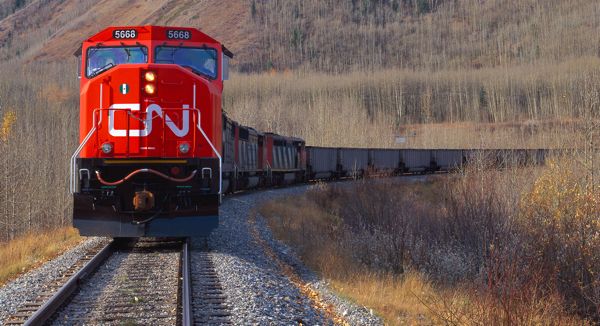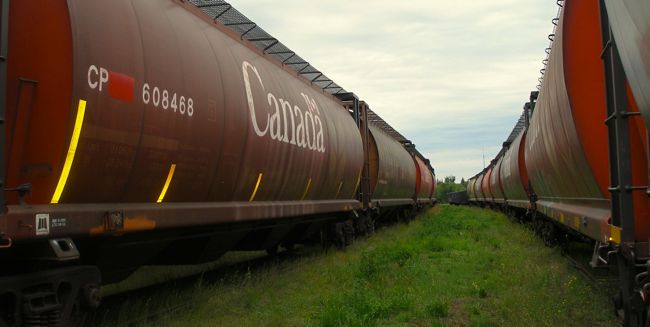
CP Rail says it’s ready to move this year’s crop to market

CP Rail says it’s ready to move this year’s crop to market

The company is investing billions to move even more grain as western Canadian production continues to increase

A senior executive with CP Rail says the company is “well positioned” to move this year’s grain crop despite recent cutbacks in staff and locomotives. Grain is, was and will continue to be Canadian Pacific Railway’s biggest cargo, John Brooks, vice-president of sales and marketing for bulk commodities, said in an interview Aug. 6. And



two students with award

Grain-shipping focus of students’ winning business plan

Assiniboine Community College students focus on grain transportation woes to earn top spot in provincial competition

Two second-year agribusiness students from Assiniboine Community College were recently awarded first place in an annual provincial business competition after focusing in on producer car shipping. Matt Tolton and Will Turner were awarded the top spot in the Manitoba New Venture Championship on April 11 at the University of Manitoba. Both Tolton and Turner grew

Aerial view of Lac-Megantic after the July 2013 derailment and explosion that killed 47 people. (TSB.gc.ca)

Canada to set new speed limits on dangerous goods trains

Updated April 25, 2015 — Ottawa | Reuters — Canada will immediately impose a new speed limit of 65 kilometres per hour for dangerous goods trains moving through urban areas with more than 100,000 people, Transport Minister Lisa Raitt said Thursday. This is one of many measures the Conservative government has introduced since the July


Stephen Harper in a discussion at a conference

Harper says railways can’t be allowed to misuse market power

The order-in-council requiring minimum grain movement expires at the end of March

Western Canadian farmers and grain companies have a new supporter for their argument that the railways have too much market power — Prime Minister Stephen Harper, no less. A year after the Canadian cabinet in an unprecedented move passed an order-in-council requiring Canadian National (CN) and Canadian Pacific (CP) railways to ship a weekly minimum

(Photo courtesy CN)

CN overshoots 2013-14 grain handling revenue cap

The Western Grains Research Foundation will get a $4.98 million gift this season from Canadian National Railway, but not out of holiday spirit per se. The Canadian Transportation Agency on Thursday ruled CN, during the 2013-14 crop year, exceeded its maximum allowable revenue from Prairie grain handling by $4,981,915, above its previously set “entitlement” of


Scrap the cap and the railways will do a better job moving western grain, says Barry Prentice, an agricultural economist and professor at the University of Manitoba’s Transport Institute.

Scrap the cap and the railways will move more grain

The University of Manitoba’s Barry Prentice says ‘Soviet’-style regulations 
make for a less efficient western grain-handling and transportation system

The railways would do a better job moving western Canadian grain if the revenue cap was scrapped, allowing the free market to work, says Barry Prentice, an agricultural economist and professor at the University of Manitoba’s Transport Institute. “I wonder why on earth do we have a government… holding up the case for capitalism… dealing


(Dave Bedard photo)

Mandatory minimum grain handle extended

A new order-in-council will extend the federal government’s mandatory minimum weekly grain handle for Canada’s big two railways through March, just as the previous order expires. Federal Transport Minister Lisa Raitt and Agriculture Minister Gerry Ritz on Saturday announced the mandatory minimums, which expired Saturday, are extended until March 28, 2015. The new order, however, adjusts the

man speaking at conference

Are rail companies poised to miss grain shipping targets?

The next few weeks will be crucial as farmers 
wait to see if grain backlogs will again be a problem 
on the Canadian Prairies

This year’s Prairie harvest may not be quite the record-breaking bin buster that 2013 was, but it doesn’t mean farmers will be free of transportation problems. Mark Hemmes, president of Quorum Corp. — the Edmonton-based company which was contracted by the federal government to monitor grain transport in the West — said that the next