
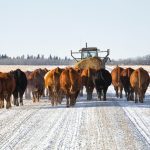
Early spring grazing sets the stage for the entire growing season

Early spring grazing sets the stage for the entire growing season

Here's a few management options for you to consider

Manitoba Forage & Grassland Association – Even though winter feed stores may still be adequate the urge to get cows to grass is escalating. Turning cows out on immature forages too early can have consequences, with the biggest challenge being to avoid permanent damage by overgrazing. If forages are overgrazed early, permanent damage of the stand

Off-site watering systems can improve herd health by reducing foot rot and increase carrying capacity.

Benefiting from a solar watering system

Installing a solar watering system has increased carrying capacity, weight gain and improved herd health

Cattle producers battling foot rot issues may want to consider employing a solar watering system. “By using these solar watering systems we have been able to fence off our sloughs and dugouts and that has dramatically improved our animal health. We haven’t seen foot rot on our farm for at least nine years. It is


Michael Thiele (r), grazing club co-ordinator with the Manitoba Forage and Grasslands Association spoke on the importance of organic matter in pasture soil at a recent grazing workshop.

Tired pasture? The solution is in the soil

To create a healthy pasture, grazing expert says to start with ground cover, 
plant a diverse mix and avoid disturbing the soil

To get more pasture growth above ground, start by looking below the surface, says Michael Thiele, grazing club co-ordinator for the Manitoba Forage and Grassland Association (MFGA). “Nutrient levels in the soils across Canada have been greatly depleted since conventional agriculture began and the same nutrient depletion can be seen in the foods we are

Editorial: GHG-reduction policy not a bad deal

Editorial: GHG-reduction policy not a bad deal

The chart in last week’s Winnipeg Free Press article on the Manitoba government’s new policy to reduce greenhouse gas neatly illustrated some of the interesting but complex implications for agriculture. It listed Manitoba’s top GHG-producing facilities, and No. 1 by a wide margin is the Koch nitrogen fertilizer plant at Brandon. The No. 2 emitter


Melinda German, general manager of the Manitoba Beef Producers, provided an update on Brandon’s research and demonstration farms at the Manitoba Feedlot School in Brandon last week.

Manitoba Beef and Forage Inc. research projects have started

First-year projects include energy-dense forages, pasture species and rotational grazing practices

It now has an official title — Manitoba Beef and Forage Inc. (MBFI) — and some of its first projects are underway. MBFI has four major partners — Manitoba Beef Producers (MBP), Ducks Unlimited, Manitoba Agriculture, Food and Rural Development (MAFRD) and Manitoba Forage and Grasslands Association (MFGA). They’ve joined to find answers on the

MFGA September hay situation and price update

MFGA September hay situation and price update

From the Manitoba Forage and Grassland Association's Sept. 17 eBulletin

Most areas of the province are reporting the completion of 2nd and/or 3rd cut alfalfa and some areas are taking or waiting to take the final cut till after the Critical Harvest Period (CHP). I surveyed the MAFRD forage staff and some of the forage industry personnel to get their impression of hay prices and


hay bales in a field

Provincial hay production below average

As harvest progresses, forage specialists take a look at how this year’s hay production is shaping up

After a season of sporadic weather, forecasters suggest Manitoba’s hay situation isn’t as dire as our neighbours to the west, but still below average. “We are below average across the province in comparison to previous years,” said John McGregor, extension support with the Manitoba Forage and Grasslands Association (MFGA). “Even in the areas that have

Ground cover and soil ecology specialist Christine Jones discussed how to develop biological activity in pasture soils at a recent Manitoba Forage and Grasslands Association workshop.

Give roots a chance to do their job, says soil ecologist

Australian soil expert says that by focusing on farming light you 
can build the biological activity in soil and boost pasture productivity

Christine Jones says if you want to increase pasture productivity, look below the surface. “Our whole production system relies on soil. We take soil tests to determine if the soil is deficient and if it doesn’t have a certain component, we will add it. If our animals have some sort of issue, we will add


Grazier Neil Dennis indicates what he looks for in animal manure to help determine the health of pasture soil.

Clues to soil health lie in the patties

If you want a quick indicator of pasture soil health, just flip the flops. “When I am in my pastures I will flip the cow patties over and I want to see as many holes as I can because that is a sign of fertility,” Dave Pogson, a grazier from Clearwater told the recent Manitoba

Tell us about your hay situation!

Tell us about your hay situation!

Please participate in a quick MFGA survey

In May and June, MFGA published our Green Gold reports to provide Manitoba forage producers with information as to how alfalfa is progressing in their area and, particularly, when to make their first cut for optimum quality. We saw Mother Nature’s influence this year as alfalfa was at the optimum stage in some areas, yet the