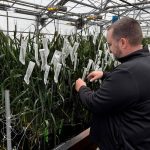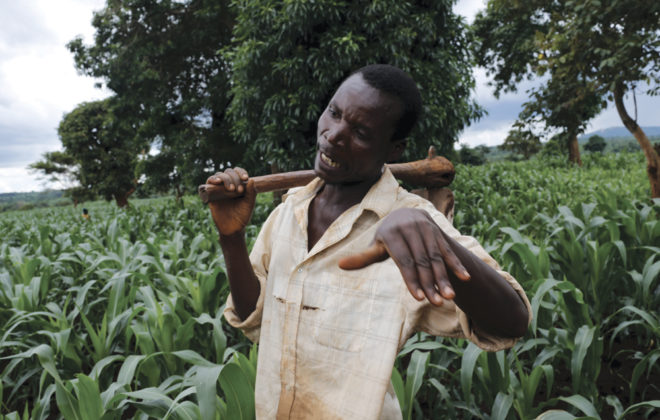
Manure management specialist Scott Dick was one of the industry partners recently recognized by the Manitoba Pork Council.

Manitoba Pork recognizes industry participants at AGM

Steve’s Livestock Transport and manure management specialist Scott Dick were singled out for 
ongoing contributions to pork sector’s success

Manitoba Pork Council (MPC) has recognized two industry partners who have contributed to the overall success of the pork business at its 2016 annual general meeting. The group presented awards to Steve’s Livestock Transport and Agra-Gold Consulting co-founder Scott Dick to recognize their ongoing commitment to the hog sector. Steve’s Livestock Transport was recognized for

Zane Pickering prepares his heavy horses for their time in the show ring at last week’s Royal Manitoba Winter Fair.

Town meets country at the winter fair

The Royal Manitoba Winter Fair might be an equestrian show, but it 
still attracts an audience of urbanites interested in agriculture

With his two Belgian horses hovering over him, Zane Pickering entertained questions from passersby. “These horses are pretty majestic, so I guess that attracts people,” said Pickering, as he prepared them for their time in the show ring at the Royal Manitoba Winter Fair (RMWF) “We have so many people stopping to look at them


Michael Thiele (r), grazing club co-ordinator with the Manitoba Forage and Grasslands Association spoke on the importance of organic matter in pasture soil at a recent grazing workshop.

Tired pasture? The solution is in the soil

To create a healthy pasture, grazing expert says to start with ground cover, 
plant a diverse mix and avoid disturbing the soil

To get more pasture growth above ground, start by looking below the surface, says Michael Thiele, grazing club co-ordinator for the Manitoba Forage and Grassland Association (MFGA). “Nutrient levels in the soils across Canada have been greatly depleted since conventional agriculture began and the same nutrient depletion can be seen in the foods we are

Brian Harper discusses his high stock density grazing program during a summer field tour on his operation last year.

Hit the grass fast and hard, and then move them out

Brian Harper says high stock density grazing has allowed him to 
double his pasture’s carrying capacity

Move the cattle through small paddocks fast, and then give the grass a good rest. That’s the theory behind a high stock density grazing system, and Brian Harper says it’s paid off. “High stock density is a management system where you have a high number of cattle in a small area for a short time.


A barn in Holland in which piglets are given burlap sacks to play with.

Hog enrichment comes in many forms

Not just toys for pigs, enrichment makes swine smarter and easier to transport

The time for thinking about enrichment as “toys for pigs” has long passed. Speaking to producers and members of the pork industry at the Manitoba Swine Seminar in Winnipeg, Jennifer Brown said not only is enrichment mandatory under the current code of practice, it actually provides benefits to both animals and those who handle them.

border lineup (trucks) - Glen Nicoll
051110.12

COOL demise a costly victory for Canadian producers

It took eight years and billions of dollars, but ultimately trade law prevailed in securing the labelling law’s repeal

UPDATED: Dec. 29 – After nearly eight years and millions of dollars spent fighting it at the World Trade Organization and billions in lower prices for Canadian beef and hog producers, the U.S. mandatory country-of-origin labelling program has been repealed. The end came Dec. 18 when both houses of the U.S. Congress passed a massive


Most farmers consider themselves professionals. Some are suggesting they make it official.

Should livestock farmers need a degree?

Profound changes in society require a different response to reassuring the public about animal care

With growing public scrutiny of livestock production, the time has come to consider requiring livestock farmers to be professionals like lawyers, doctors and accountants, said a veteran animal welfare educator. The training and certification a livestock production professional would require “would be the most powerful way to assure the public about animal care,” said David

Canada can retaliate on COOL

Canada can retaliate on COOL

But the tariffs will be lower than it wanted

In a ruling released earlier this week, Canada and Mexico got about one-third of the clout they sought from the World Trade Organization to impose retaliatory tariffs on American products because of country-of-origin labelling. But Canadian officials say the ability to penalize imported U.S. goods to the tune of C$1,054,729 is enough to pressure U.S.


(Gloria Solano-Aguilar photo courtesy ARS/USDA)

U.K. review calls for urgent cuts to antibiotic use in livestock

London | Reuters –– Massive use of antibiotics in farming poses a critical threat to global public health and should be reduced dramatically to an internationally-agreed target, according to a British government-commissioned review. Agreeing and implementing a global target for agricultural antibiotic use won’t be easy, the review, led by former Goldman Sachs chief economist

“Research in the dairy industry shows that cows eat more forage that is higher in sugar content. Researchers are also seeing a corresponding increase in milk production, up to eight per cent,” said Bill Houston, senior range and forage biologist with AAFC.

Industry updated on research efforts in forage and grassland sector

Agriculture and Agri-Food Canada presented the details of its forage research project that began last October

Awareness of the role forage plays in a healthy agricultural sector has grown over the past six years since the formation of the Canadian Forage and Grassland Association (CFGA), speakers told the group’s annual meeting here. “Just as recent as two years ago the dairy industry had no interest in investing in the research and