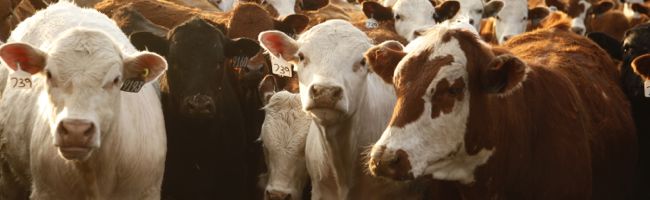
(USDA.gov via Flickr)

U.S. cattle herd growth to five-year high spells cheaper beef ahead

Chicago | Reuters — Beef prices will keep trending lower, analysts said after the government’s semi-annual cattle inventory report on Friday showed the U.S. cattle herd as of Jan. 1 grew three per cent from a year ago, to a five-year high. Healthy pastures, more-affordable grain and record-high cattle prices a year ago encouraged ranchers


(Photo courtesy Canada Beef Inc.)

Klassen: Uncertainty causes feeder market volatility

Western Canadian feeder cattle prices traded steady to as much as $10 lower compared to week-ago levels. Feedlot hands are contending with adverse winter conditions and cattle travelling farther distances were down $6 to $12 in non-major feeding regions. Feeder markets were slightly softer Monday through Wednesday; however, feedlot operators were quick to back away


(Photo courtesy Canada Beef Inc.)

Klassen: Feeder cattle market falls sharply

Western Canadian feeder cattle prices experienced a week-over-week decline of $12-$15 on average, with fleshier unweaned calves trading down $20-$25. Major feedlot operators reined in buying interest across the Prairies as fed cattle and wholesale beef prices remain under pressure. Feeding margins continue to deteriorate beyond pain thresholds and the backlog of market-ready feedlot supplies


(Photo courtesy Canada Beef Inc.)

Klassen: Feedlots curb buying interest

Despair is the price one pays for setting an impossible aim. Given the phone calls over the past week, producers have been expecting something the market cannot offer. Western Canadian feeder cattle prices were under severe pressure, with 700-plus-pound cattle down $8-$12 from seven days earlier; calves under 700 lbs. traded $4-$8 below week-ago levels.


(Photo courtesy Canada Beef Inc.)

Klassen: Feeder market stronger but volatile

The Western Canadian feeder cattle market appeared to gain momentum this week.  Feeder cattle prices were extremely volatile compared to last week trading $5 lower to as much as $10 higher in the Eastern Regions.  When April live cattle futures were higher, the bids flowed more aggressively but on days when the futures struggled, buyers