Life can be tough on a tuber.
Lots of things can cause blemishes or otherwise diminish the visual quality of a potato. It could be herbicide injury, North Dakota State University plant pathologist Andy Robinson said. Or the tubers might have been jostled by harvest equipment. Maybe it’s just a consequence of field conditions.
“Lots of bad things can happen to your tubers, mainly skin cracking and misshapen tubers,” he said. “I like to call this tuber trauma.”
Read Also
Manitoba Beef Producers targets elk surge, wildlife losses in resolutions
Resolutions at last month’s Manitoba Beef Producers meeting seek help to rein in elk and deer populations, expand fencing supports and improve compensation for wildlife damage.
To understand tuber trauma, it helps to remember that a potato is an offshoot growth of a root structure and, as far as the plant is concerned, serves two purposes.
Why it matters: Visual flaws can stem from stresses suffered in the field, such as inconsistent watering, herbicide carry over or other environmental stress.
First, it’s a perennating organ, a way for perennial plants to store energy in the form of starch. It is a reserve to keep the plant alive during times of environmental stress, such as drought.
The starch reserve is surrounded and protected by a skin called the periderm.
“It protects the tuber from disease, injury or water loss, very much like the skin we have on our body,” said Robinson.
Potatoes are also a form of asexual reproduction. If the plant dies back because of environmental stress, one or more plants will grow again from the tuber, using its stored energy. Each “eye” will generate a new plant.
Tubers grow quickly while bulking up, requiring a lot of rapid cell division. If the process happens quickly enough, the inside of the tuber can outgrow the periderm, causing micro-cracks in the skin.
The plant treats the cracks as something it needs to heal, to prevent injury, disease or water loss, the NDSU plant pathologist said. So, the tuber grows new periderm between the cracks, creating a distinct pattern called russeting, commonly seen on commercial potatoes.
“Another thing we sometimes see is elephant hide, and this can be from herbicides,” Robinson added. “It’s also been noted that other things such as temperature, genetics and disease such as rhizoctonia can cause it.”
Elephant hide looks like a more drastic version of russeting. It resembles large, square scales on the periderm. There is little to be done about the condition because the cracks are large, crescent-shaped lesions.
It is “typically a result of the fluid pressure, or what we call turgor pressure, within the cells being really high at harvest,” Robinson said. “This can cause those little thumbnail cracks.”
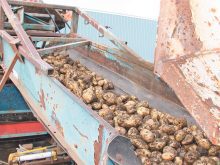
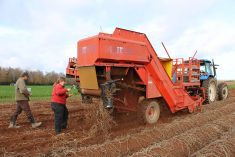
There is also the risk of shatter bruise, a consequence of whole tubers being dropped and shifted during the mechanical harvesting process.
Opinions differ regarding the effect of temperature on thumbnail cracks and shatter bruising. A sudden drop in temperature may cause thumbnail cracks, and it’s well known that a cold, crisp tuber that hits a hard surfacxe will suffer skin breakage and tissue damage, causing discolouration.
Deeper wounds
Robinson said deeper cracks or fissures happen early in the bulking stage, enlarging as the tuber grows. Growth cracks start small, usually from some kind of stress, and grow with potato.
“For example, you get some big rainstorms coming through (and) you don’t know if you should turn on the irrigation or not,” Robinson said. “Ideally, you want to maintain the same soil moisture level for optimal growing conditions.”
Producers may try to manage irrigation for consistency, holding off if there’s rain in the forecast, but there may be unexpected amounts or the farmer may wait too long the turn on the pivot, Robinson noted.
Air temperatures or changes to soil chemistry can also be sources of stress, as is herbicide misapplication or drift.
“We see a lot of cracking from herbicides,” Robinson said. “With most herbicides, you’re going to see some type of cracking on the tubers. The cracks will be typically deeper and they happen earlier during the growing season.”
That means carry over can be a huge issue, so it’s important to keep records of any herbicide applications on potential potato land, the pathologist noted. This is especially crucial for land being swapped or rented.
“One interesting one is Imazamox,” Robinson said. “It’s used a lot in dry bean production and it’s either a nine-month or an 18-month rotation, depending on how much rain or irrigation you get. There’s also some pH issues … You can go nine months if your rain plus your irrigation is over 18 inches and your soil pH is above 6.2. If you fail to meet any one of these, then you have to wait 18 months.”
A certain amount of tuber damage is inevitable, he noted. Farming puts a lot of demands on both land and crop. A grower’s ability to avoid unwieldy levels of damage comes down to good management, good information from agronomists, scientists and other growers, plus experience and a bit of luck.
“The best way to control a lot of these tuber problems is just providing the best growing conditions for the plant that you can,” Robinson said. “I know that’s not always possible, but you’ve got to do the best that you can.”