
The $52.8-million expansion of the Winkler Meats processing plant in south-central Manitoba is a sign of a healthy sector, according to Manitoba Pork Council general manager Cam Dahl.
“This is a really good news story, frankly, for all of Manitoba, but of course it’s especially a good news story for Manitoba hog producers,” he said.
Why it matters: The Winkler Meat plant expansion means processing jobs will remain in Canada rather than being exported to the U.S., says Manitoba’s pork producer group.
Read Also
Trade uncertainty, tariffs weigh on Canadian beef sector as market access shifts
Manitoba’s beef cattle producers heard more about the growing uncertainty they face as U.S. tariffs, and shifting trade opportunities, reshape their market.
The expansion is a joint venture between Winkler Meats, owned by farm management services firm the Progressive Group, and U.S. sausage company Johnsonville. It is expected to more than double the number of jobs at the Manitoba facility, to 155 full-time equivalent positions. It is also expected to increase the company’s contribution to provincial gross domestic product by five times, to $23 million per year.
Funding for the project was augmented by the Canadian and Manitoban governments. A joint federal-provincial release July 24 announced nearly $2.4 million for the expansion over two years. Funds will come through the Sustainable Canadian Agricultural Partnership capital infrastructure stream and will go toward new harvesting and processing equipment and a high-capacity packaging line.
The province also approved more than $7.8 million in loan financing and tax rebates for the project.
Dahl said that, while government backing is always welcome, the amount of private interest in the enterprise is the real testament to Manitoba’s agricultural strength.
“An overwhelming majority of the investment is coming from private money, and that’s a really good sign for agriculture in Manitoba – and that’s a really good sign for the pork sector in Manitoba.”
Dahl said the Winkler Meats project is one on a list of similar enterprises.
“We’ve seen investments on all sides of the sector,” said Dahl. “We saw the investment in the bacon plant from Maple Leaf. Topigs Norsvin has put $35 million into their new facility in Plumas, and now we’re seeing another $52 million investment in Winkler.
“We’re not just seeing the production on farms grow, which is a really good thing, but we’re seeing growth in processing and genetics development, as well as some of that further processing, like the bacon plant,” he added.
Dahl said the announcement sends a strong signal about the health of the industry.
It also comes in the wake of less optimistic signs for the North American pork sector.
Earlier this year, meat giants Tyson Foods and JBS reported quarterly losses, as did Maple Leaf Foods, and pork units were part of those results.
Manitoba’s own HyLife Foods shuttered its plant in Windom, Minn., after the facility declared bankruptcy. In June, the company announced 87 layoffs among its roughly 2,500 staff, largely affecting administrative positions.
Other notable closures include 40 Smithfield Foods sow farms in Missouri and a Quebec hog plant run by Olymel Foods.
The industry generally attributed the difficulties to market conditions including high production costs and inflation.
Keeping it local
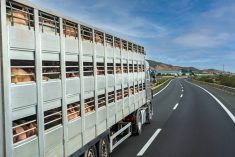
The Winkler project will divert millions of kilograms of live animals from export to the United States, which will reduce the number of trucks needed and their associated greenhouse gas emissions.
The expansion means that processing and jobs will be based in Canada rather than the U.S.
“Most of the cull sows in Alberta, Saskatchewan and Manitoba come through here and go south to be processed,” Dahl said, but it is getting harder to move things across the border.
“Protectionism has been on the rise for a while, and it was exacerbated a bit by COVID. To have that processing available here in Canada without having to go across the U.S. border is a little bit of an insurance program for producers here.
“It’s also really critical infrastructure in the case that we get a foreign animal disease like AFS [African swine fever] or foot-and-mouth disease.”
From the province’s perspective, the project checks a lot of boxes.
It aligns with the Manitoba Protein Advantage Strategy, which aims to attract $1.5 billion in investments and create 1,550 new jobs in the animal and plant protein sectors by 2025, said Manitoba Agriculture Minister Derek Johnson.
He said the project also aligns with the province’s Opportunities for Economic Growth Action Plan, which is based on the premise of partnering with stakeholders to bolster Manitoba’s economic future.
“Our government is taking concrete action to accelerate development in Manitoba’s agri-processing sector by assisting with capital investments that enhance efficiency, productivity and environmental sustainability,” said Johnson.
“Enabling companies to scale up production creates new jobs, supports the skill development of existing employees, increases the value and volume of Manitoba-processed foods and strengthens our province’s economic competitiveness.”
The project has tapped Efficiency Manitoba, which has identified opportunities for energy savings on design and construction of the facility.
“This further cements Manitoba as a leading protein centre in North America,” said Winkler Meats president Jeff Senebald. “The occasion to partner with a company like Johnsonville to share our respective skill sets, to grow and improve the pork supply chain, is an exciting opportunity for Winkler, Manitoba and Canada.”
Michael Stayer-Suprick, CEO of Johnsonville’s parent company, Johnsonville Holdings, said the project is good news for his company as well.
“We’re confident that with our respective capabilities and experience, Johnsonville and Winkler Meats can continue providing a solid pork supply chain and quality products for retail customers and our end consumers,” he said.