

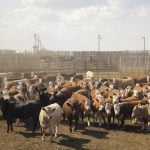
Jethro Hamakoko breeds Brahman cattle on a small ranch about an hour outside of the Zambian capital of Lusaka.

Zambian herd grows, despite ticks, poachers

While not without challenges, some farmers forced out of Zimbabwe 
have found a home ranching in Zambia

Quietly, after the bulk of journalists has moved on to other things, Graham Rae describes the situation as 15 to one. That is 15 poachers and one security guard shot so far. On a still morning near the central Zambian town of Chisamba, it’s hard to imagine, but cattle rustling is a major problem for
A worker cleans photovoltaic solar panels inside a solar power plant at Raisan village near Gandhinagar, in the western Indian state of Gujarat, February 11, 2014.

A new climate-smart cash crop — sunshine

Selling surplus solar energy to the grid is a triple-win scenario in India

London / Thomson Reuters Foundation – A pioneering project in one of India’s sunniest states has led to one farmer harvesting what could become the country’s most climate-smart cash crop yet — sunshine. A pilot project by Sri Lanka-based non-profit International Water Management Institute (IWMI) offered farmers the opportunity to sell excess energy generated by solar


A farm employee pulls out cornstalks on an 18-hectare operation owned by a retired educator near Livingstone.  hotos: Shannon VanRaes

A mix of pragmatism and fear keeps GMOs out of Zambia

While the debate over GMO labelling continues in North America, Zambians take it for granted that they aren’t consuming products made with genetically modified ingredients

In Zambia, it’s practically everywhere. Maize is in tiny garden plots, on small farms, huge estates, in markets and on dinner plates. Since its introduction to Africa by the Portuguese in the 16th century, maize has become the main staple crop in this region. Two megalithic-size cobs even flank the entrance to the Zambia National

people in Africa on a hillside

Moving from famine relief to relief from famine

Ethiopia has made solid gains thanks to a co-ordinated attack on the root causes of hunger

Famine relief was a hit in the 1980s — literally — as pop music stars donated the proceeds of their collaboration on the song “Feed the World” to help feed starving people in Ethiopia. It was a sincere effort that raised millions and was part of a global response by governments and aid and development


women in Africa

Making life a little less hard for women

When communities started talking, they discovered all would be better off if harmful traditions were abandoned

If there’s a list of “worst places in the world to be born a woman,” Benishangul-Gumuz would rank near the top. This is a place that remains steeped in cultural taboos and superstitions, many of them targeted at women. The sanitized bureaucratic terminology is “harmful traditional practices (HTPs),” the origins of which no one seems

Members of the Sirba Abay irrigation users’ group gather in the shade of their new farmers’ training centre to discuss how irrigation has improved their incomes and nutrition.

Irrigation project means year-round food, and more

A Canadian government-supported project has led to 
impressive gains in yields, and in health of the local population

Vegetables were once a rarity in this community located three hours northeast of Asosa in the remote Benishangul-Gumuz region of Western Ethiopia. If onions, potatoes and tomatoes were available at all, they had travelled a long distance and been on at least three trucks. They were expensive, often prohibitively so, and poor quality. Two of


Irrigation on a farm in Ethiopia

Delivering the water of life

Cash crops often replace food crops in farming

It was almost 30 years ago, but the engineer who brought water to Bila remembers well the people’s plight prior to irrigation. Many were refugees who had been repatriated after the Ethiopia-Somalian war. They were given a piece of canvas for shelter, a shovel, pickaxe, a goat and a cart — and told to start over.

Betty Tembo

Increasing food security and nutrition

More families are eating better food more often

Who would have thought cooking could be so tasty — oh, and nutritious too? As we sat in the shade of a tree outside the Tiyanjane Co-op Society Ltd., members of the cooking subgroup explained through an interpreter how they once looked upon soybeans as a cash crop, not something they could eat. Now they


Zambian farmer Wilfred Hamakumba and his wife Irene, have embraced herbicides as part of their conservation agriculture management. Over the past several years, the farm’s yields have more than doubled, their crops are more diversified and their farm has expanded in size. Irene is particularly pleased with their spraying program, saying it takes a lot less labour than weeding.

Can conservation agriculture save Africa’s soils?

Adoption rates are 
slow, but it may be the continent’s best — 
and last — hope

It was the end of a very long day. We had travelled to remote areas on bad roads, walked barefoot across a flooding creek and hiked nearly an hour both ways to reach one of the three farmers we were scheduled to visit. We were on the trail of conservation agriculture (CA) success stories, and

young African girl

In Zambia, investing in farmers keeps kids in school

Families who see improved yields under conservation agriculture use the extra income to pay school fees

Juliette, the eldest daughter of Olipa Tembo and her husband Dickson Nkata, came home from school early one day. She was crying. The child, who would have been about eight at the time, had walked the four kilometres to the local school, only to have the teacher promptly send her home again. The family had