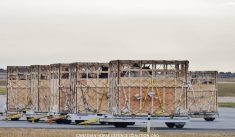

The Manitoba horse exporter at the centre of a private prosecution from a human rights group says the case’s verdict — which cleared the farm — reflects the reality of the sector.
“It’s the only common sense ruling there was. There was nothing else (that) could happen,” said Lyle Lumax, owner of Carolyle Farms near Swan River.
The case got its day in court this March after having the trial date delayed last year.
Read Also
Spruce Woods Colony takes top honours at Royal Manitoba Winter Fair pork competition
Spruce Woods Colony took grand champion honours at the 2026 pork quality competition in Brandon.
WHY IT MATTERS: The air export of horses bound for mostly Asian meat markets continues to be a flashpoint in Canada, with animal rights groups pushing to end the practice, while industry argues that reaction is emotional rather than based in science.
The farm had faced a charge of failing to have a contingency plan during an air shipment of horses that was delayed due to weather. The new timeline pushed the shipment longer than the Canadian Food Inspection Agency’s 28-hour travel time cap, after which point horses must be given food, water and at least eight hours of rest.
Lumax, however, argued that once the horses are on a plane, control shifts to other parties involved in the transport.
Manitoba provincial court Judge Sandra Chapman dismissed the case, finding there was reasonable doubt the company failed to meet federal animal transport requirements.
The judge ruled the exporter did have a contingency plan in place for the 2022 shipment and could not be held solely responsible for disruptions after the animals were transferred to air transport.
How the case got here
The shipment at issue was bound for slaughter in Kagoshima, Japan, and left Winnipeg by plane Dec. 12, 2022. The original plan included a stop in Anchorage, Alaska. A heavy snowstorm, however, made that impossible.
In consultation with the Canadian Food Inspection Agency (CFIA) and the Japanese buyers, it was decided that the plane would instead reroute to Seattle. CFIA officials were involved in discussions and did not intervene, even though the revised route was expected to exceed the 28-hour transportation limit for horses without feed, water or rest.
Other involved parties included a freight forwarder and the airline responsible for different stages of transport, raising questions about who was responsible for contingency planning once the animals were in transit.

Animal Justice, the animal rights group that brought the charge, had been tracking the shipment and could see the time threshold would be exceeded, the group said in a 2024 release. Along with the Winnipeg Humane Society, the Canadian Horse Defence Coalition and Manitoba Animal Save, it filed a complaint with the CFIA. After no enforcement action was taken, the group proceeded with a private prosecution.
The group first floated three charges, including a charge of violating the 28-hour cap and distress to animals. In a 2024 pre-inquiry hearing, however, a Manitoba judge found that the CFIA’s involvement in the decision to go ahead with the shipment nixed the first charge, while the distress to animals charge was rejected on jurisdictional issues. That left only the charge relating to contingency planning to go ahead.
Lack of clarity on contingency needs
Federal regulations require a contingency plan but do not clearly define what it must include or who is responsible. “Compliance will be evaluated on whether the contingency plan was available and implemented, not on its format,” the regulations state.
Animal Justice argued the exporter failed to meet the bar as set out under the Health of Animals Regulations.
Lumax argued that he had a contingency plan, though it was not written down, noting that plans can be verbal under the rules. He said 18 horses were returned to the farm before loading, but once the delay occurred, decisions had to be made quickly.
“Not many airports are big enough to handle this plane.”
Lyle Lumax
Carolyle Farms
“This was about a 10-minute decision. When we found out [about the snowstorm in Alaska], the plane was half loaded,” he said at the time the charge was laid. “Not many airports are big enough to handle this plane.”
He also noted the number of needed pilots as another issue that limited which airports the shipment could have landed at.
The decision to proceed was “a no-brainer,” he said, adding that all parties involved believed it was the best outcome for the animals.
Who is responsible?
In her ruling, Judge Chapman found the evidence did not support a conviction, pointing instead to a more complex web of responsibility.
Chapman said responsibility for the animals is shared among multiple parties. Placing full responsibility on the exporter for all possible contingencies would be unreasonable, she found, particularly once control of the animals had been handed off.
Chapman’s reasoning focused on the question of control. While the exporter was responsible for preparing the animals for transport, responsibility became less clear once the shipment moved into the hands of other federally regulated entities. In that context, the court found it would not be reasonable to place the full burden of contingency planning on a single party.
Historic case
Animal Justice expressed disappointment with the ruling, but emphasized the significance of the trial itself.
“This case is historic,” said Kaitlyn Mitchell, director of legal advocacy at Animal Justice, in a media release. “It is likely the first time farmed animal welfare has been the subject of a private prosecution that reached trial in Canada.”

Mitchell said her organization is concerned the decision could weaken enforcement of animal transport laws and leave animals at risk during long-distance shipments.
“Today’s decision is disappointing and shows why Canadian horse protection laws are meaningless without proper enforcement by the CFIA,” she said.
The group is reviewing the decision and considering whether to appeal.
Horse for slaughter future
Carolyle Farms has since taken steps to reduce travel time, including establishing a feedlot near Winnipeg, Lumax said.
Lumax rejects the animal cruelty label that’s been levelled against him, saying, like most livestock farmers, he cares deeply for his animals.
“I’ve had horses my whole life. That’s all I’ve done. I speak horse more fluently than I do English,” he said.
Nevertheless, he expects he hasn’t heard the last of Animal Justice, who support the push to ban the air export of horses to the international meat market entirely.
That push extends into the policy arena. In 2021, the Trudeau Liberals pledged to end live horse exports by air. A private member’s bill to ban the practice passed second reading in the House and went to committee, but died when Parliament was dissolved ahead of the last federal election.
Mitchell said she’s unsure whether the issue remains a priority for the Carney Liberals.
“It’s a concern,” she said outside the court building after the recent ruling. “I know that the political landscape and the global landscape has changed since this promise was made in 2021, but we’re not backing away until the practice is banned.”