A Manitoba judge has allowed an animal rights group to proceed with a private prosecution against a meat horse exporter under a rarely used provision in the Criminal Code.
Carolyle Farms of Swan River, Man., is accused of violating the federal Health of Animals Regulations by failing to have a contingency plan in place if their transport exceeds 28 hours without a break for food, rest and water.
Why it matters: Animal Justice attempted to lay two additional charges, including exceeding the maximum time limit for transport and causing distress to animals, but those did not proceed.
Read Also

THROWBACK: A refresh on pain management practices during calving
Having painkillers for hard calf births can lead to healthy calves and beef cows this calving season, Manitoba veterinarians say.
Animal rights activists are taking legal action more often to challenge the industry’s animal welfare practices.
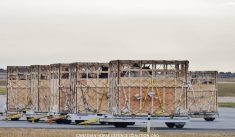
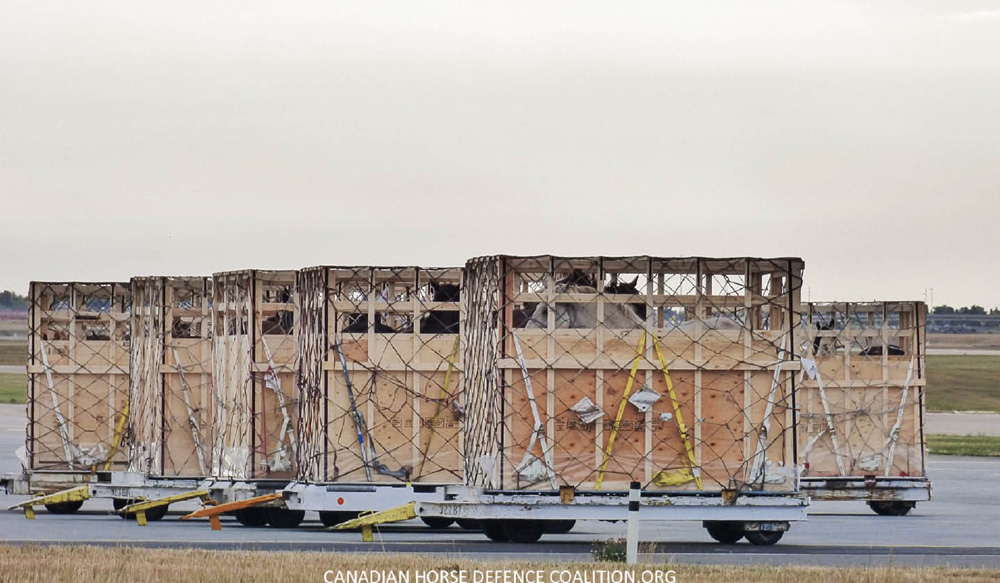
At issue is a shipment of horses bound for slaughter in Kagoshima, Japan, which left Winnipeg by plane Dec. 12, 2022. The original plan included a stop in Anchorage, Alaska, but a heavy snowstorm made that impossible.
In consultation with the Canadian Food Inspection Agency and the Japanese buyers of the horses, Carolyle Farms decided to reroute the plane to Seattle. The delays put the trip over the transportation time limit, Animal Justice argued.
Animal Justice had been tracking the shipment and could see the time threshold would be exceeded, the advocacy group said in a release Feb. 27. They, along with the Winnipeg Humane Society, the Canadian Horse Defence Coalition, and Manitoba Animal Save, subsequently filed a complaint with the Canadian Food Inspection Agency.
After the CFIA did not take enforcement action, Animal Justice began the process of laying private charges, it said in the same release.
Rare provision
According to the Public Prosecution Service of Canada website, a private prosecution is “started by a private individual who is not acting on behalf of a law enforcement agency or prosecution service.”
“They’re a tool that exists in Canadian law so that, where a person has reasonable grounds to believe that another person has committed an offence, they can take steps to have that person charged and brought to court,” said Animal Justice’s director of legal advocacy, Kaitlyn Mitchell. “It has really long and deep roots in our legal system. It used to be much more common.”
Today, she said, it is a far rarer step.
“It’s not a step that we, or anyone, takes lightly,” said Mitchell. “We did put a lot of effort into bringing this matter to the attention of the CFIA, urging them to take action. It was only once it was quite clear to us that they were refusing to do so that we then decided to take this somewhat extraordinary step.”
Animal Justice brought three possible charges to the table: two federal charges under the Health of Animals Regulations for transportation of livestock (one for exceeding the maximum time limit and one for not having a contingency plan) and one provincial charge under the Animal Care Act (causing distress to animals).
In June 2023, Animal Justice executive director Camille Labchuk submitted a sworn affidavit that it was her personal belief that offences had been committed.
“Since that time, our counsel (Peter Sankoff) has been going back and forth with lawyers for the Crown, essentially to determine what their position will be,” said Mitchell.
On Feb. 27, the group reported that the matter had been brought up in a pre-inquiry hearing. According to the Public Prosecution Service of Canada, that hearing is meant to “determine whether process should issue to compel the attendance of the person named in the information to answer to the charge, thus to determine whether a criminal prosecution will be commenced,” and to screen out “vexatious litigation” or misuse of the Criminal Code.
If the evidence passes muster and a judge decides to start the process to compel an official appearance of the person being accused, the Crown may decide to take over the criminal prosecution. It may also decide to stay the charges once a criminal proceeding has begun.
Only one of the three charges proposed by Animal Justice, failure to have a contingency plan, remained standing after the hearing, the group said. The charge for exceeding the maximum time limit was rejected on the grounds that the CFIA was involved in the discussions that led to the decision to go ahead with the shipment. The provincial charge of causing distress to animals was rejected on jurisdictional concerns.
“As a result of those discussions, we are only proceeding with one charge … We may or may not agree with that assessment, but we accept it and so, we are focusing on the lack of a contingency plan only,” Mitchell said.
At this point, there are a few ways a private prosecution can go.
“One is that the Crown can step in and stay the matter,” Mitchell said. “Another is that the Crown can step in and take it over. The final is that the Crown can just let the private informants (Animal Justice) proceed with the charges. So far, that is what is happening here.”
Transportation muddle
The requirements for a contingency plan are spelled out in federal legislation, but what that needs to look like is less clear.
“Compliance will be evaluated on whether the contingency plan was available and implemented, not on its format,” the regulations read.
Carolyle Farms owner Lyle Lumax said he had a contingency plan. It just wasn’t written down.
According to the rules, the plan can be either written or verbal.
Lumax said that, in his contingency plan, the option of returning animals to the farm is always a possibility. In fact, on the date in question, 18 horses that had yet to be loaded on the plane did return to the farm.
But Lumax said that, regardless of any contingency plan in place, sometimes plans go awry and decisions have to be made on the fly.
“This was about a 10-minute decision. When we found out [about the snowstorm in Alaska], the plane was half loaded,” said Lumax. “Not many airports are big enough to handle this plane, and not many airports have three pilots.”
On a long flight like that one, pilots will run out of hours and have to be changed.
“Within three or four phone calls, we found an airport that had the extra pilots,” he said. “Just imagine if we were to take three hours to take them off the plane, put them back in the trucks, haul them for five and a half hours back, unload them and then do it all again when the weather improved.”
The ensuing decision was “a no-brainer,” he said. He argues it was the best choice for the welfare of the horses.
“Every one of us agreed – myself, the Japanese and the CFIA – that we were making the decision based on the best outcome for the livestock,” Lumax said.
He called the charge a “publicity stunt.”
But Mitchell noted the judge allowed the charge.
“All of the evidence we’ve reviewed suggests that there wasn’t (a contingency plan), and the court agreed with us yesterday that there were reasonable grounds to believe that there was not,” she said.
She also argued that the rules, while sometimes complicated, are there for a reason.
“You’re responsible for making sure that these animals are not suffering any more than it’s absolutely necessary,” said Mitchell. “If you’re shipping horses in the dead of winter, from Winnipeg to Alaska, snowstorms are not that unforeseen.”
Rule changes
A few years ago, things would have been different.
In 2019, the CFIA shortened the time in which livestock could be transported without a rest and laid new rules on how long those rest breaks had to be. The maximum time for horses went from 36 hours to 28, while rules for cattle dropped from 48 hours to 36 hours.
The beef industry argued vigorously against the regulation change. It said the changes were not science-based and were made before ongoing research examining the impacts of rest stops could report findings. As a result, the CFIA announced a two-year grace period, during which efforts would be focused on awareness rather than enforcement of the rules.
That grace period ended in February 2022.
“We had 36 hours until nine months earlier,” said Lumax.
In fact, since that regulation change, Lumax said his wiggle room for shipping within the 28-hour window is about half an hour.
The CFIA has also adopted a policy of flexibility in other areas. In mid-2022, the agency said it would not prioritize enforcement in the shipment of ruminants, as long as the animals were at least nine days old, trips were within four hours of the time limit and other animal health measures were met.
Lumax bristles at the idea that he treats his horses poorly. He said he cares deeply for the animals. Secondly, it would be bad for business.
“I buy the colts from all over Manitoba. I bring them home, feed, trim and vaccinate them. I make them the best they can be. I have to make sure the Japanese want them. You cannot be mean or mistreat under any circumstance.”
Lumax said he’s not clear on his next steps. As of Feb. 28, he had only heard about the charge due to media contacting him for comment. In terms of penalties he might face if found guilty, wording in the legislation is vague.
“Enforcement actions are proportional to the animal welfare situation and the seriousness of the non-compliance and can include notices (verbal or written) and penalties (monetary or non-monetary),” the Health of Animals Regulations state.