Assiniboine Community College is holding out for federal funds that would top off what it needs to start construction on its Prairie Innovation Centre for Sustainable Agriculture.
The provincial government has committed around $90 million, college president Mark Frison said, and as of the third week of January, the private fundraising campaign had met its $20-million goal.
“We have an ask in for the federal government for $40 million,” Frison said.
Read Also
Neutral conditions drive 2026 weather as La Niña subsides
U.S. government meteorologist expects there will be neutral ENSO conditions for the 2026 farm growing season.
In the lead-up to Manitoba’s election in October 2023, now-Premier Wab Kinew promised $60 million for the project and also included it in Agriculture Minister Ron Kostyshyn’s mandate letter after taking office.
Why it matters: ACC’s Prairie Innovation Centre for Sustainable Agriculture is a key part of the college’s plan to aggressively expand ag-related programs and courses.
‘Breaking ground’ means something a little different for this project, Frison noted.
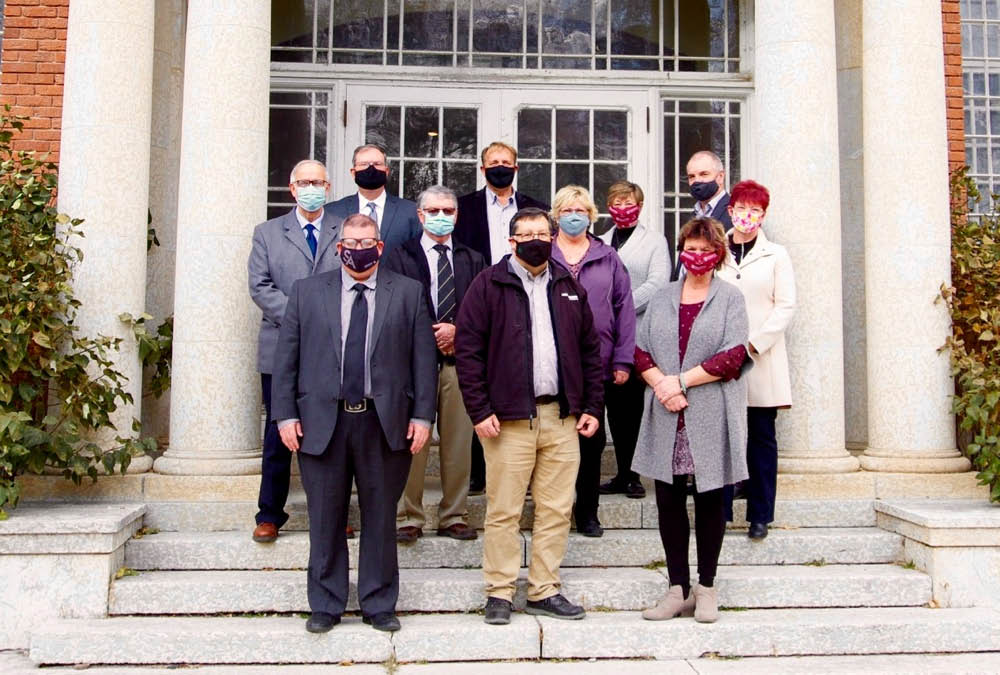
The plan is to refurbish the Valleyview Building on the college’s North Hill Campus. The historic building was built in 1913.
The college recently saw several major funding announcements to get that done. On Jan. 15, it announced a $10-million private donation.
“This donation, from a philanthropist who wishes to remain anonymous for the time being, plays a pivotal role in the next steps for the marquee project for the newly minted Russ Edwards School of Agriculture and Environment at Assiniboine Community College,” ACC said in a release.
Days later, Kostyshyn announced $1.3 million in provincial and federal funds over five years to boost ACC’s horticulture programs. Those funds are provided through the five-year Sustainable Canadian Agricultural Partnership.
“This funding to Assiniboine Community College will help ensure our farmers in Manitoba can continue to meet the growing global demand for our high-quality products, while strengthening food security right here at home,” federal Ag Minister Lawrence MacAulay said in a Jan. 17 release.
That funding builds on the college’s prior Field to Fork initiatives, the two ag ministers said.
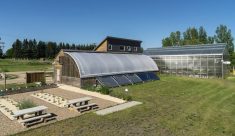
They pointed to ongoing work at ACC, such as research into passive climate control for greenhouses and high tunnel production, as well as increasing the resilience of crop production through variety use, cropping systems and farm practices.
Tim Hore, dean of the Russ Edwards School of Agriculture and Environment, said that the horticulture investment adds to what the college is trying to accomplish through the Prairie Innovation Centre.
“Our horticultural expansion is really built on our agriculture- and education- applied research hub,” he said.
The site of that horticultural work is adjacent to the Valleyview Building, Hore noted. “It really provides the outdoor space for students to continue that learn-by-doing philosophy here at Assiniboine. “
“That expansion is going to continually help when we provide graduates for companies like Vermillion Growers and others,” he said, referencing a large-scale vegetable greenhouse operation near Dauphin.
That company signed a memorandum of understanding with ACC in 2020 to, among other things, facilitate research. In 2023, the two announced a one-time tuition-free horticultural certificate program for Indigenous students living off-reserve.
Frison said there has been “a great trajectory” on horticulture and sustainable foods over the last decade, “building not only the program, but the applied research pieces.”
The college hopes to expand its normal horticultural production programming to its Parkland Campus in Dauphin for fall 2024.
Ag expansion
The innovation centre is the key piece of a plan to increase ACC’s ag-related student spaces from around 300 a year to over 800.
The new hub will one day be home to ACC’s existing agricultural programs like agribusiness, horticulture, land and water management, GIS and communications engineering technology. But the college also hopes to bring in new course offerings tailored to what current agriculture and agri-food employers are looking for.
Those include things like mechatronics, which hopes to train students for an increasingly automated and technical agri-processing industry.
Industry has also been active in the curriculum development for those new programs. In May 2022, ACC noted the role of pea processor Roquette in developing its three-year chemical engineering technology and food science programs.
Applied research in collaboration with industry, such as the connections between ACC and Vermillion Growers, will also be a major part of the centre’s vision, the college has repeatedly said.
Frison expects to see students come through the centre’s doors by fall 2027.