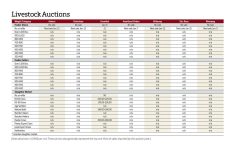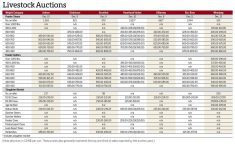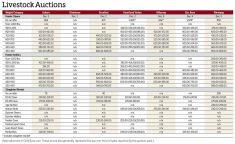
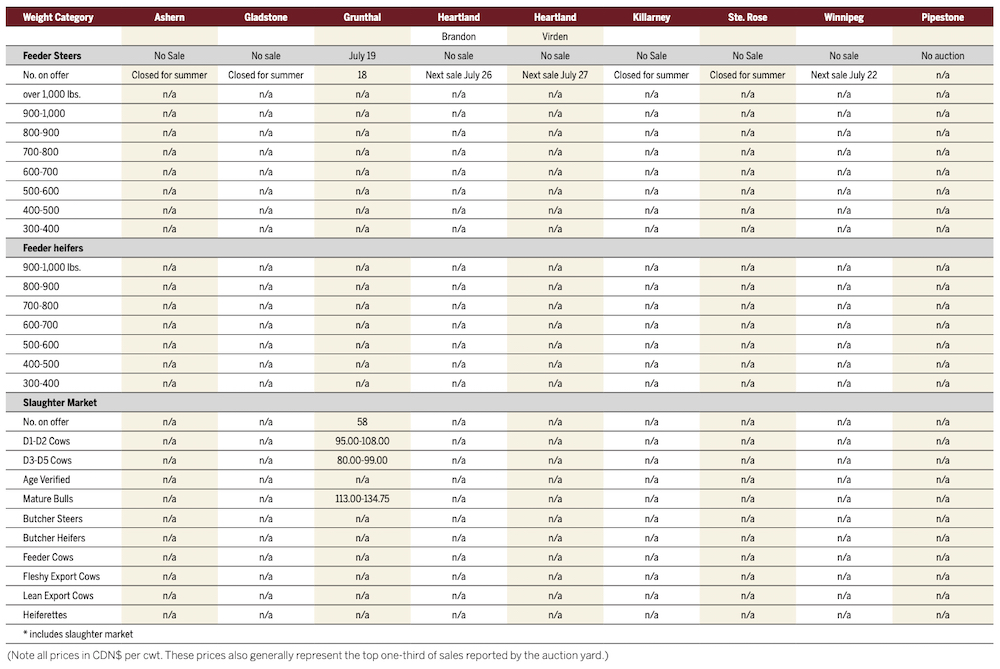
Midsummer is a particularly slow time for Manitoba’s cattle auctions and the week ended July 21 was no exception. Of the province’s eight auction sites only one, Grunthal Livestock Auction Mart, had a sale. The auctions in Ashern, Gladstone, Killarney and Ste. Rose du Lac are closed for the summer.
Heartland Livestock Services remained on a bi-weekly schedule at its Brandon and Virden facilities, with Winnipeg Livestock Sales following suit.
The number of cattle coming to sale is small compared to those seen during a fall run, but Grunthal auctioneer and sales representative Brad Kehler has been impressed with those being sold.
Read Also

World’s winter wheat crops look good for now
Winter wheat crops look good in the Black Sea and the U.S., although there is plenty of drought in the U.S. winter wheat region.
“I would say our numbers are pretty stable,” he said, noting 18 feeders and 58 slaughter cattle were auctioned at Grunthal on July 19. Prices were not available due to low numbers.
Of those for slaughter, D1 and D2 cows garnered $95-$108 per hundredweight (cwt.) that day. That’s on par with the prices at Grunthal’s July 12 sale. The D3 to D5 cows fetched $80-$99 per cwt. last week compared to $80-$97.50 the previous week. The mature bulls brought in $113-$134.75 on July 19, while the latter was the lone price from the previous sale.
Kehler said he’s impressed with prices seen for slaughter cattle and chalks it up to their condition.
“Most of the cattle we have been getting lately are mostly cows and for the most part they have been very good,” he said, noting changes in feed grain prices will be beneficial down the road.
“I’m looking forward to lower grain prices. If we get lower grain prices, we should see higher feeder cattle prices,” Kehler said.
In Manitoba, feed barley prices have dropped by $1.50 per bushel over the last month, with prices at $7-$7.47 per bu. delivered. Feed wheat has backtracked $1.95 per bu. on the month with prices at $11.37 delivered.
With the wet conditions in the province, and in eastern Manitoba in particular, Kehler said cattle are more susceptible to foot rot but his talks with farmers reveal no particular problems.
The July 19 Manitoba crop report cited the eastern region of the province as needing to “carefully manage grazing herds to clean up paddocks well in order to avoid having plants become too mature and less palatable.”