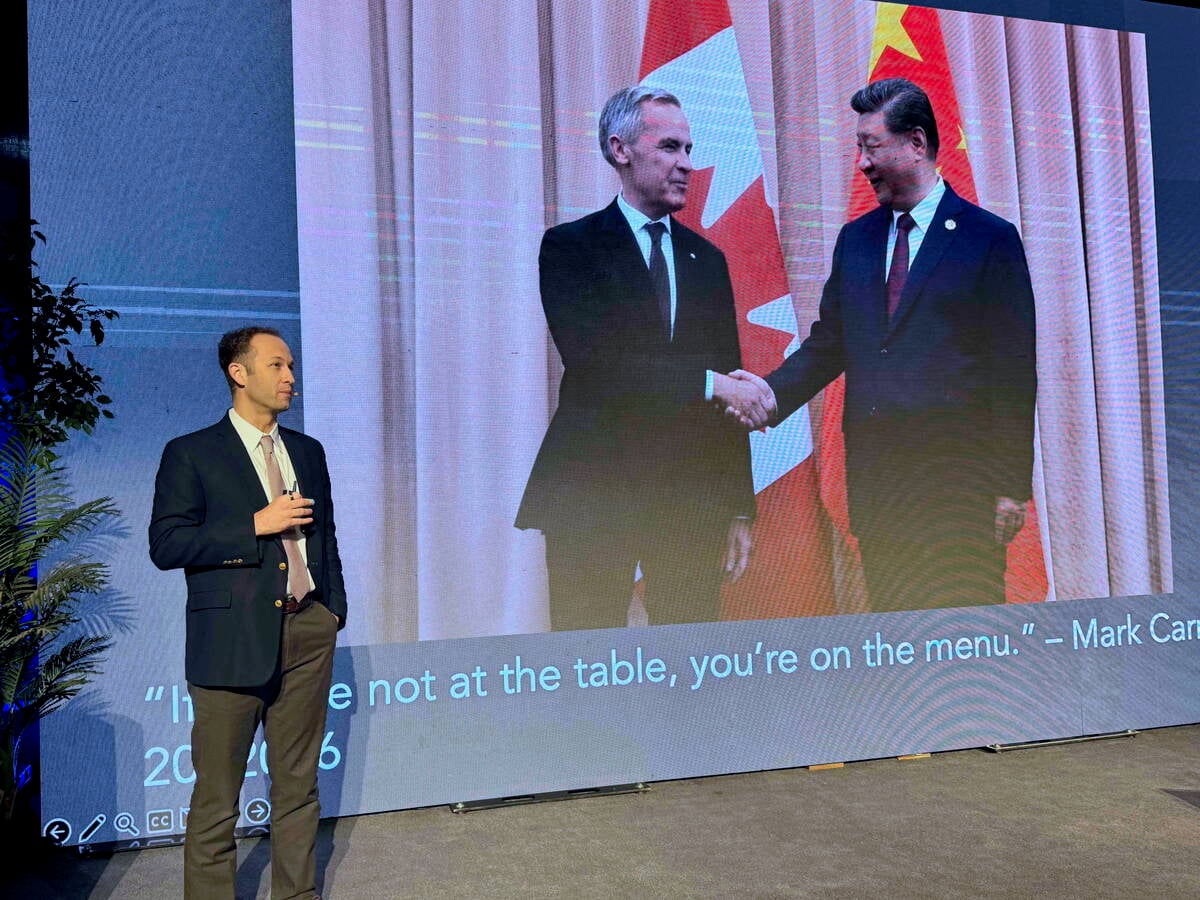
A U.S.-based business analyst had some simple advice for farmers worried about how recent global developments will affect their businesses:
“Turn off the social media, turn off the news, stop listening to whoever is the president of the United States, and start figuring out what markets need, what can I grow for them and how much can I charge them,” Jacob Shapiro told farmers attending Manitoba Ag Days.
WHY IT MATTERS: Trade and geopolitics were again big topics of conversation among both Ag Days attendees and speakers Jan. 20-22 in Brandon.
Read Also

Iran war volatility sends shock waves through agricultural markets
Here are the numbers on how badly fuel, fertilizer and grain markets have been thrown for a loop by the conflict in Iran so far.
The large, general forces driving those markets are different than what has previously prevailed in living memory, and those changes are here to stay, said Shapiro, the founder and lead strategist for Perch Perspectives in New Orleans.
“I don’t think we are in a cyclical downturn at all,” he said. “I think we are in a fundamental structural reorganization for global agricultural markets, full stop. I think the way that things have worked for the past 200 years are not going to work going forward.”
In a speech that reinforced some of the points made by Canadian Prime Minister Mark Carney at the World Economic Forum a day earlier, Shapiro said that while dominant global powers such as the United States and Russia are trying to use their might to coerce smaller players into submission — their ability to succeed is fading.
“You may see this and see a problem. I see this and I see a massive opportunity hiding in plain sight.”
Jacob Shapiro, Perch Perspectives
on farmers overproducing food grains and underproducing protein, vegetables and fruit
Russia’s efforts to subdue Ukraine has not succeeded. The U.S. administration’s use of economic force to increase its control has caused harm, but has not changed much, he argued.
Efforts by Donald Trump to mimic the so-called McKinley era of the late 1800s, when former-U.S. president William McKinley used protectionist tariffs to grow the U.S. manufacturing economy, won’t be successful. The U.S. has outsourced so much of its manufacturing capacity, and it would take decades to restore it, Shapiro said.
He added that the world is returning to a state of multipolarity that existed in the 1800s where trade and political alliances were more fluid and dynamic.

“The world is deglobalizing, but that within the sphere of influence that you find yourself, there’s actually more globalization and more trade integration at the same time,” he said. “There’s opportunity and risk and equal measure.”
To protect their sovereignty, countries reliant on imports are now focusing on producing more of their own food or sourcing it from suppliers who aren’t attempting to exert control over them.
“Other countries are treating food not like a cheap commodity that they need to get in surplus countries, but as a fundamental issue of national security,” he said.
“They don’t care how much it costs to grow it themselves. They care to source it from a country that will not try and tell them what to do, or raise tariffs on them, or kidnap their leaders, or threaten them, or cajole them in all sorts of ways it they won’t do what is asked,” he said.
Proactive on trade markets
Shapiro warned Canadian farmers not to become complacent about diversifying their export markets and urged them to consider their domestic market as their best market.
He predicted that the recent renewed trade in agricultural commodities with China won’t be long lived because of the Asian nation’s continued focus on feeding itself.
“All I am saying is that when the Chinese don’t need you anymore, and they are actively trying not to meet all of you in this room, they will stop buying,” he said. “They are not a viable source of economic growth and export growth for farmers in North America period.”
He said farmers should consider whether their future lies in continuing to produce cheap calories for export to markets that are oversupplied.
“Farmers are the only profession I know in the world where the better you do your job, the better crops you grow, and the more that you grow, the worse you actually get paid,” he said. “The more there is out there, and the more the prices go down in general.”
Farmers are producing more food grains than the world needs while not producing enough protein, vegetables and fruit, he said, citing a Harvard study that compares current production volumes to human caloric needs.
“You may see this and see a problem. I see this and I see a massive opportunity hiding in plain sight.”
For more Manitoba Ag Days coverage, check out the Manitoba Co-operator’s Ag Days landing page.