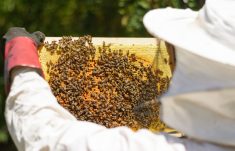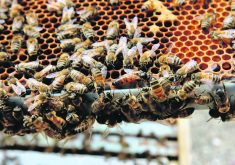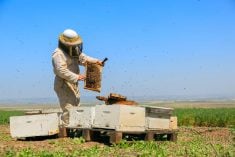

Beekeepers are getting in line for their checkups, and they’re pretty happy about that fact.
Manitoba’s honey producers will have at least another two years of hive inspections now that the province has approved a new contract with DLJ Consulting and its team, led by Derek Micholson.
The new contract will cover 2019 and 2020, with an option to extend into 2021, and will see a target of 5,450 colonies inspected annually.
Why it matters: The words “American foulbrood” generally make apiarists recoil, but the industry hopes a recently renewed inspection contract will help keep it and other diseases under control.
Read Also
Manitoba lamb price high on tight supply
Manitoba lamb prices in 2026 rise sharply from last summer’s dip, not only from the Easter upswing, but decent demand and tight supply.
Manitoba’s provincial apiarist, Rhéal Lafrenière, says the deal adds 1,500 colonies a year to the previous contract.
The province introduced hive inspections as a public program in 2013, but the service was contracted out to a third party in 2015, due to budget cuts.
“We tried to address the growing industry — that there were more beekeepers and colonies being operated in Manitoba,” Lafrenière said. “Traditionally, the inspection program tries to target around that four to five per cent of the colonies in the province and this 5,500 kind of gets you in between that four and five per cent, probably closer to five per cent.”
There were 145 new beekeepers in Manitoba from 2013 to 2016, according to an industry overview from Agriculture and Agri-Food Canada last year. The number of colonies jumped from 80,000 to 102,000 in the same period and, in 2016, Manitoba produced 16 per cent of the country’s honey and was the third-largest honey-producing province.
Mark Friesen, president of the Manitoba Beekeepers Association, puts the inspection target closer to five per cent than four.
The producers’ group strongly advocated for a renewed contract.
“The difference of an inspection program and a surveillance program is distinctly based on whether you are able to make a measurable determination of the colonies in the province,” he said.
Friesen welcomed the news that Micholson would be heading up the inspection team under the new contract. Micholson has supported the producers’ group at events in the past and he and his team are, “very capable beekeepers,” Friesen said.
Reporting has stepped back since the public inspection program ended, Lafrenière admitted, but suggested that the contractors could easily pick the practice up again if there was producer demand.
Inspectors have released the number of colonies inspected and found infected by disease, but have not prepared the more in-depth reports Lafrenière once reported back to the Manitoba Beekeepers Association.
Eyes out for foulbrood
Disease is top of mind for the program, according to Lafrenière.
Inspectors will be keeping a sharp eye out for American and European foulbrood, both bacterial infections infamous for their damage to hives and the persistence of their spores.
“If that beekeeper is unsuccessful as a beekeeper and decides to quit, that disease will remain in the equipment and that equipment gets sold or dispersed. That disease can transfer very easily,” Lafrenière said. “It’s also a disease that, once it becomes invasive in an operation, those hives do get weakened.”
Bees present a unique biosecurity challenge as livestock since they are not contained by fencelines, he said, and a hive that is stressed by disease might have food taken by other hives, thus spreading infection through an operation or from one beekeeper to another.
Producers have been told that inspections will stress early identification and disease management rather than elimination of infected hives.
“When disease is found, we work very closely with those operators… we do have tools to manage the disease and they have been very effective,” Lafrenière said.
Commercial operations should be inspected once every two years and hobby beekeepers every three to four years, he added.
Inspectors will maintain a cycling priority list to try and meet that frequency.
The province is also preparing to launch new diagnostic services for beekeepers, expected later this summer.