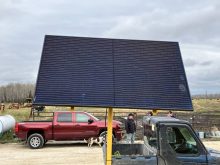
Its always better to plug in if you can, but for remote pastures away from the yard site, a battery-powered fencer charged via a solar panel is the only option.
Remember, though, that deep-cycle batteries need to stay as close to 100 per cent charged as possible. Repeated heavy cycling – running them down below 50 per cent of a full charge – will kill a battery in less than a year. They need to be fed electricity every day, and many people unwittingly starve their batteries to death by using a solar panel that is too small.
Read Also

Dairy farmers look to limit more loss of market
Canadian dairy farmers have given up 18 per cent of domestic market in recent trade deals, want government to hold the line in a CUSMA review.
“You’ve got to match the right size solar panel to the fencer,” said Rex. “If you’ve got a fencer that is taking five amps out of the battery every day, and your solar panel is only putting three back in, it’s going to be a dead battery, isn’t it?”
It’s always better to use a charge controller and figure on overfeeding a battery, because cloudy days happen, and they may leave the battery in an undercharged state. Leaving a battery drained too low for too long ruins it by allowing sulphate deposits to build up on the lead plates. If kept charged and topped up with de-ionized water twice a year, deep cycle batteries should last five years or more.
A “dirty” fence – one with lots of faults – won’t drain the battery any faster than a clean fence, but extremely low temperatures severely limit the storage capacity of lead-acid batteries, said Rex.