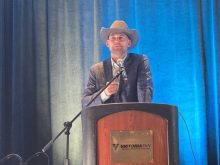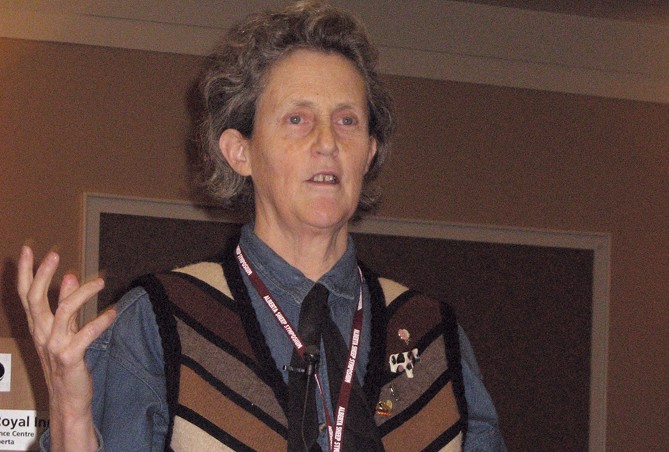
Fixing the slaughter plants was easy,” Temple Grandin told the 2015 annual meeting of the American Farm Bureau Federation (AFBF). “But now I see problems that we are going to have to fix at the farm: lame dairy cows, emaciated dairy cows because somebody let them go too long, animal production to the point we are starting to have problems with animal biology. We need to look at what is optimal not what is maximum.
“But what we’ve got to do is there are some practices that are going to have to change… and there are some people in the ag industry who are not happy with me because I won’t defend everything that ag does. And we’ve got to change some practices, but what we’ve got to do is we’ve got to communicate with the public. We also have to remember that everybody has one of these (holds up cellphone) and you can’t get away from the video cameras anymore. So what we need to be doing is change some practices and open up the doors.”
Read Also
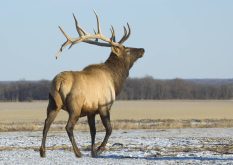
Manitoba Beef Producers take aim at elk surge, feed losses from wildlife
Resolutions at last month’s Manitoba Beef Producers meeting seek help to rein in elk and deer populations, expand fencing supports and improve compensation for wildlife damage.
Grandin is known to many for her work with slaughter plants to reduce animal stress during the slaughter process. The result is a system that is both more humane and more efficient.
At the meeting, Grandin received an award from the AFBF. The comments in her brief acceptance remarks are a synopsis of her paper “Animal welfare and society concerns finding the missing link,” published in Meat Science last year. She points out than in today’s highly urbanized culture most young adults have little connection to or knowledge about farming and farming practices. This lack of knowledge deprives them of context when it comes to understanding a video clip involving farm animals.
Grandin writes, “Young consumers do have a desire to connect with the origin of their food… the meat industry must start communicating more effectively with these affluent young adults. Their influence will extend beyond the developed world because they will write future legislation and policies that will have an effect on the entire world.”
To meet consumer requirements for meats, retailers and processors are increasingly implementing farm-level audits. In looking at farm-level issues, Grandin writes, “It is the author’s opinion that to pass (an animal welfare audit) a farm must receive an acceptable score on all of the following critical points: air quality in indoor facilities, animal stocking density, coat/feather condition, lameness, injuries, body condition, animal cleanliness, and low levels of abnormal behaviour. A failing score on any one of the above critical points would be an automatic failure.”
Biological system overload
In raising the issue of “biological system overload,” Grandin writes, “In intensively housed broiler chickens, laying hens, pigs and dairy cows, there is increasing concern that pushing the animal to produce more meat, eggs, or milk will cause both increasing welfare problems and a decline of functionality… Green, Huxley, Banks, and Green (2014) reported that dairy cows that give more milk had thinner body condition. These two studies show that fat reserves in the body of high-producing cows are reduced. In many large dairies a cow lasts for only two years of milk production. In layers, the rate of bone fractures due to osteoporosis is very high even when the hens are housed in good systems. In enriched furnished colony cages, hens had 36 per cent keel bone fractures and in the aviary system with multi-level perches they had 80 per cent… fracture levels are so high that even in better housing the improvements are like comparing something that is atrocious to something that is poor. In the future, researchers and managers need to breed for optimal production instead of maximum production.”
Grandin suggests that industry become proactive by videoing their operations so everyone can see how things work. In her remarks to the press, Grandin praised one operator for providing 24/7 camera feeds of their animal operations. She also advocates opening up farms for public tours as a means of creating an informed consumer base.
“Bad responses from the U.S. industry are so-called Ag Gag laws which make it a crime to take undercover video. This sends the wrong message to today’s consumer. Agriculture has to look at everything it does and ask themselves, ‘Can I explain this to my guests from the city?’”
“The meat industry needs to be transparent and explain and show everything we do. Many practices can be easily defended but some practices will have to be changed.”