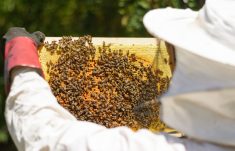

Canada’s beekeeping sector doesn’t dismiss everything the Canadian Food Inspection Agency (CFIA) is doing to prevent tropilaelaps mite from reaching Canada. If the deadly bee parasite does make it here though, they want a more robust compensation plan to take the sting out of any hit to their farms.
“If there was a case where this pest landed on shore and the government moved forward to contain that pest through quarantine (and) went to take the next step to eradication, we just (need to) make sure that the beekeepers who are involved with this … get compensation,” said Ian Steppler, chair of the Manitoba Beekeepers Association.
WHY IT MATTERS: The honey sector has suffered a string of bad mortality years, with hives struggling to make it through the winter, as well as stubborn issues with varroa mite parasites. The last thing they need is another damaging bee pest to worry about.
Read Also
Manitoba lamb price high on tight supply
Manitoba lamb prices in 2026 rise sharply from last summer’s dip, not only from the Easter upswing, but decent demand and tight supply.
Tropilaelaps, also called tropi mite, has earned particular worry because of how quickly it can infest and take down a hive (by some reports, six times faster than varroa mite). Like varroa, the mites live in brood cells, feed on bee larvae and transmit disease. Unlike varroa, they don’t tend to hitch a ride on adult bees — limiting their exposure to many mite control products — and reproduce fast inside the capped brood cells.
It’s also physically smaller than the varroa mite, making it harder to detect, said Canadian Beekeepers Federation president Curtis Miedema. The jury’s still out on how it might weather Canadian cold, he noted during a Nov. 25 press event, but its apparent adaptability is not encouraging.
Better known in South and Southeast Asia, with the giant honeybee, Apis dorsata, as its historical host, tropi mite, at some point developed a predatory taste for Apis mellifera, the western honeybee kept by beekeepers around the globe. It’s moved steadily westward, with detections in Ukraine, Georgia and southern Russia. Its presence is also suspected in Iran, Turkey and other European locales.
CFIA containment plan
Quarantine and depopulation, along with control zones with extra biosecurity and traffic rules around an infected site, are standard tools in the CFIA’s playbook when it comes to federally reportable animal disease and transmissible issues. Along with that mandated depopulation come CFIA compensation mechanisms.
One step, therefore, is getting tropi mite on the “federally reportable” list, Steppler said.
Agriculture and Agri-Food Canada counts reportable issues based on how significant they are to human or animal health or to the Canadian economy. The estimated contribution of honey bee pollination to the Canadian economy is $7 billion per year.

After that though, there would still likely be questions to answer. CFIA compensation has been an occasionally thorny issue on other animal health topics.
African swine fever, for example, has earned considerable federal response, zoning plans and financial investment. The prevention effort has mobilized a fleet of stakeholders nationwide for years. Despite the attention, pork producers have had to push hard for concrete details on “day one” farmer compensation. The industry argued those details were needed so farmers could feel secure knowing they would have enough cash flow to pay staff, buy feed and generally keep their farms running.
In March of this year, the government announced $567 million for pork producers should African swine fever hit Canada or the United States and markets closed.
Ocean travel a tropi risk
Like other foreign animal health threats, Canada’s plan is still heavy on prevention.
Steppler serves on the Canadian Honey Council’s tropilaelaps mite committee. The organization is working with the CFIA to keep it out.
If tropi mite lands in Canada, or anywhere in North America, there’s a good chance it would arrive by ocean freight, warned Steppler.
Global shipping brings ships all over the world. As those ships dock “a honeybee swarm might cast off a colony within a region that does have the tropi mite in it, land on a container ship, and then get shipped across the ocean to another country, and then that swarm relocates itself onto mainland, introducing that pest into the country,” Steppler said.
There was a recent close call with a container ship arriving from India (where tropi mite has been found), he added. The ship arrived in U.S. waters with bees aboard.
“The container ship crew found the nest,” Steppler said. “They destroyed it. They followed all the protocols they needed to and then they reported that to their destination, which was New Jersey, and they followed through accordingly.”
A less experienced or attentive crew might not have recognized the danger.
“We hear, just through the grapevine, that in some ocean ports throughout the States that those protocols don’t necessarily get followed and maybe some of those swarms get relocated onto mainland out of ignorance, not understanding the severity of the potential issue,” he said.
Any tropi mite strategy will require the full understanding of the Canadian Border Services Agency, which manages security protocols at port, Steppler noted.
He fears some security officials may ignore the problem out of a well-intentioned but misguided “save the bees” sentiment.
“You destroy the swarm to save the bees because you could potentially be relocating a very serious pest on mainland which could wipe out the bees,” he said.
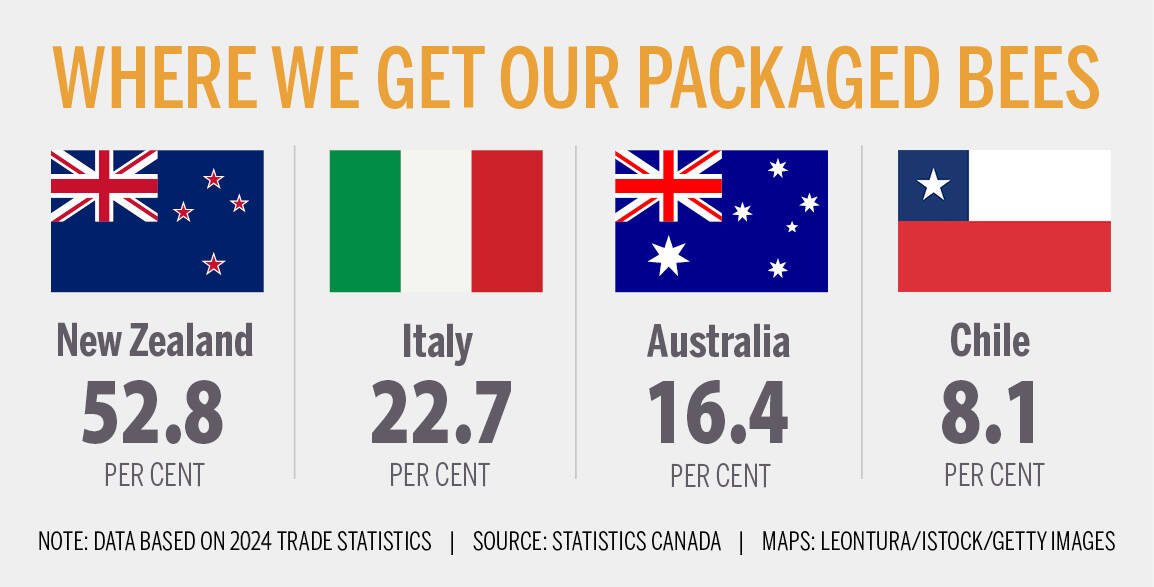
The mite hasn’t been found yet in either Canada or the U.S. Nor has it been found in any country the CFIA currently allows Canadian beekeepers to import packaged bee stock from.
U.S. needs to be on board
Canada and the U.S. are already tightly intertwined by trade and common interest, and they need to work in tandem to keep tropi mite out, said Connie Phillips, executive director of the Alberta Beekeepers Commission.
“The relationships have been there and well-established for a very long period of time. I think one of the drivers for the industries on both sides of the border is that the reality is bees are flying back and forth across the border, whether the government wants them to or not,” she said.
The recently updated North American Bee Strategy — billed as “a path for pollinator health and a fair honey market” — began three years ago with that in mind. It’s the product of four beekeeper groups: the American Honey Producers Association, the Canadian Honey Council, the Canadian Beekeepers Federation and the American Beekeeping Federation.
The document outlines an array of challenges, including bee health and biosecurity, export controls, environmental health and the roles of both federal governments in developing co-ordinated response plans.
While helping to develop the strategy, Phillips learned a few things from beekeepers to the south.
“They lobby like mad, where this industry in Canada has not tended to do that so much, but I think are beginning to realize that they do need to do that more just because government has changed so much and if you want to talk to them, you’ve got to have a good lobby,” she said.

Outside of beekeeping though, general relations between the U.S. and Canada aren’t exactly at a high point. Trade tensions and tariffs continue to weigh.
Although indicating some concern about unpredictable U.S. policy, CBF director Peter Awram argued that beekeepers on both sides of the border are facing the same challenges.
“If it shows up in either (the) U.S. or Canada, both industries are going to be in trouble because we have this common border. Bees are flying across the border all the time,” Awram said.
“If we get it here, we’re going to give it to them. If they get it, they’re going to give it to us.”
The U.S. has an historically solid record of bee-related biosecurity, he said, including its decision to shut off bee imports from Australia in the late 2000s following the discovery of a bee-susceptible virus there.
“The U.S., on the whole over the years, has done a better job of security that way. So we’re hoping that they will keep that implemented and continue to behave that way. And we want to be on the same page with that,” he said.