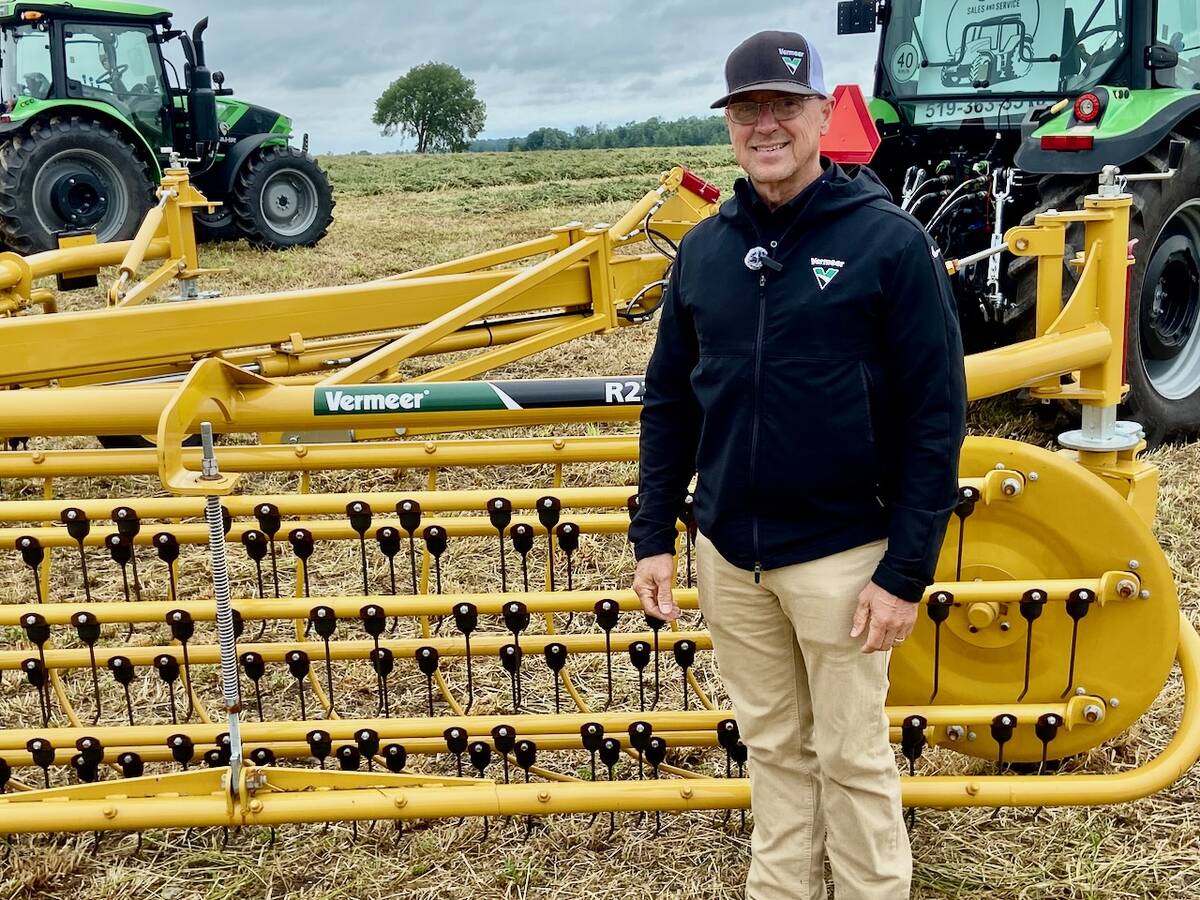
Most rakes on display at the Ontario Forage Expo earlier this year were rotary rakes, so Vermeer’s basket rake stood out for its different design.
Pouring rain in the morning meant that the many pieces of equipment on display at the Expo stayed put and farmers didn’t get to see the usual cornucopia of hay harvesting equipment at work.
Diverse equipment involved in hay production were on display at the event.
Read Also
Improved fertility key to boosting pasture productivity, specialist says
Colin Elgie, fertility specialist, says improving soil fertility can boost farm profitability, increase forage yields, and promote healthier pastures.
WHY IT MATTERS: Rotary rakes are quicker, but Vermeer argues that their basket rake is less prone to picking up soil and debris and makes a cleaner windrow for baling.
The rain kept the equipment from the fields, but company representatives went over each piece of equipment and answered questions.
There were many rakes of different configurations, and most are the common rotary rakes, which circle their tines parallel to the ground sweeping the hay into a windrow.
Vermeer’s Bart Elder, the company’s eastern region sales manager, talked about the importance of a well-formed and clean windrow for baler efficiency and forage quality.
He says the basket rake can help with both of those goals.
Rotary rakes move quicker, but there’s more chance of moving soil and debris on the ground into the windrow.
“We want a nice clean windrow. We don’t want a lot of ash content or rocks in the windrow. The cows don’t like it and the rocks are hard on our equipment,” he says.
The R2300 basket rake that Elder was showing at the Expo was hydraulically driven. The teeth can be set just above the ground, for cleaner hay.
The basket rake also shapes windrows well, meaning that the hay is evening distributed in boxy windrows.
“We want to keep the material to the edge so that we pack our sidewalls,” he says. That results in denser and heavier bales that stay together well.
A basket rake can be adjusted so that the bottom of the basket is tilted inward, fluffing the windrow and allowing the hay to be fed through the back of the rake into a boxy windrow.
“They say what makes a good baler is a good rake, and the guy in the rake tractor can make you look really good,” says Elder.
Basket rakes also have fewer mechanical parts, unlike the rotary rakes, which mostly have a cam. That can mean longer life and higher resale value for a basket rake, says Elder.
The Vermeer basket rakes come in 23-foot and 28-foot versions.