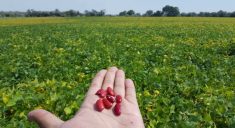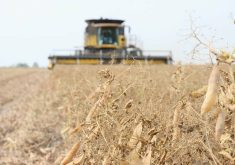

Morden is one of several Agriculture and Agri-food Canada (AAFC) centres contributing genetic lines to a massive, global project that aims to speed up breeding for dry beans.
The project is being led by Valerio Hoyos-Villegas, assistant professor of plant breeding and genetics at McGill University, and is being funded through the pulse research cluster backed by the federal government this year.
Why it matters: Speeding up the breeding process means farmers can take advantage of new varieties sooner.
Read Also
VIDEO: Seed less canola, harvest more? Bourgault field trials say it’s possible
Bourgault field trials tested canola seeding rates as low as 1.25 pounds per acre and found individual plants grew larger with stronger roots.
The initiative emerged out of an earlier Quebec-specific project.
“In the process of constructing that effort, we realized that, due to the phenotypic diversity in beans, the final data set would have been insufficient to develop something that was robust,” Hoyos-Villegas said. “That’s when we decided that we would form a consortium of breeding programs.”
The idea was to involve as many breeding programs as possible to contribute genetic material, which would be used to create a predictive model that will allow breeders to more effectively predict traits based on parentage of the lines being crossed, thus speeding up the variety development process.
Hoyos-Villegas presented the idea of building the model under a consortium approach to the Bean Improvement Cooperative in 2023.
“The moment we presented it as a collaborative initiative, beyond just the immediate members of this project, everybody was eager to get started,” he said. “The scientific community of breeders saw that there is a void there. It went off like gangbusters; everybody was immediately drawn to it.”
He and his team are now working with over 30,000 data points from over a dozen big breeding programs from around the world. AAFC’s breeding program is among the group contributing germplasm, including sites at Morden, Man., Lethbridge, Alta., and Harrow, Ont.
The exchange of germplasm isn’t new for researchers at AAFC’s centres. Anfou Hou, a research scientist from AAFC Morden, said it’s a big part of what he’s been doing since he started in 2008.
“We call it mining the germplasm, and we will look at hundreds of collections,” said Hou. “We have a large collection. We look through all those materials for whatever traits we’re looking for, like disease resistance.”
While a tool to speed up breeding gains is welcome, it also has the side benefit of just expanding the germplasm database researchers have to work with, according to scientists like Jamie Larsen of AAFC Harrow.
“It’s interesting in that (the project) not only involves all of the breeding programs in Canada and a large number from the U.S., but also programs in Africa and in South America,” Larsen said. “Who knows? There could be a variety in Tanzania that contributes something to dry beans in Canada that will make them grow better. So it’s a pretty fascinating idea.”
What does this mean for bean growers?
It takes years to go from a first cross to a finished variety. Shortening that window, Hoyos-Villegas said, means less time between the seed of an idea for a new variety, and that variety hitting the market.
“We have other aims with this project, but if we’re able to go from, say, seven years to five years, you’ve increased your efficiency by 20 per cent,” he said. “Now you’ll have gone from being released every seven years to every five years. They get to the marketplace faster, and the adoption is potentially faster.”
The genomic prediction model is part one of a three-part study. Hoyos-Villegas refers to the model development part as the “agronomy package.” There is also a “disease package” that focuses on white mould and common bacterial blight, and a “nitrogen efficiency package” that focuses on nitrogen use.