The Western Grain Elevators Association’s (WGEA) appeal to the Federal Court of Canada concerns how much moisture shrinkage elevator companies are allowed for tough, damp, moist or wet grain artificially dried at the farmer’s request.
A Canadian Grain Commission (CGC) order, which took effect last Aug. 1, changed the formula that grain companies use to calculate moisture shrinkage. As a result, the amount of shrinkage companies can deduct was reduced – leaving settlement tonnage roughly one per cent higher than it used to be.
Read Also
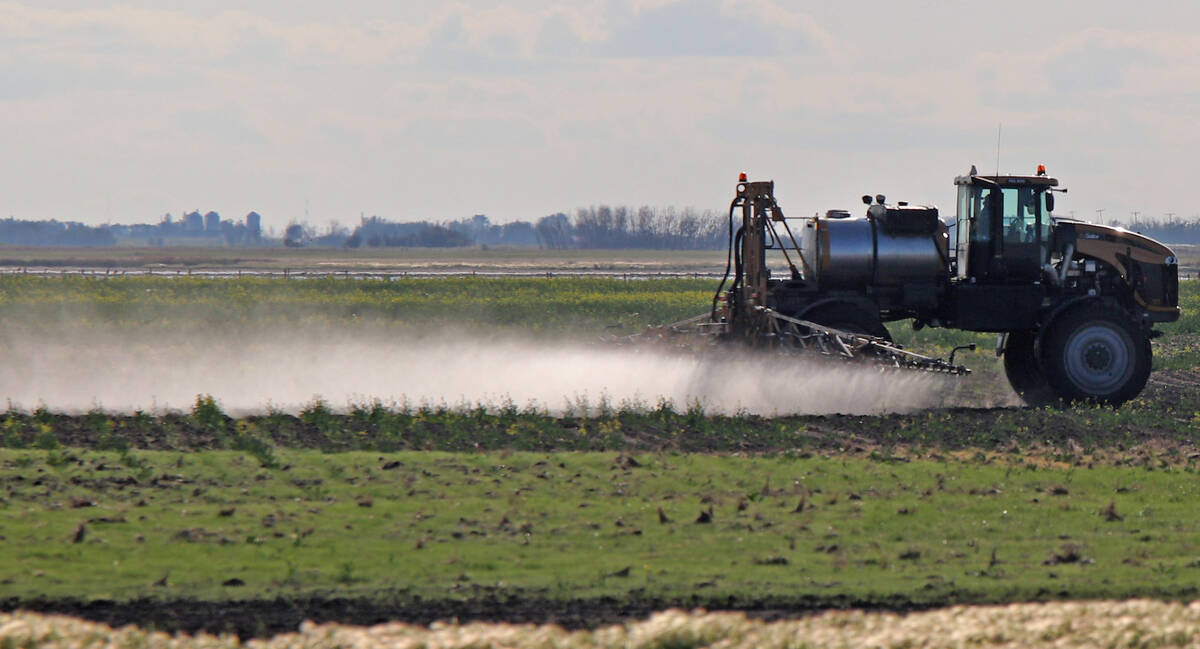
Herbicide-resistant weeds now on 72 per cent of surveyed Manitoba fields, costing farmers $77M a year
About 72 per cent of Manitoba fields last surveyed have herbicide resistance, says report — and that’s costing farmers big money.
That may not seem like much, but when dealing with millions of tonnes it adds up and puts more money in farmers’ pockets. But the WGEA, which represents Canada’s major grain companies, contends the revamped formula is unfair.
“That’s why we’ve appealed the CGC’s order to the Federal Court and it has agreed to hear our case,” said Wade Sobkowich, the association’s executive director.
The dispute concerns something called the “rebound factor” which is part of the shrinkage formula. The CGC has ruled that factor should be dropped to 0.1 per cent from 1.1 per cent.
The rebound factor is based on the idea that soon after grain is artificially dried its moisture content goes up a bit or “rebounds” as moisture inside the kernel migrates to the outside.
The higher the rebound factor, the more weight the elevator company is allowed to deduct.
“Many in the industry consider the 1.1 per cent rebound factor to be an arbitrary deduction that’s not based on science,” CGC spokesman Rémi Gosselin said in an interview last July.
Because the matter is before the courts, Gosselin declined to comment when contacted earlier this month.
The new 0.1 per cent rebound factor is just as unscientific as the 1.1 per cent, Sobkowich said.
“We know its (shrinkage) is not nothing,” he said.
The WGEA volunteered to work with the CGC on a study to determine what the correct rebound factor should be, but the offer was turned down.
“We say the CGC has the right to set moisture rebound but not the right to prohibit it and what they’re doing is basically prohibiting it,” Sobkowich said.
The CGC has suggested if the change in rebound factor is costing elevator companies money, they can adjust their handling fees (tariffs), but the WGEA doesn’t like the idea.
“It’s not fair to bury this sort of thing in the tariffs,” Sobkowich added.
“We have no interest in trying to take something that’s not ours. We just want to find the right number and that’s the CGC’s responsibility. It says so in the regulations. The CGC needs to operate on science and what happens in the real world and not on politics or what looks good from an optics point of view.”
The CGC has quasi-judicial powers. Those that oppose CGC orders can seek leave to appeal before the Federal Court of Canada. It has agreed to review written submissions on the matter.
(The CGC’s moisture shrinkage calculator can be found at www.grainscanada.gc.ca/guides-guides/drying-sechage/cwldd-pprsc-eng.asp.) [email protected]