Straight combining canola can help farmers better manage harvest, but it won’t necessarily result in higher yields.
“Compared to optimal swath timing, straight-cut yields are going to be similar over the long term,” Angela Brackenreed, Canola Council of Canada’s eastern Manitoba agronomy specialist told the Eastman Crop Talk webinar Aug. 4.
“We are certainly leaving a lot of bushels on the table by swathing too early, so if we can use straight cutting to manage that there certainly could be indirect economic benefit for us.”
Read Also
VIDEO: Manitoba farmer tests controlled traffic farming to fight soil compaction and flooding
Manitoba farmer Alex Boersch wants to improve the stability of his crop yields. He’s been experimenting with controlled equipment traffic on his fields
There are risks and benefits to both straight cutting and swathing canola. But some farmers have more canola than can be swathed at the optimum time, which is 50 to 70 per cent seed colour change on the canola plant’s main stem.
Straight cutting canola can happen when seed moisture content is around 10 per cent. Canola should be stored at eight per cent or less moisture content and cooled to avoid spoiling.
“When we initially put it in the bin it is going to be upwards of 30 C so if you can get it down to 15 as quickly as possible that’s what you want,” Brackenreed said. “But going into winter get it as cool as possible. The cooler it is the less chance of biological activity and moisture migration in the bin.”
Farmers who swath too early lose yield because a higher percentage of seeds is immature. But farmers who wait too long to straight cut risk yield loss due to pods dropping or shattering. Swathed crops can lose pods and shatter too.
Companies with shatter-tolerant varieties suggest delaying swathing until 80 to 90 per cent seed colour change on the main stem, Brackenreed said.
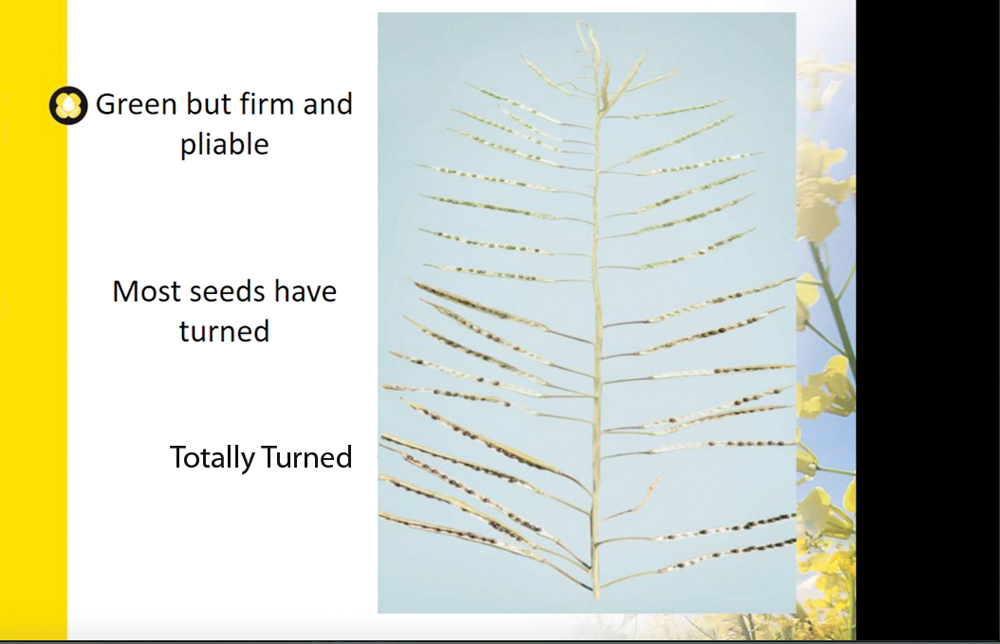
“It is important to remember that a seed is considered contributing to seed colour change as soon as there is any amount of brown on it,” she said. “Canola matures from the bottom up to the top and from the inside out.”
When assessing the main stem divide it into thirds and open the pods, Brackenreed said. Seeds in the bottom third should be fully black. Seeds in the middle third should be mottled and the top seeds should be green but firm when rolled between one’s fingers.
“We tend to see about a 10 per cent seed colour change every two to three days,” she said. “That can move a lot quicker if we have hot, dry conditions.
“In Manitoba from the end of flowering until maturity is somewhere around 25 days.”
Candidate crops
Slightly lodged, thick stands provide a bit more protection against pod shattering due to wind and feed easier into the combine. Even maturity helps too. Topography influences this, with lower areas sometimes being greener.
“The timing of harvest certainly can be more critical as compared to swathing,” Brackenreed said. “It can delay harvest (as one waits for the crop to dry).”
Later harvest means more weather risk, including frost.
Something else to consider is that even though the canola seed is dry enough to harvest, plant stalks can still be green forcing the combine to travel at very low speed to prevent plugging.
“The best thing I can recommend in this scenario is to cut as high as possible… to try and increase the capacity of the machine and put a little less of that green material through,” she said.
Harvest aids
Applying a desiccant or another harvest aid isn’t absolutely necessary before straight cutting — but it can help, Brackenreed said.
Reglone is a true desiccant that works via contact, killing the plant at the stage the product was applied.
“It is really important with a product like this to get the timing right,” Brackenreed said. “Eighty to 90 per cent seed colour change is what Syngenta recommends.
“One thing I would caution is if you do spray Reglone… you want to be sure that you can get into the field within that four- to seven-day window as you can certainly see a lot more pods dropping and shatter if it is left too long past that time frame,” she said. “You really, really want to make sure that you are not too early with this product as it has the potential to lock in a lot of green seed.”
BASF’s Heat, tank mixed with glyphosate, is another option. This combination is slower than Reglone, but faster than glyphosate alone, Brackenreed said. Apply at 60 to 70 per cent seed colour change.
Glyphosate alone is good for perennial weed control and can help dry green canola stalks, but needs good growing conditions. Apply when the crop is ready to swath. Harvesting can follow seven to 28 days later, depending on weather conditions.
There were anecdotal reports last year of straight-cut canola heating in storage, Brackenreed said.
“We don’t know if there is anything to this or not, but I heard it enough times that I think it is probably worth mentioning,” she said.
“Obviously with straight cutting canola there is that potential for higher-moisture dockage material, particularly if you’re not using a pre-harvest aid. Green weeds, pod material, stem pieces going into the bin can create volatility.”
Sometimes straight-cut canola is harvested later in the fall, when temperatures are cooler, making air-drying in the bin less efficient.
Researchers are also unsure about where there could be differences between transpiration rates in swathed and straight-cut canola.
“Until we really have a good handle on this it is probably important to be particularly cautious with a straight-cut canola and maybe monitor it a bit more closely,” Brackenreed said. “Most of our storage issues occur from non-uniform temperatures and moisture throughout the bin.”