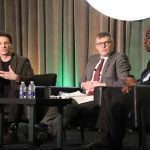
Dr. Alan Moulin takes tour attendees through the field.

Mixing and matching inputs and rotations

Brandon researchers spent 18 years combining three different input levels and crop rotations to study the impact on nutrients, soil quality, yield and implications for climate change

Farming for short-term yield will be different than long-term soil benefit. That’s not a new idea, but it has been driven home by 18 years of research spearheaded by researcher scientists Alan Moulin and Taras Lychuk of Brandon’s Agriculture and Agri-Food Canada research station. From 1994-2003, the pair’s team cross-compared organic, reduced- input no till,


Pea processing attracting wide interest

Pea processing attracting wide interest

The Prairies has become a hotbed for ingredient manufacturing based on the crop

The French company Roquette may have kicked off the pea party when it announced a protein-processing facility at Portage la Prairie earlier this year — but it’s no longer the only guest. In September Academy Award-winning film director James Cameron announced he would be investing in a new multimillion-dollar pea-processing plant in Vanscoy, Sask. As

The Manitoba Organic Alliance announced the working group Oct. 23 during its annual meeting in Brandon.

Organic Alliance says crop insurance needs an update on organic production

Organic growers argue that insurance excludes critical production practices, but change may come with some real logistical problems, according to MASC

Organic farmers in Manitoba hope a new working group will help solve long-standing crop insurance issues. The body will have members from both the Manitoba Organic Alliance (MOA) and Manitoba Agricultural Services Corporation (MASC). “There’s definite improvements that need to be made, so we want to know what the timeline on that is,” MOA president


Dr. Alan Moulin takes tour attendees through the field.

Measuring tillage impact

There may be a middle path that gives the best results

Conventional wisdom says less tillage is better when it comes to soil structure, but the issue is more complex when comparing organic soil health to zero till, according to Agriculture and Agri-Food Canada researcher Dr. Alan Moulin. Moulin’s team looked at “soil aggregates,” or how soil particles bind together into larger groups, under high-input conventional

The University of Manitoba’s Martin Entz, an agriculture professor and cropping systems specialist, suspects reduced tillage and organic production may not be mutually exclusive.

Can organic no till work in the field?

Environmental benefit is part of organic market value, but organic weed management usually means tillage, commonly considered a black mark for soil health. Is there a middle ground?

Hairy vetch may be the key to reducing tillage in organic farming, at least in the short term. Martin Entz, a professor and agriculture systems expert from the University of Manitoba has been looking at mulches for organic weed suppression, rather than the tillage typically used. “We found that when we used the right mulch,