Cover crops are an often-cited tool when it comes to sustainable farming, but the practice also comes with plenty of logistical questions and differences in approach. How to get the cover into the ground, without losing ground on the actual cash crop or adding yet one more thing to an already jam-packed shoulder season, is one such conundrum.
Taking to the skies, though, might be one way to underseed a cover crop without much impact to established grain stands and without further tillage.
WHY IT MATTERS: Drones can make seeding cover crops easier and reduce the risks posed by heavy equipment.
Read Also
Manitoba farmers must be flexible on white mould control
Farmers should watch their bean and soybean canopies and disease risk, not the calendar, when choosing when to spray fungicide against white mould.
Researchers in Ontario are one year into a three-year Living Labs study, looking to extend the cover crop application window for corn and soybeans.
That subject might also yield insights for Western Canada, where the short growing season remains a major wild card for whether investing in a cover crop will pay off for the farmer.
Among other things, initial results noted that broadcasting into fields planted without tillage can be challenging. Farmers would also love some legumes in their broadcast cover crop mix, researchers found, but that can be a problem when the cover crop runs into herbicide sensitivity due to chemistry used that season in the chosen field.
Drone seeding cover crops
Some of the study sites used a drill, but the project, led by soil management specialist Jake Munroe of the Ontario Ministry of Agriculture, Food and Agribusiness, also hoped to answer questions about drone seeding, and how the technology can be applied to cover crops.
Advantages of the drone include less interference with an already growing cash crop. Running a spreader or sprayer through a maturing crop will lower yield, but waiting to seed until harvest means the cover crop has much less chance of establishing itself or, in the case of winter cereals, survive the winter.
The trial includes three farmer co-operators and three corn and three soybean trials. One of those trials is at the farm of Brett Green near Embro, northwest of London, Ont.
“The interest in getting the drill out and competing with wheat seeding, or getting the drill back out after it’s clean, after wheat seeding, there’s a bit of a barrier there,” said Munroe.
The project is administered by the Ontario Soil and Crop Improvement Association (OSCIA) and farmer co-operators have some influence over the trials to build in experiments relevant to their farm.
Munroe said that included a request to add red clover to the trial in the first year to try to get more nitrogen fixed in the soil from the legume. It didn’t work out due to herbicide interactions, so wasn’t replicated in year two.
Munroe highlighted results from one site that provided a valuable comparison between seeding approaches, where the farmer had also drilled and broadcast cover crop the day after corn was harvested, as well as trying out seeding via drone.
All three treatments survived, with the drilled cover crop being the most uniform and the earlier-seeded drone cover crop more advanced, but more variable.
Biomass ratings taken by drone imaging in May 2025 showed the most biomass from the earlier drone seeding.
Munroe said seeding cover crops into no-till fields, whether by drone or another broadcast method often leads to poorer growth.
“No till systems can tend to pose challenges, both with the surface residue interfering with seed-to-soil contact, and potentially with slug feeding,” he said. There will be more active monitoring of slug feeding in this year’s trials.
Eyes in the sky
Andres Hurtado of Terralynx, an imagery analysis company that uses drones, talked about what he can learn from trials like the cover crop project using multi-spectral imaging. Multi-spectral drones record the light from plants, even the infrared lights we can’t see, when a plant is early in a stressful period.
Increased resolution and high-speed computer processing of images mean even more detail than ever, with the ability to see single rows and plants.
Hurtado was among the industry representatives of a recent OSCIA demonstration day, which also featured the ongoing cover crops projects. Hurtado highlighted a LiDAR drone at the event, which creates three-dimensional models of land. This can help create more accurate maps for drainage companies.
Practical applications of Hurtado’s drone image analysis include farmers who have had him create emergence maps and variable rate nitrogen maps.
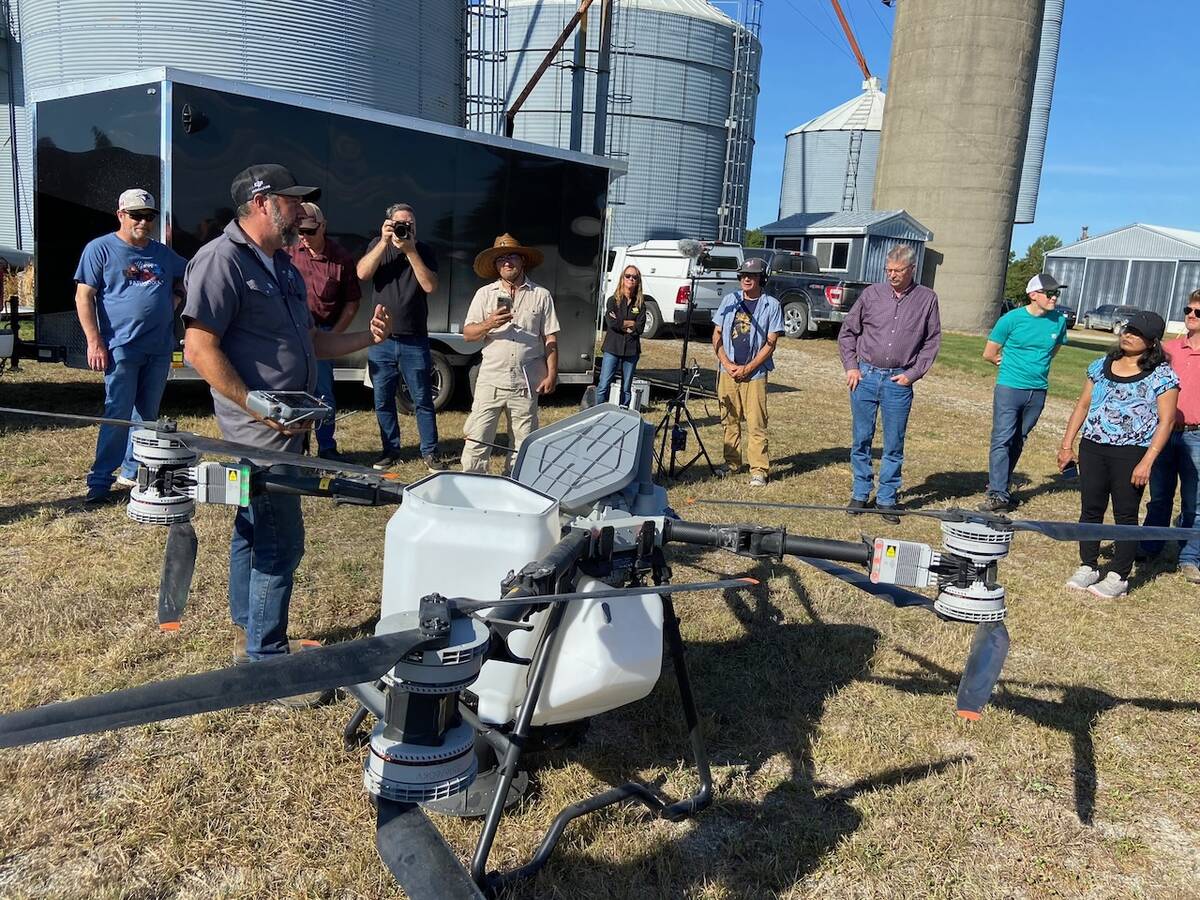
Drone Spray Canada brought along some large DJI drones to the event, including the new T100, which it uses to apply fertilizer and broadcast seeds.
There are no labels approved for pesticide applications in agriculture with a drone in Canada yet, unlike the United States and Brazil, where drone spraying is mostly regulated with existing aerial approvals, explained Adrian Rivard of Drone Spray Canada.
A blanket aerial label can be a “double-edged sword,” said Rivard. It can open up the market to drone spraying, but there are limits for applications where a helicopter needs a much larger buffer zone than a drone would, but they are regulated similarly.
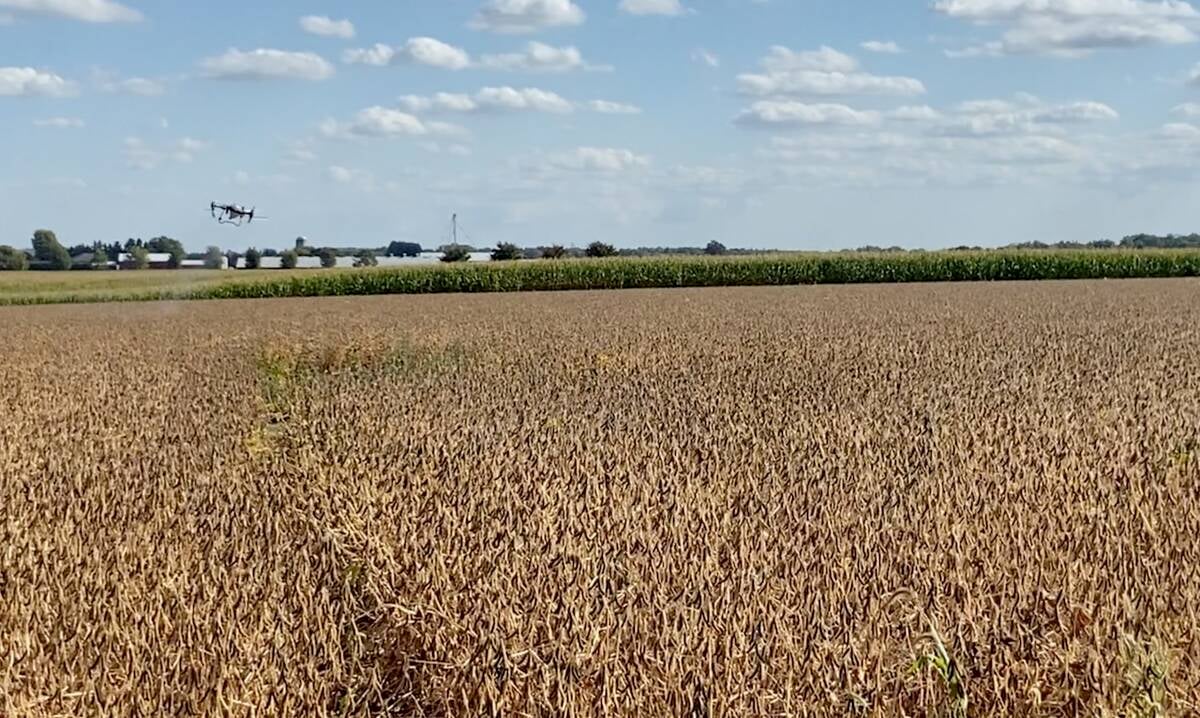
The drones at the OSCIA demonstration broadcast cereal rye and oats at about 65 pounds per acre on an area of a soybean field that wasn’t part of the OSCIA cover crop trial.
Vegetation determines coverage width. In standing corn, a width of 21 feet is best, but Rivard said they can cover 30 feet on bare ground.
The drones are also being used for fertilizer application, and Rivard said an applicator in the Ottawa area applied 360,000 lbs of urea this year with a DJI T50.
Rivard, a DJI drone dealer, has been experimenting with the new DJI T00; with a 100-kilogram payload, it can cover 50 acres with cereal rye seed in 45 minutes.
“It flies at 45 miles per hour. Previously, the T50 was at 23 (mph), so twice the payload, twice the speed. It’s a better rocket. It’s kind of fun.”