As the bins fill up and the combines wind down, farmers in Western Canada head back to the start line for one last race with Mother Nature. The snow is coming. The question is, how ready will the farm be when it arrives?
WHY IT MATTERS: Manitoba’s entering the time of year when every new long-term forcast could mark an abrupt switch to winter conditions.
Every farm has a different plan, depending on their preferred process, their needs and how much time they have on the back-end of the season. Farmers are also well aware of their uncertain deadline. Whenever the snow comes — for some areas of Saskatchewan and northern Manitoba, it already has, with a system blowing though over the Thanksgiving long weekend — no one wants to be scrambling through drifts, trying to get things done.
Read Also
Vaccine confusion wipes out barrel racing at Manitoba Royal Winter Fair
Competitors were left scrambling after the event was cancelled the day before competition.
Chris Procyk, who operates a Saskatchewan grain farm with his wife, parents and two full-time employees, said the team relies on a long checklist for prepping and storing machinery and cleaning up the yard.
“I think we’ve come to the realization we’re never going to get it all done. We just kind of prioritize what needs to be done and what we’d like to get done,” said Procyk, who is also vice-president of the Agricultural Producers Association of Saskatchewan, the general farm group for that province.
In Randolph, Man., Kevin Peters is pursuing his own prep work, alongside his brother, cousin, dad and uncle. His family farms over 7,000 acres of grains and oilseeds, including fall rye, wheat, canola, soybeans, sunflowers and corn. The family also has a hog business.
“There are things that you don’t always think about. Some things you do naturally without thinking; it’s just part of your routine already,” said Peters, vice-president of Keystone Agricultural Producers.
“As we transition, it really comes to equipment, buildings and grain,” he said.

Winterization race
The sprayer tender trailer, with its water carying tanks vulnerable to freeze damage, is the biggest thing on the Manitoba farm that needs to be winterized.
“Make sure you use either antifreeze, or drain and blow out those systems,” Peters said.
Grain quality is anouther thing they need to keep an eye on. When colder weather approaches, the team likes to condition the grain in the bin with the aeration fans to get things cooled down and prepared for winter, he added.
Procyk, likewise, says the big priorities are always winterizing water trailers and sprayers and stowing away equipment that needs to be stored.
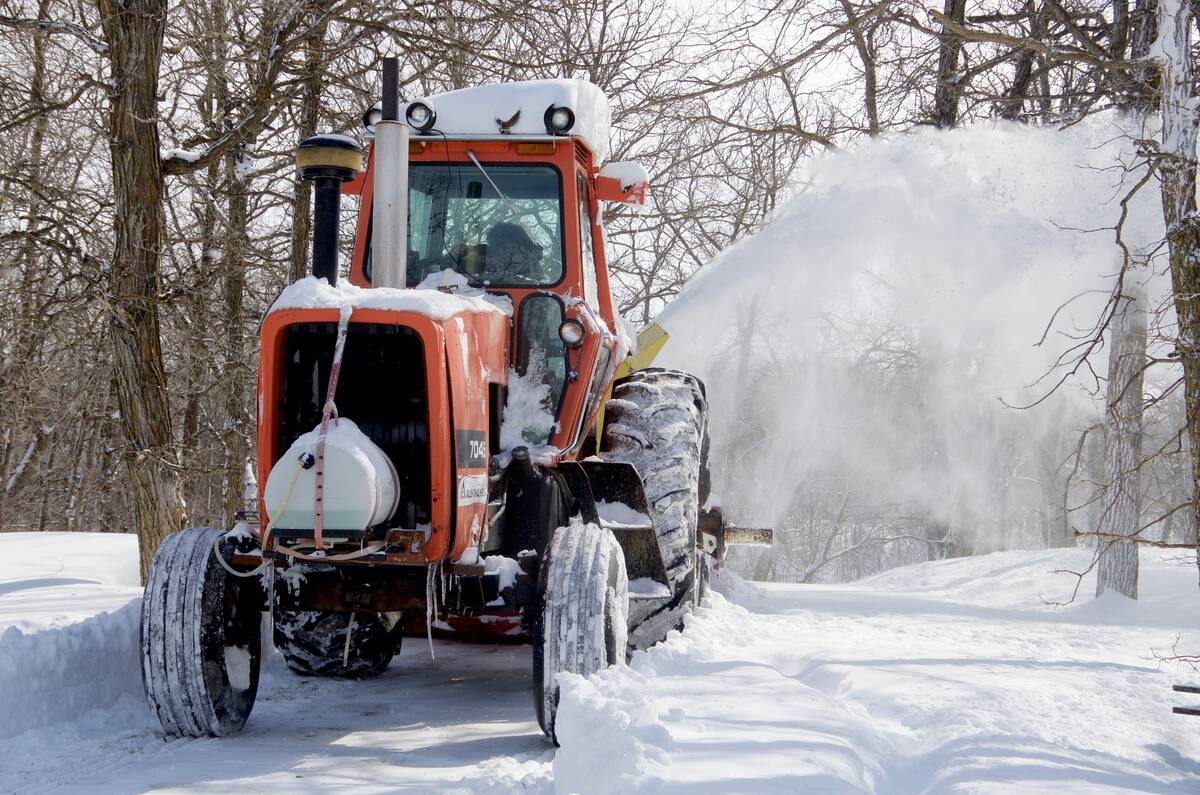
One of the most important things Procyk’s team does is make sure the snow blower is on the tractor so it’s ready for when the first flakes fall. That’s learned from hard experience.
“We have dug it out of a snowbank before and it’s not fun,” he noted.
It’s also not just about the farm equipment. There are plenty of other, less directly agricultural things around the yard that take up farmers’ time in the shoulder season.
There isn’t a lot to be done with the cars and trucks on Procyk’s farm. He uses all season washer fluid, for example, so he doesn’t have to worry about it freezing up.
But there are little projects, such as draining, rolling and storing his wife’s garden hoses. The family also has a camper, which also needs to have all the water blown out and antifreeze dumped into the heat traps and sinks.
“That sometimes gets forgotten about. I did that just the other day, walking by. I had five minutes,” he said.
“It’s not a big process, but it’s still something that is easy to forget,” he added.
His wife also has horses. Their heated watering bowls need to be plugged in.
“There’s not really a whole bunch of big jobs,” he said. “There’s just a whole pile of little ones, and they take half an hour or a couple hours here and there. They really chew at your time. The biggest thing is prioritizing the jobs that have to get done versus the ones that are right in front of you, and the easy ones — making sure you’re getting the right ones done first, and then moving on to the bonus ones,” he said.
And, of course, there’s the race to get as much field work as possible in to set up the 2026 crop up for success.
Timing is everything
For Procyk, the planning starts well before his crop is off the field.
“We start thinking about it halfway through harvest,” he said. “Honestly, at the beginning of harvest, we start thinking about all the things we’d like to do after harvest is over.”
The team takes one day off to recharge after harvest, he noted. Then the sprint for fall work starts.
“We go through almost the same routine every year,” he said.
Settling in for winter
Winter is when the Peters family does a lot of maintenance on their machinery, making sure things are ready for spring and summer, and that all possible preventative maintenance and repairs have been done.
In the hog barn, there’s a transition from summer ventilation, when the fans are all open. In the winter, the big fans are closed so no drafts can get in the barn.
“To go with that, there’s a bunch of air inlets that get closed up as well so we don’t get a lot of snow drifting in the attic or anything,” said Peters. “We’re trying to prevent a lot of catastrophes on the building side.”
Peters also checks his buildings for drafts and gaps around windows and doors, making sure things are tight, preventing both drafts and rodents from getting indoors.
“If you have places outside where you run water seasonally, you know that all has to be blown out and cleaned out, so it doesn’t freeze all winter,” he said.

Some farmers have fire extinguishers that can be filled with water. Those must also be cleaned out before the temperature drops to freezing so they can be used the following year.
As far as the vehicles go, “In our shop, we do maintain our cars and pickup trucks and stuff, making sure they are fit for winter,” he said.
That includes making sure that proper winter tires are on.
His family’s winter prep also includes a little generator to run the well and sewer pumps if the power ever goes down
“I can turn on a few lights, and being natural gas, I can run my furnace with very little power,” he said.
He also installed a gas fireplace in his house that can also run with three Double A batteries. If he loses power, the house will stay above freezing.