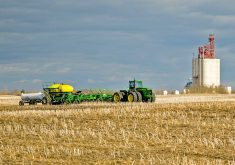
Manitoba’s weather patterns leave fields at risk for salinity to rear its head.
Salinity is a water problem, not a salt problem, said Manitoba Agriculture soil management specialist Marla Riekman. It’s a symptom of big variation in water table levels, wherein rising water brings up dissolved minerals, only to orphan them high in the soil profile after water levels recede.
Manitoba’s oscillation between heavy, wet weather and dramatic dry cycles is a textbook set up for that volatility.
Read Also
Herbicide-resistant weeds now on 72 per cent of surveyed Manitoba fields, costing farmers $77M a year
About 72 per cent of Manitoba fields last surveyed have herbicide resistance, says report — and that’s costing farmers big money.
“We start seeing that salinity pop up and get a little worse,” Riekman said about the moisture teeter-totter in the province.
Why it matters: A field’s salinity issues should feature heavily in rotation and management plans.
Historically, Red River Valley soils have been only mildly saline.
“It’s such a low level that it wasn’t really affecting a lot of our crops,” said Riekman, but that was before the rise of warm season crops like soybeans and corn. Soybean acres exploded in the last quarter century, becoming the third most popular crop in Manitoba with almost 1.6 million acres this spring.
Nowhere has that trend been more apparent than in the Red River Valley.
Aside from a longer growing season, those crops were also less salt tolerant. Issues began to peek through on fields that had background salinity.
“This is the part of the message nobody wants to hear, but there are some fields that aren’t suitable for things like soybeans and corn if they deal with higher levels of background salinity,” said Riekman.
Diagnosing the field
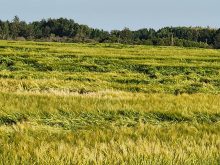
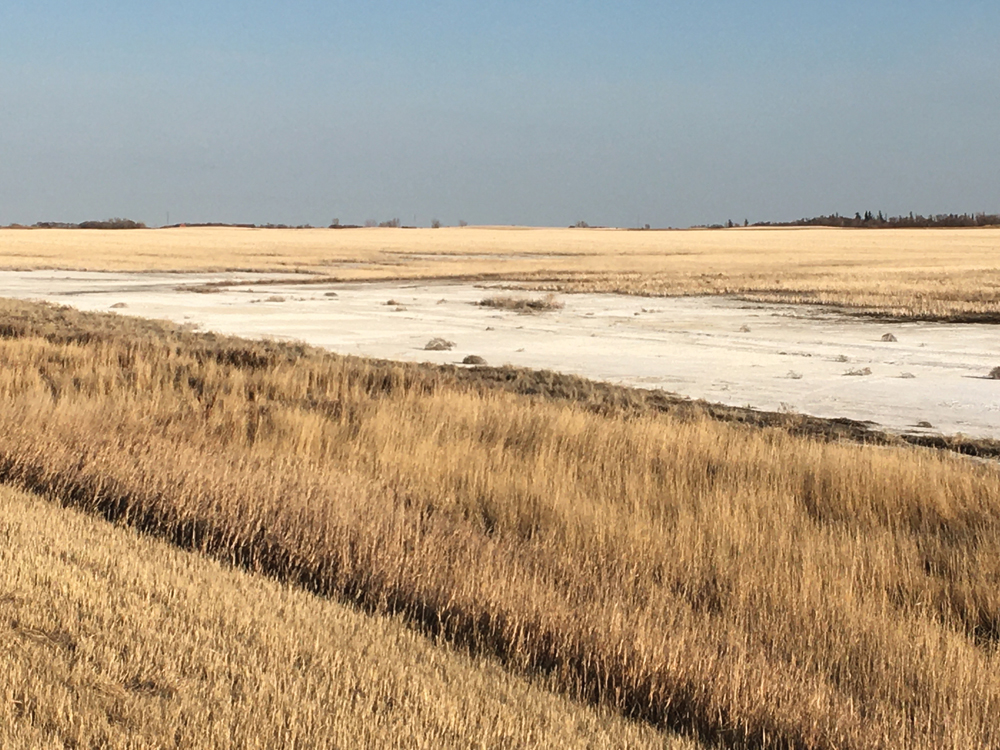
Besides a telltale white soil crust, the first red flag will often be otherwise unexplained stunting and drought symptoms, particularly in saline-sensitive crops.
“It’s easy to see in a crop like corn,” Riekman said. “When those leaves kind of fold in and take on the look of a droughty crop or a water-limited crop when there’s adequate moisture, that is telling you that it’s probably a salinity problem.”
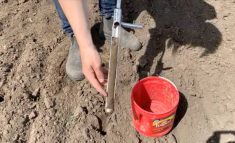
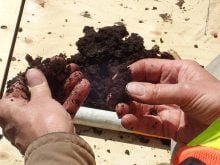
A soil test can confirm soil salt content.
After a producer knows there’s an issue in that field, they should stop throwing good money at bad land.
“If you go in and keep planting a crop that can’t grow in there, it’s obviously not going to do anything. If we’re going to choose to grow soybeans and corn on land that is not meant to grow soybeans or corn, it’s a waste of money.”
Soil test results will be a key piece in developing a new strategy.
“If it’s a mild salinity problem, you just maybe step away from salt-intolerant crops,” Riekman said. “If it is your headlands area, maybe you seed something else around the headlands and put your sensitive crops in the interior of the field.”
More traditional crops like canola, wheat, fall rye or barley will deal better with mild salinity, she said, while more significantly saline patches might be a candidate for forage. In that case, producers will likely lean toward wheatgrasses and Russian wild rye.
There are also forage mixes and species specifically marketed for saline tolerance, such as AC Saltlander wheatgrass and Halo alfalfa.
“One of the benefits of Saltlander is that it has more palatability, so it’s great for feed,” Riekman said.
It also requires more patience.
“It might not look good for the first year or two, but it starts to kind of take off in year three,” according to the soil expert.
Salt-tolerant alfalfa varieties are also tricky to establish, and producers may want to wait until a wet cycle, when salinity symptoms subside, to start that kind of forage.
Next season management
Another management strategy is to lower the water table. Weeds can be a force for good in that area, if tapped right and with robust control plans to keep populations firmly leashed. Weeds are growing vegetation, Riekman noted, and all growing vegetation sucks up water.
Kochia, for example, is highly saline-tolerant, and can grow in areas too salty for anything else.
If producers are fighting kochia patches in those saline areas next year anyway, mowing them before plants set seed might be a win-win option. Keeping it vegetative will keep it growing and using moisture, while preventing spread.
If 2024 is another drought year, mowed kochia can make the switch from weed liability to forage asset.
“Mowing your weeds can be a really great and cheap starting point.”
Keeping soil covered will also help keep the water table low, since evaporation draws moisture from below.
“You can put mulch, manure and straw on saline patches to decrease the upward movement,” Riekman said, but warned that measure is “a short-term solution and might only be feasible on small areas.”
Evaporation is also the reason Riekman said soils with high salinity risk should not be tilled.
“All it does is increase the amount of evaporation from those regions. It’s the No. 1 no-no when it comes to dealing with saline patches.”
Farmers could also plant a buffer crop consisting of thirsty plant species to intercept rising water around sloughs.
“You want to get something like alfalfa established to have that deep root that intercepts this water,” she said.
Incurable
Farmers can manage salinity but it will always be just a change in the weather away. Symptoms will disappear in wetter cycles as rain slowly washes salts deeper into the soil profile. When the tap turns off, however, that salinity will come back.
“Tile drainage can actually lower salinity,” Riekman said, but with the caveat that it takes a long time, and salinity reduction may be small.
“Is the installation cost of tile going to be worth it for something that could take 30 to 40 years in order to actually be low enough that you could grow a crop there? Probably not. But if you have more minimal levels of salt, maybe then this could work.”
Producers should also be skeptical of quick fixes such as chemical soil conditioners.
“They only work in your imagination,” she said.