

The Keystone Agricultural Producers (KAP) says it will focus on educating farmers about grain delivery contracts and encourage grain companies to improve them.
It won’t seek retroactive changes to help farmers who can’t fulfil their contracts because of this year’s drought.
“As an industry we need to be aware of the long-term implications of what we ask for,” KAP president Bill Campbell told members attending an online advisory council meeting Oct. 20.
Delivery contracts are important for farmers to lock in prices before harvest assuring farmers, grain companies and railways of early-fall grain movement, he said.
Read Also
Farmer mental health support extended in Manitoba
The Manitoba Farmer Wellness Program is slated for $300,000 over the next two years for its farm mental health services
“The drought has exposed some weaknesses and some of the problems of this particular model,” Campbell said.
“I think we need to be aware of those circumstances and that’s why KAP has taken the position of education and relationship building. We have been informed that some of the companies are utilizing unique features to work with the producers and so the grains and oilseeds committee has met with interested parties on how to better deal with this situation in the future.”
- Read more: Past season a reminder crops can fail
Grain delivery contracts were discussed at length, starting with Chuck Fossay, chair of KAP’s grains and oilseeds committee, explaining KAP’s position arrived at a week earlier after meeting with an official from the Western Grain Elevator Association.

“We need to deal with educating our members and producers about marketing challenges and different ways of dealing with the risk rather than getting into the whole issue of writing contracts,” Fossay said.
“A lot of members feel that’s their responsibility. They can deal with the contracts. They don’t want KAP to be involved.”
Nevertheless, several members made the case for KAP to get more involved.
Why it matters: As the Manitoba government’s checkoff-approved general farm organization, KAP works hard to reflect the views of grassroot members, but finding consensus often isn’t easy.
“Just to accept the programs that we have is not good enough,” Lowe Farm producer Wilfred (Butch) Harder said.
According to Harder some farmers face a $500,000- to $1-million bill because they can’t come up with the grain they contracted to deliver.
Two factors went against some farmers this year who priced and sold a portion of their crop before it was in the bin.
First the drought cut, or in some cases, all but wiped out their production.
Second, many locked in prices that were attractive at the time, but because demand is outstripping supply, current prices are much higher. Farmers now have to pay a lot more to buy the grain so they can deliver it, or pay the grain company the price it says it needs to replace it.
Some of the gap will be filled by crop insurance, but the values used to calculate payouts were set last December and are much lower than today’s prices.
Moreover, at most, crop insurance underwrites 80 per cent of a farmer’s 10-year average yield.
While some farmers suggest grain company contracts should be standardized, Fossay said that might be seen as collusion.
It could also reduce grain company competition, WGEA executive director Wade Sobkowich said in an interview later.
“Do we want competition where grain companies can do different things to try and compete for that farmer’s grain, or do we want something standard that applies to everybody the same?”
Fossay said farmers should know their legal obligations when signing contracts. Grain companies have contracts to deliver grain to end-users they contracted from farmers, he added.
Harder said when there was shortage of soybeans in his area several years ago grain companies rolled contracts over to the following year.
“They really didn’t want to do that this year,” he said.
That’s because the drought resulted in widespread yield reductions making it harder for companies to make up contract shortfalls, Fossay said.
“It wouldn’t hurt to look for a system that’s a little bit more user friendly on both sides,” Harder said.
“There’s not much we can do,” Fossay replied.
“At this point it’s really difficult for us to get the companies to change their existing contracts.”
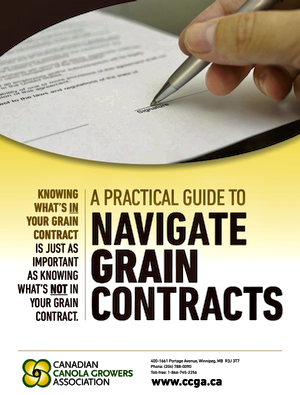
For advice on grain delivery contracts Fossay said farmers should go to the Canadian Canola Growers Association’s website to find A Practical Guide to Navigate Grain Contracts.
Stalled
Some farmers tried to get out of their contracts early when they suspected they wouldn’t be able to fulfil them, but grain companies didn’t allow it, Fisher Branch farmer Paul Gregory told the meeting.
“I was told by a lawyer that if you have written confirmation that you wanted to get out of the contract in June, and you were not allowed to, and it went to court, they would find in favour of the farmer’s side,” he said.
Sobkowich said later he doesn’t know if some companies unjustly blocked farmers. However, some farmers who wanted out didn’t provide the data companies wanted, or didn’t like the cost of buying out the contract, he said.

KAP vice-president Jake Ayre said KAP has “received overwhelming support saying ‘don’t touch our contracts,’” the Minto farmer said. “Yes, there are some issues, but there are issues with everything we do in business. As the executive we’ve heard leave this alone.”
Ayre said he contracted more grain than he could deliver, but was able to make an arrangement with his grain company.
“There was no buyout,” he said. “It worked perfectly.”
Minto farmer David Rourke made the case for grain company contract consistency, pointing to Ayre’s experience and past contracts being rolled over.
“You can’t do it some years one way and a different way another year because it builds false expectations,” he said.
Foxwarren farmer George Graham suggested limits on how much farmers can sell before they have the crop.
“There are some big, big bills out there and we need to make rules to actually protect ourselves,” he said. “I don’t like that, but droughts come and droughts go and there’s going to be another one and we have to be prepared better next time.”
Fisher Branch farmer Shannon Pyziak noted contracts are an emotional issue for farmers on both sides of the debate.
While it’s important to hear the WGEA’s view, it represents grain companies, and it’s important to consider the drought-stricken farmers who can’t fulfil their contracts, Pyziak said.
The issue for farmers seeking a break is not that they want to get today’s higher price, but that they don’t have the crop, she said.
“I think everyone is getting painted with a brush that’s not necessarily true,” Pyziak said.
“When you get conditions where you’re getting five bushels an acre of canola consistently across the board in this drought year knowing what our average is, I think that’s significant.”