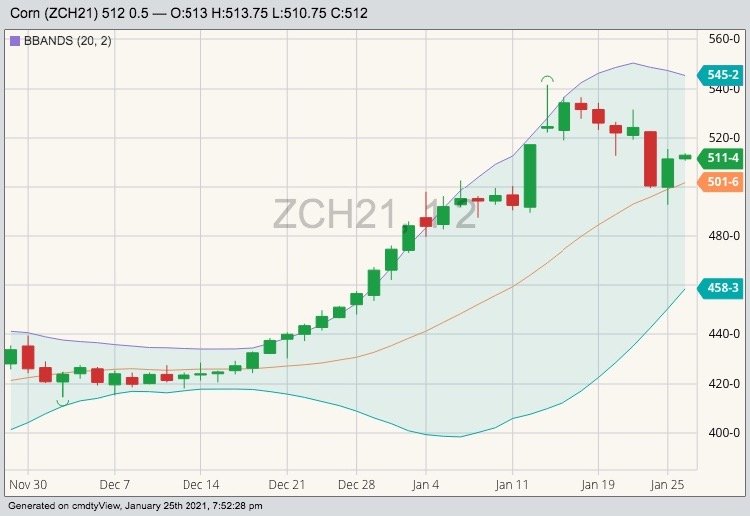
Chicago | Reuters — U.S. corn and soybean futures rallied on Monday as commercial and technical buyers stepped in to take advantage of Friday’s steep declines, analysts said.
Wheat futures firmed on bargain-buying after a four-session slide and improving export prospects.
Chicago Board of Trade March corn settled up 11 cents at $5.11-1/2 per bushel, rebounding after a dip to $4.92-1/2, the contract’s lowest since Jan. 12 (all figures US$).
CBOT March soybeans ended up 31-3/4 cents at $13.43-1/2 a bushel, after dipping to $12.98, and March wheat settled up 14 cents at $6.48-1/2.
Read Also

Feed grains weekly: Prices bump up
To Darcy Haley, vice-president of Ag Value Brokers in Lethbridge, there are two main reasons for recent increases for feed barley and wheat. Haley said on March 12 that there’s an ongoing lack of farmer selling, plus stiff competition from the grain companies looking to export barley.
“We reached some targets, around $5 on corn and around $13 on beans, where the end-users just wanted to get covered. So we are pushing back up,” said Don Roose, president of Iowa-based U.S. Commodities.
Traders continued to keep a close eye on weather in South America, where corn and soy crops are still developing. Weekend rains aided crops in parts of Brazil and beneficial showers were forecast this week in Argentina, factors that had weighed on grain futures last week.
The movement of grain to Argentina’s Rosario export hub was slowly returning to normal on Monday, after a week of protests by truckers who blocked roads leading from the farm belt to port, industry sources told Reuters.
Bullish weekly export data lent support to CBOT futures. The U.S. Department of Agriculture reported export inspections of U.S. corn in the latest week at 1.391 million tonnes, the highest tally since August 2018, and soybean inspections at 1.979 million tonnes were near the high end of expectations.
Weekly U.S. wheat export inspections reached a seven-week top at 523,901 tonnes.
“Wheat is being supported by good U.S. export prospects, with Russia pulling out of the export market and the European Union having limited export supplies,” said Matt Ammermann, StoneX commodity risk manager.
Russian wheat exports are expected to be curbed by a wheat export tax as the Russian government seeks to curb domestic food inflation.
Also supportive was news that Algeria issued an international tender to buy milling wheat.
— Julie Ingwersen is a Reuters commodities correspondent in Chicago; additional reporting by Michael Hogan in Hamburg and Emily Chow in Shanghai.