
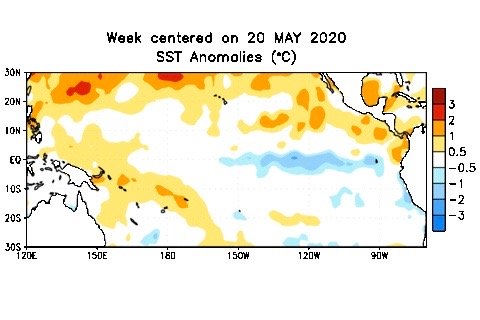
London | Reuters — Sea surface temperatures in the tropical Pacific remain neutral, meaning that neither El Niño nor La Niña weather patterns are prevailing, the U.N. World Meteorological Organisation said on Thursday.
The El Niño pattern brings a warming of ocean surface temperatures in the eastern and central Pacific every few years, and is the opposite of La Niña.
Recent cooling of the sub-surface waters in the region has caused slightly above-average sea surface temperatures to return to near-average levels during May, the WMO said.
Read Also
Prairie forecast: Cold weather settles in after snowy start
As the weather models were indicating as early as last week, we are now seeing a clear shift in our weather pattern from unseasonably warm and dry to more seasonable cold. This comes with a snowy start and additional chances for snow over the next week or two.
The latest seasonal forecasts indicate that tropical Pacific sea surface temperatures are likely to cool further, potentially approaching weak La Niña levels during the second half of 2020.
Given current conditions and model predictions, the chance of El Niño-Southern Oscillation (ENSO) neutral conditions continuing through June-August 2020 is estimated to be around 60 per cent, with a 30 per cent chance of La Niña, the WMO said.
“Chances for La Niña rise to 40 per cent for the September-November period,” it added.
Earlier this month, a U.S. government weather forecaster said there was about a 65 per cent chance that neutral weather conditions will prevail in the Northern Hemisphere this summer with no El Niño or La Niña.
Historically, milder-than-normal winters and springs are known to occur in Western, northwestern and central Canada during El Nino periods, according to Environment Canada.
Eastern and Atlantic Canada aren’t known to be “significantly” impacted by El Nino events, though such an event may reduce tropical cyclone activity in the Atlantic.
Anomalies known to occur in La Niña conditions include colder-than-normal temperatures on the Prairies and above-average precipitation in British Columbia, Ontario and Quebec.
— Reporting for Reuters by Nina Chestney; includes files from Glacier FarmMedia Network staff.