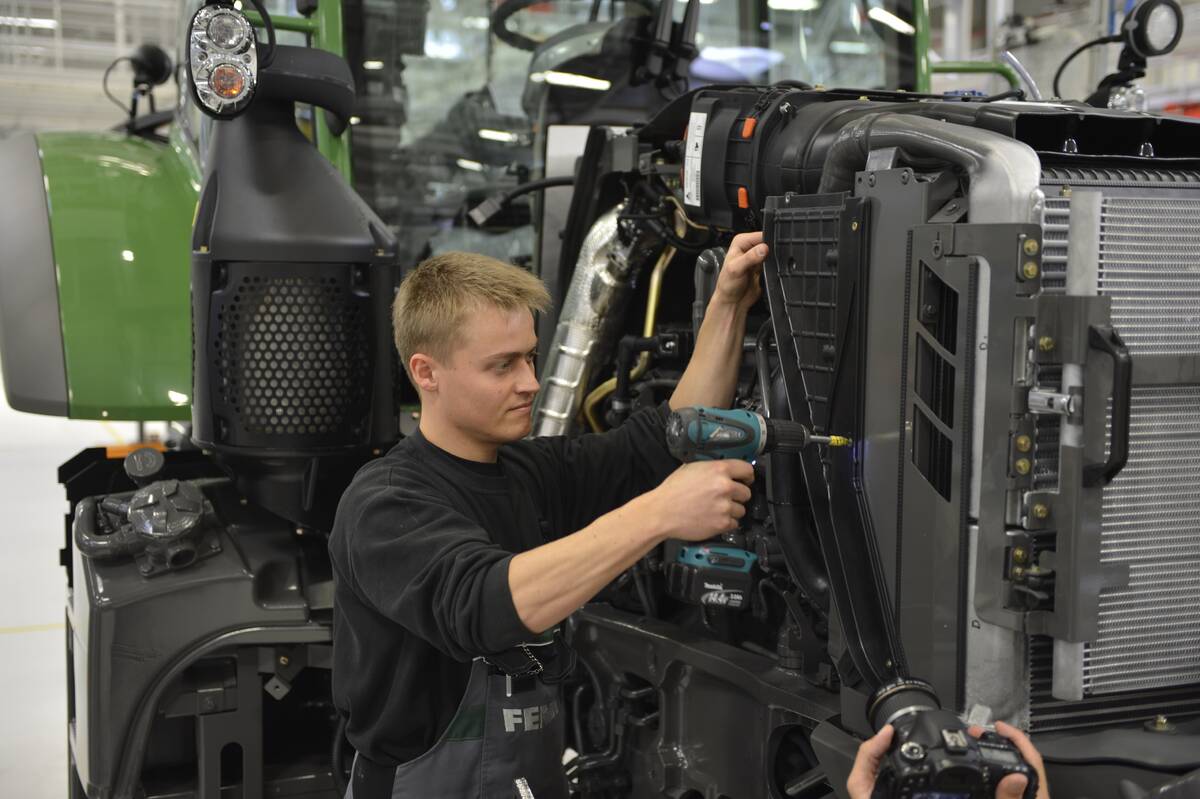
All of the major ag equipment manufacturers are publicly traded companies, meaning each one has millions of outstanding shares that trade daily on stock exchanges.
The cumulative value of those outstanding shares determines the overall value or market capitalization of a company. Of course, those numbers change daily as share prices rise and fall with normal market fluctuations.
Read Also

Mahindra plans new tractor lineup for North America after Mitsubishi joint venture ends
Mahindra Ag North America is rolling out a new tractor lineup after ending its joint venture with Mitsubishi, with models from 26 to 70 hp expected through 2027.
WHY IT MATTERS: While Fortune 500-level companies are typically somewhat better insulated against market shocks, reduced market cap can make it more difficult for publicly traded firms to obtain favourable credit or raise capital through share offerings.
Those fluctuations are the result of profits each company reports and the outlook on their future fortunes along with the condition of the overall economy.
Stock markets slide as war upends global trade
In recent days, however, there is another consideration to factor into those market trends: the war in Iran. That gambit, initiated by the Trump administration and Israel’s leadership, has roiled markets around the world.
The U.S. Dow Jones had been riding pretty high despite a global economy upended by U.S. tariff policy.
The Dow had reached a yearly high average on Feb. 10 of more than 50,000. However, the Middle East war cratered it, causing the average to drop to slightly more than 46,000 by March 25. Almost every other market around the world saw significant declines as well.
At the same time, oil prices have reached higher than US$100 per barrel as global supply is choked down by roughly 20 per cent due to the closure of the Strait of Hormuz, impacting urea fertilizer prices as well.
Iran war strikes at agriculture
All of this has affected the input costs farmers will face this year, but it has also had a negative impact on the market value of farm machinery manufacturers.
As their profitability and share prices were starting to rise from a low point in the cyclical equipment demand cycle, the stock market declines have caused significant reductions in the valuation of those companies.
Here’s a look at just how much the market capitalization of those brands had fallen from mid-February to late March:
John Deere shares peaked just before the war on Feb. 24 at US$664. By March 25, those share values had dropped $82. With about 270.1 million shares outstanding, that represents a market capitalization loss of roughly $22 billion.

Agco shares peaked Feb. 13, and by March 25 had seen a $1.7 billion valuation reduction.
CNH Industrial, parent company of Case IH and New Holland, realized a $2.5 billion decline. In the automotive sector, the story is the same. For example, Ford saw its market value decline by more than $8 billion.
The situation is the same for nearly all publicly traded companies listed on many different stock exchanges around the world, meaning globally, companies collectively have probably lost trillions of dollars in market value, at least temporarily.
Financial market fallout
At the same time, financial analysts are sounding the alarm over the possibility of insider trading on the U.S. stock market related to government announcements, with unusual trading patterns observed that could have netted millions for unidentified entities just minutes before a White House announcement.
More than a few analysts are now questioning the integrity of the U.S. stock market as a result. Since the current administration took office, the ability of the U.S. Securities and Exchange Commission to prosecute violations has reportedly been significantly reduced.
This comes at a time when foreign investment in U.S. government treasury bonds is declining, reportedly due to a lack of confidence in the administration. Those bonds help finance the government’s deficit. Without continued investment, the U.S. treasury will find itself in a bind.
Add to that the recent increase in global oil trades conducted in yuan, rather than the standard U.S. dollar transaction, which came to be known as the petro-dollar.
The so-called petro-dollar has helped prop up demand for U.S. currency for decades. That has been an economic boon for the United States, but the continued decline in U.S.-dollar oil transactions would lead to significantly reduced demand for greenbacks.
As a lack of confidence in the U.S. among investors, trading partners and allies grows, there could be a very rocky road ahead for the U.S. economy, and the valuations of U.S.-based corporations could continue to take a beating.