“When it comes to soil, “… it’s all about the matrix.”
Not the futuristic film, but the morphology. The soil structure. The ‘architecture.’
That’s according to soil scientist Francisco Arriaga from the University of Wisconsin, when talking about soil compaction at the recent 2022 Northern Soil Compaction Conference, hosted by the Minnesota Soil Health Coalition earlier this winter.
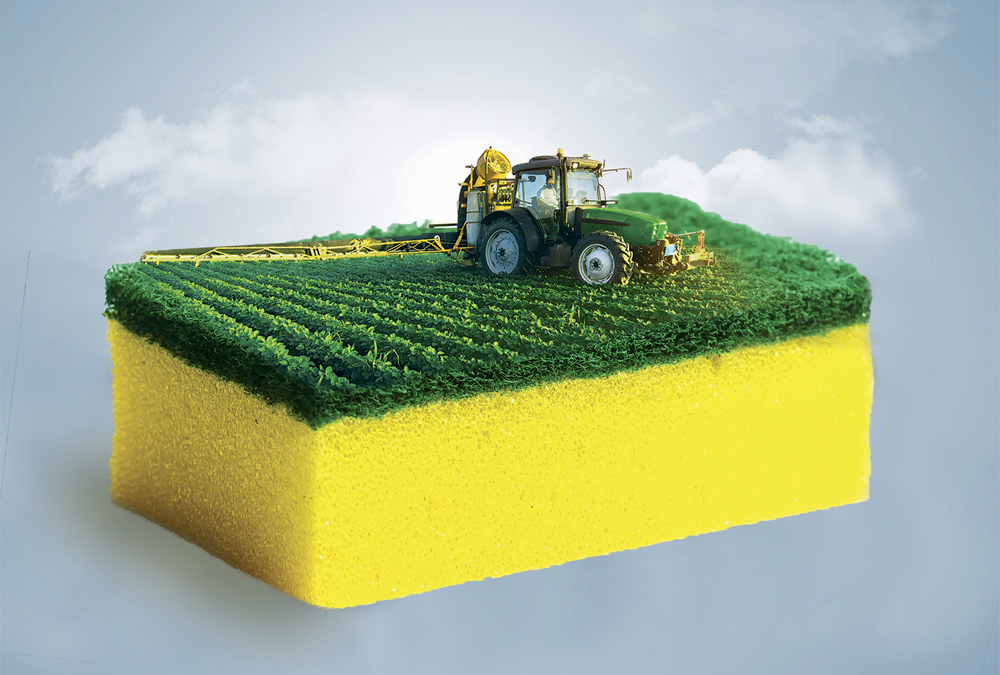
“We want our soils to be more like a sponge,” he said. “Low bulk density, high pore space and pore size distribution. That affects the fertility and the biology. It’s all interconnected. It’s all affecting one or the other.”
Read Also
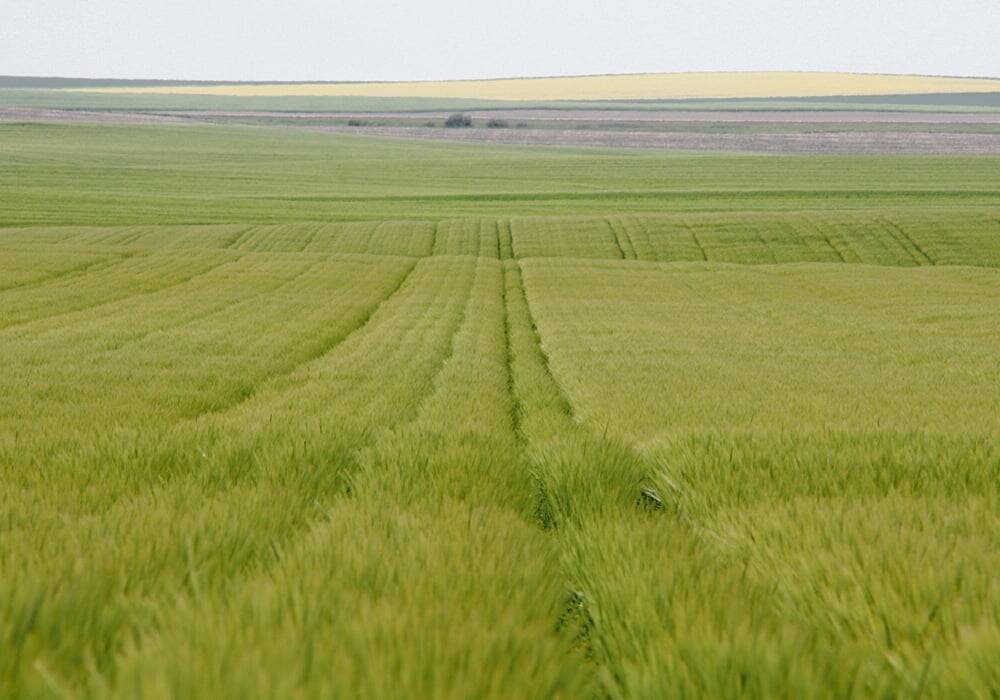
VIDEO: Manitoba farmer tests controlled traffic farming to fight soil compaction and flooding
Manitoba farmer Alex Boersch wants to improve the stability of his crop yields. He’s been experimenting with controlled equipment traffic on his fields
This is why the compaction question is important. As farm machinery gets bigger and heavier, it puts more weight on the soil. With each pass the compaction is greater. Arriaga says this affects the pore size and pore size distribution and the industry needs to consider what this means to agriculture.
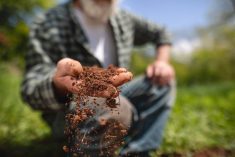
We all know about the basic building blocks of the matrix. We’re told about sand, silt and clay, the materials from which soil is made. Sand grains are the largest and have big spaces between them. Silt particles are much smaller and occupy some of the space between the sand grains along with the microscopic clay colloids. This still leaves a fair amount of pore space and the matrix needs this.
“We say that a soil should be 50 per cent solid and 50 per cent porosity,” he said. “In reality soils that are not compacted are going to be maybe 55 per cent solid and maybe 45 per cent porosity. It will vary with the particle size.”
At its simplest, soil is a three-phase system: soil minerals, soil moisture and soil atmosphere. It’s the last two that really explain the matrix. It’s the air and moisture in those pore spaces that make that 45 per cent so important. They’re always in flux and changing depending on the surrounding environment. It’s a dynamic system.
“Those pores that have water in them also have solutes and those are your plant nutrients,” Arriaga said. “Then we need good aeration, soil air for roots to perform and function but also for the biology of the soil. So all of these fractions, these spaces in the soil, are extremely important for how soil behaves.”
There are so many processes within the soil affected by the pore spaces. This is where water infiltrates and flows so it affects soil erosion. It’s where the roots penetrate, bind and hold it together. It’s where the soil atmosphere delivers the necessary oxygen the soil organisms need for respiration and the soil moisture delivers the plant nutrients. This also home to those soil organisms, the living part of the system.
“I like to think about it is an aquatic system,” Arriaga said. “The biology is living in the spaces, or porosity, with water. This relationship with the water in the soil that’s in the pore spaces is extremely important.”
This is what he meant when he said we want our soils to be like a sponge having many different pore spaces and a variety of sizes. Compacting the soil is like squeezing that sponge. You’re effectively reducing those pore spaces leaving no place for the water or air.
“Compaction is not only a reduction of porosity but destruction of structure and aggregation in the soil which creates all kinds of problems,” Arriaga said. “It’s not only changing the total amount of pores but it’s also changing the pore size distribution in the soil.”
Aggregation is the way nature binds the soil particles together and it lies at the heart of soil structure. If sand, silt and clay are the bricks from which soil is made then the mortar that holds them together is the organic matter. This may come from bacteria that help form the microaggregates, or macroaggregates formed from plant roots, mycorrhizal fungi and earthworms.
This brings tillage, an old and very traditional farm practice, into the picture. Since tillage involves opening up the ground to kill weeds, to prepare an even seedbed and to introduce oxygen into the soil microbe population, it also damages the aggregate structure of the soil. The loss of structure makes it more susceptible to compaction. Comparisons of low-tillage to high-tillage systems show low-tillage systems maintain soil structure and productivity better.
“There are some research plots that we inherited awhile back and after some rainfall you can see really nice footprints,” Arriaga says. “In the no till on the same day there’s barely any mark on the field which signifies that this no-till soil has better aggregation and lower risk of compaction. Reduced tillage increases the aggregation so the risk of losing productivity by compaction goes down.”
It also makes the soil less prone to erosion. Soil can’t absorb water as easily when it’s compacted. It has lost its sponge-like structure so the water simply collects on top. This increases the amount of run-off. As that water is running it gains speed, it starts scarring that soil and creating rills and then gullys. Once that water gets enough energy it can move freely and create a lot of damage.
One more system that may be severely affected by compaction is the living biota within the soil. Soil moisture and air are absolutely vital for living things from soil bacteria all the way up to springtails and earthworms.
“They decompose litter and other organic matter and so they provide a tremendous service to our soil system,” Arriaga said. “One of the functions of soil is recycling organic matter and the nutrients that are in that organic matter. They are the first ones that would be chewing on that residue.”
We often take soil for granted as little more than dirt, a medium into which you push seeds so they can grow. We don’t often think of the complex interchange between different elements within the system that make that possible. The foundation is the structure, the pore size distribution, and how it makes space for all the different mechanisms to work.
“So hopefully you’ll be thinking about soil and compaction a little differently,” Arriaga concluded. “We should be asking, how is my compaction management and how is my management in general affecting that pore size distribution?”