WINNIPEG — An unusual animal welfare trial about a shipment of 79 horses from Manitoba to Japan in December 2022 inched closer to a verdict Feb. 13 at the Provincial Court in Winnipeg.
The prosecution and defence submitted their closing arguments on a case that’s focused on the following question: Did a farmer from Swan River, Man., make the necessary plans to ensure that horses were humanely transported on a flight from the Winnipeg airport to Japan?
WHY IT MATTERS: Air export of horses bound for slaughter has come under the gun in Canada.
Read Also
Farm equipment makers caught in war-driven stock market shockwave
Major manufacturers, including John Deere, AGCO and CNH Industrial, see market capitalizations drop by billions as Iran war continues to roil global markets.
The case is unusual because the crown isn’t leading the prosecution — it’s a private prosecution by Animal Justice, an animal welfare organization from Toronto.
The group launched the private prosecution in 2024 after bringing up their complaints with the Canadian Food Inspection Agency and after which the agency did not to take legal action.
After nearly four hours of submissions from the prosecution and defence, Provincial Court justice Sandra Chapman reserved her decision for a future date.
The basics
Animal Justice’s lawyer, Dan Stein, laid out the basic facts of the case in his submission to the court:
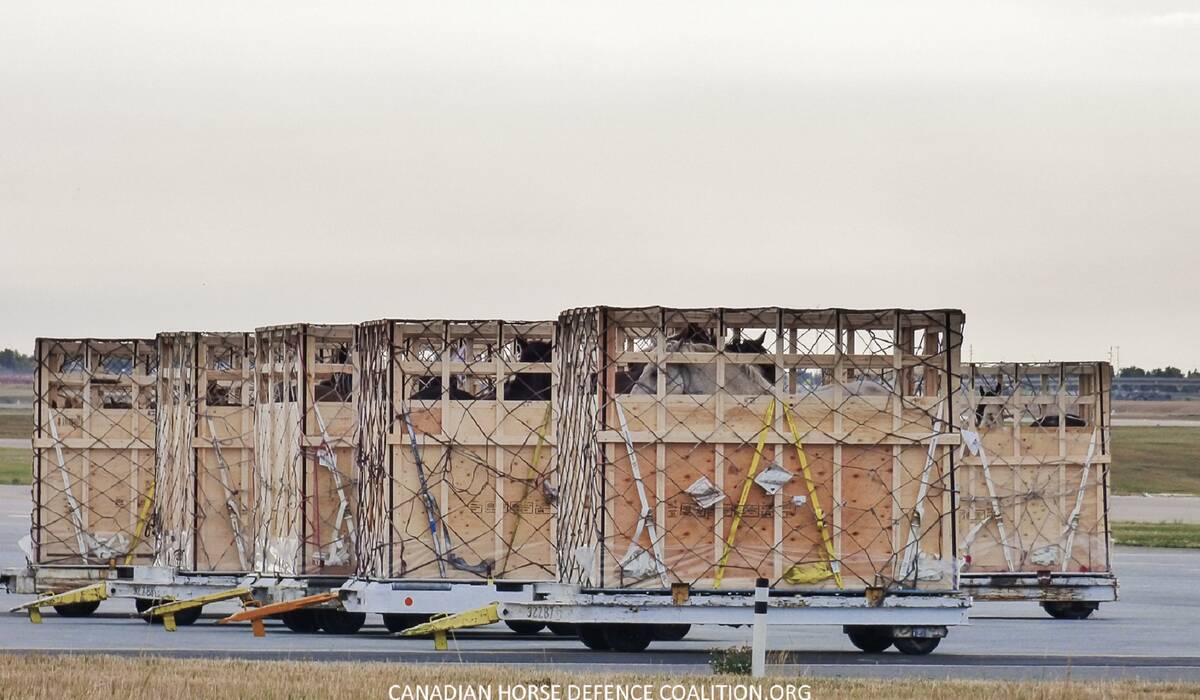
- On Dec. 11, 2022, Lyle Lumax, owner of Carolyle Farms in Swan River, transported 97 live horses by truck to the Winnipeg airport.
- Of that group, 79 horses were put in crates and loaded onto a Korean Air plane in the early hours of Dec. 12.
- The flight departed Winnipeg at approximately 4 a.m. that day, but the plane was re-routed from Anchorage, Alaska, to Seattle because of a snowstorm in Anchorage.
- That re-routing caused the horses to be in transport for more than 33 hours without food, water or rest during their journey to Kagoshima, Japan, Stein said.
- That exceeded the 28-hour time limit for transporting horses in Canadian Food Inspection Agency regulations.
Contingency plan
Animal Justice claims in its prosecution that Carolyle Farms failed to a have a contingency plan for unknown but foreseeable events for the shipment from Winnipeg to Japan.
Canada’s Health of Animals Regulations require a contingency plan to prevent an animal’s death, injury or suffering.
Carolyle Farms did file a contingency plan in September 2022 for the trip to Japan, but Stein said that Lumax only had a contingency plan for the transport of the horses from Swan River to Winnipeg and not the entire journey to Japan.
“His plan only went as far as the airport and wheels up,” he said.
“Was it OK that Carolyle Farms washed their hands of this (contingency plan) once this plane lifted off?”
Dr. Erika Spek, a CFIA veterinarian, told the court Feb. 12, that someone needed to have a plan if there were animal welfare issues during the flight.
“Lyle (Lumax) is not on that plane with those horses, but somebody has care and control over (the horses), so somebody better know what to do,” she said, according to the CBC.
Having a contingency plan to prevent death and suffering and ensure the welfare of the horses is a shared responsibility of the farmer, the airline (Korean Air) and the shipper, Sea Air, Stein said.
The horses could have been stuck in a crate on the plane, sick and dying for more than 25 hours, because there was no plan after the Winnipeg airport, the lawyer said.
In his closing submission, Stein didn’t provide evidence that the horses suffered. His argument focused on the lack of plan to prevent suffering.
“It’s a planning offense … . Did someone consider the consequences of a failed contingency plan?”
Lumax wasn’t in court Feb. 13.
His attorney told the court that the farmer can’t be held responsible for decisions made, or not made, after the Korean Air flight departed from Winnipeg.
Yes, there is shared responsibility to ensure the welfare of the horses and develop a contingency plan, the defence said, but ultimately there is a decision maker and when the plane is in the air, Korean Air is responsible for the welfare of the animals.
The defence pointed to testimony from Spek, who told the court that the air portion of the contingency plan is the responsibility of the airline.
Further, the defence argued that Lumax transferred ownership to the Japanese buyer of the horses when he delivered the horses to the Winnipeg airport.
Months of delay
The trial was initially meant to come before a judge last May, but was pushed back after the farm’s lawyer asked for more time to review witness statements.
Animal Justice had initially sought three charges against the farm, two of which were dismissed in a pre-inquiry hearing in 2024. A charge of exceeding the 28-hour maximum was not allowed to go ahead, as the CFIA had been consulted in the decision to continue with the shipment. Another charge, distress to animals, was dismissed on jurisdictional issues.