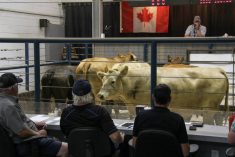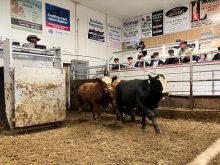

Cattle moving through Manitoba’s auction yards were up and down during the week, with some classes moving higher and others lower.
The market had “a mixed feeling,” according to Robin Hill of Heartland Livestock Services at Virden. There was no real rhyme or reason to the gains or losses in the different classes of feeder cattle, he said.
Demand continued to come from both eastern and western buyers, with volumes to the south still lacking. Futures in the U.S. were a bit more positive during the week, which lent some support to the Canadian market.
Read Also

MBFI livestock research farm gets major expansion
Manitoba Beef & Forage Initiatives expands Brookdale Research Farm by 467 acres to benchmark grazing profitability at commercial scale.
However, the Canadian dollar rose sharply during the week ended April 13, hitting 79.5 U.S. cents. The rising currency will be followed closely by the cattle sector, as it cuts into profitability.
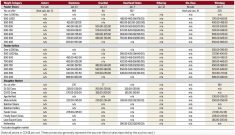
Grass cattle saw the best demand, with prices for lighter-weight steers (under 500 lbs.) generally in the $190-$220 per hundredweight area across the province. Heifers in the same weight category ranged from about $180 to $210, although some sold above $220.
With the lingering winter, cattle are eating more and will go out to grass later. “Feed shortage is becoming a bit of a factor on some farms,” said Hill, noting “more and more producers are talking about the feed situation.”
On the butcher side, cows and bulls were generally a bit firmer on the week. Hill said demand was good for butcher cattle, with “hamburger season just around the corner.”
Roughly 7,800 head of cattle were marketed through the province’s auction yards during the week. A slowdown in activity is normal for this time of year, as ranchers are busy with calving and attention turns to the spring.
Hill expected to see numbers dwindle in the upcoming weeks, but noted many producers will still have a “cleanout day” sometime in the next month or two. If a cow loses her calf, that animal will likely come to auction shortly after.