A recent bout of frigid temperatures could not keep most cattle producers away from Manitoba auction sites and prices remained high during the week ended Feb. 23.
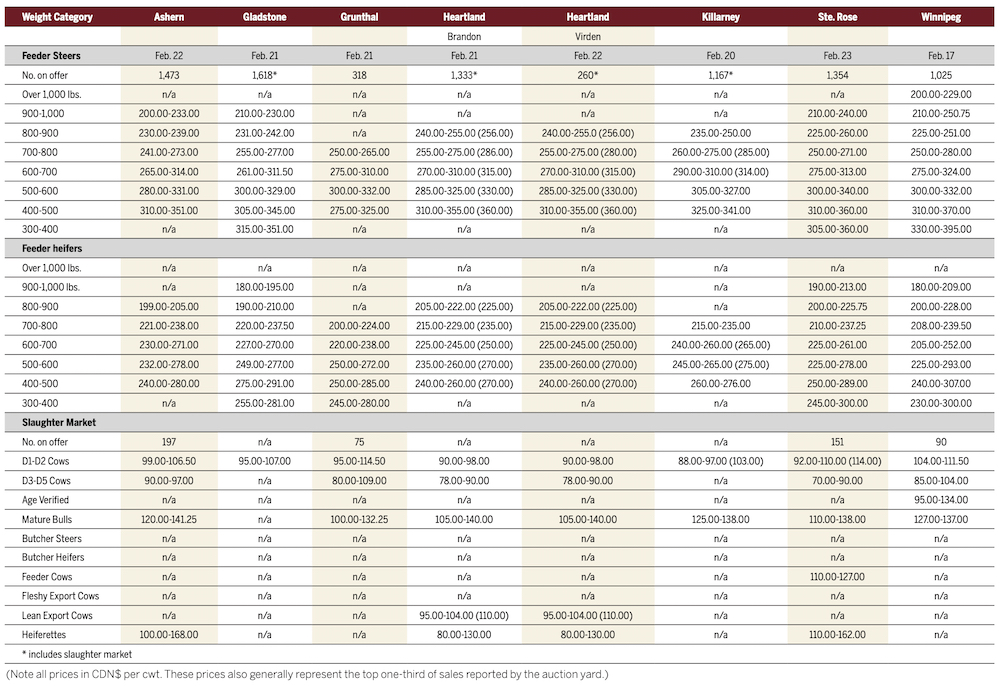
While some daytime highs were below -20 C, cattle numbers and prices remained elevated. In total, 9,061 animals went through the rings at eight auction sites during the week, compared to 11,079 head in the previous week.
Kirk Kiesman, general manager of Ashern Auction Mart, said there is long-term optimism among cattle producers about high feeder prices.
Read Also

Iran war volatility sends shock waves through agricultural markets
Here are the numbers on how badly fuel, fertilizer and grain markets have been thrown for a loop by the conflict in Iran so far.
“I think there’s not a lot of feeder cattle out there with the downsizing over the last couple of years. There is a little bit of supply issues, which is driving the market up too,” he said. “I think that’s kind of why we’ve seen heifers go up because feedlots are looking at heifers.”
Steers weighing under 500 pounds. ranged in price from $275 to $395 per hundredweight during the week ended Feb. 23, compared to $250-$368/cwt. one week earlier.
Those weighing 800 lb. or more cost $200-$260/cwt., compared to $195-$260.50/cwt. in the previous week.
Heifers under 500 lb. sold for $225-$300/cwt., while $218-$295/cwt. was price range during the week of Feb. 17. For those 800 lb. or heavier, $180-$228/cwt. was the range, compared to $170-$230 the week before.
D1 and D2 cows sold for $90-$114.50/cwt., compared to $90-$110/cwt. the week before. Mature bulls sold for $100-$141.25/cwt. during the week of Feb. 24, a similar range from $100-$140/cwt. in the previous week.
“The cattle are moving throughout Canada, either to the west or the east,” Kiesman said.
On the Chicago Mercantile Exchange, the April live cattle contract closed Feb. 23 at US$165.325/cwt. after hitting $166.10/cwt. during the day, its highest since January 2015. The March feeder cattle contract closed at $189.225/cwt., while its session high of $189.75/cwt. was at a level unseen since last September.
Low cattle supplies in the U.S., as well as Brazil’s ban on beef exports to China due to a self-reported case of BSE, factored into recent rallies.
The Canadian dollar also lost six-10ths of a U.S. cent during the week to settle at 73.81 U.S. on Feb. 23.
Kiesman predicts prices for heavier cattle will stay firm while lightweight cattle will have more upside.
“I don’t see (heavy cattle) changing much (in price). I think it’s going to stay relatively flat at where it is right now. I could see lighter cattle picking up as we get closer to grass,” he said.