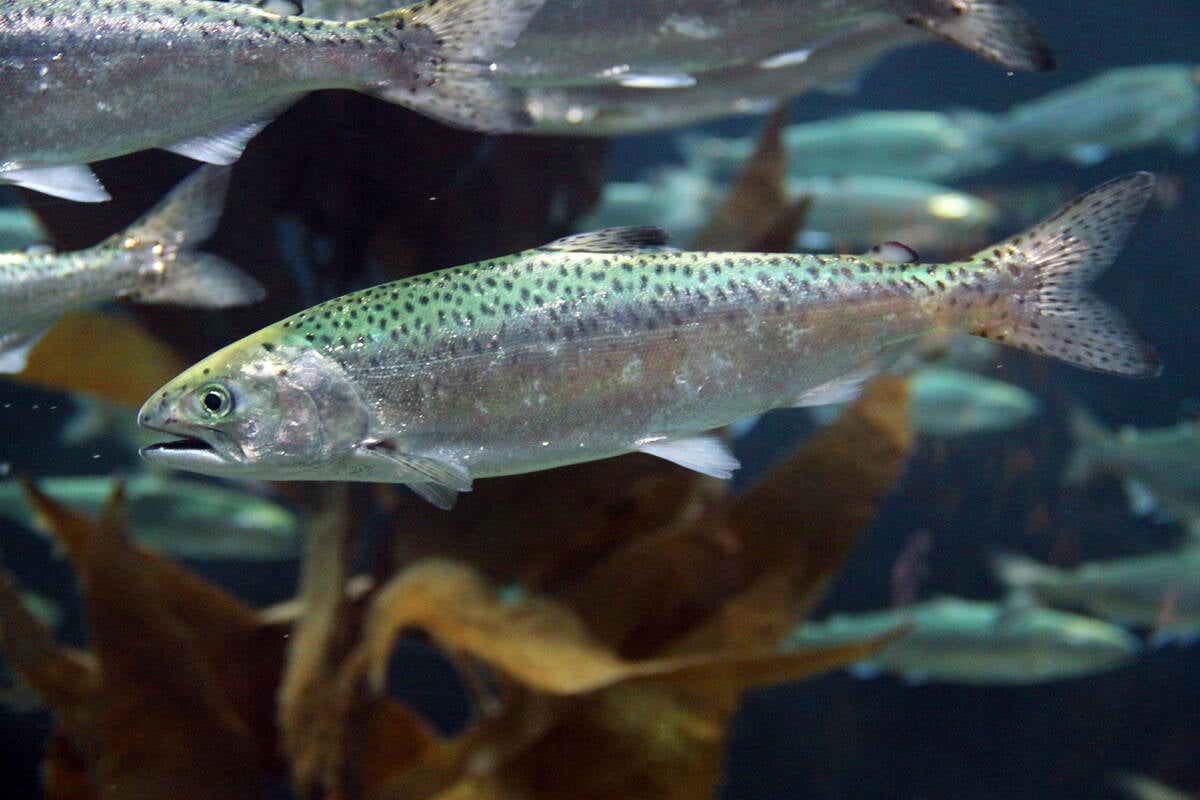
Canada’s aquaculture industry needs a strong, well-respected voice to convince governments and the general public that fish farming is not harmful to the wild fishery and environment and, in fact, can be a significant contributor to the Canadian economy while delivering social benefits.
That’s according to members of the aquaculture sector during the Food Leadership Summit in Calgary earlier this fall.
WHY IT MATTERS: Aquaculture isn’t just for Canada’s coast lines. Fish farming is digging roots on the Prairies, while the sector is being eyed as a potential feed market for canola meal.
Read Also
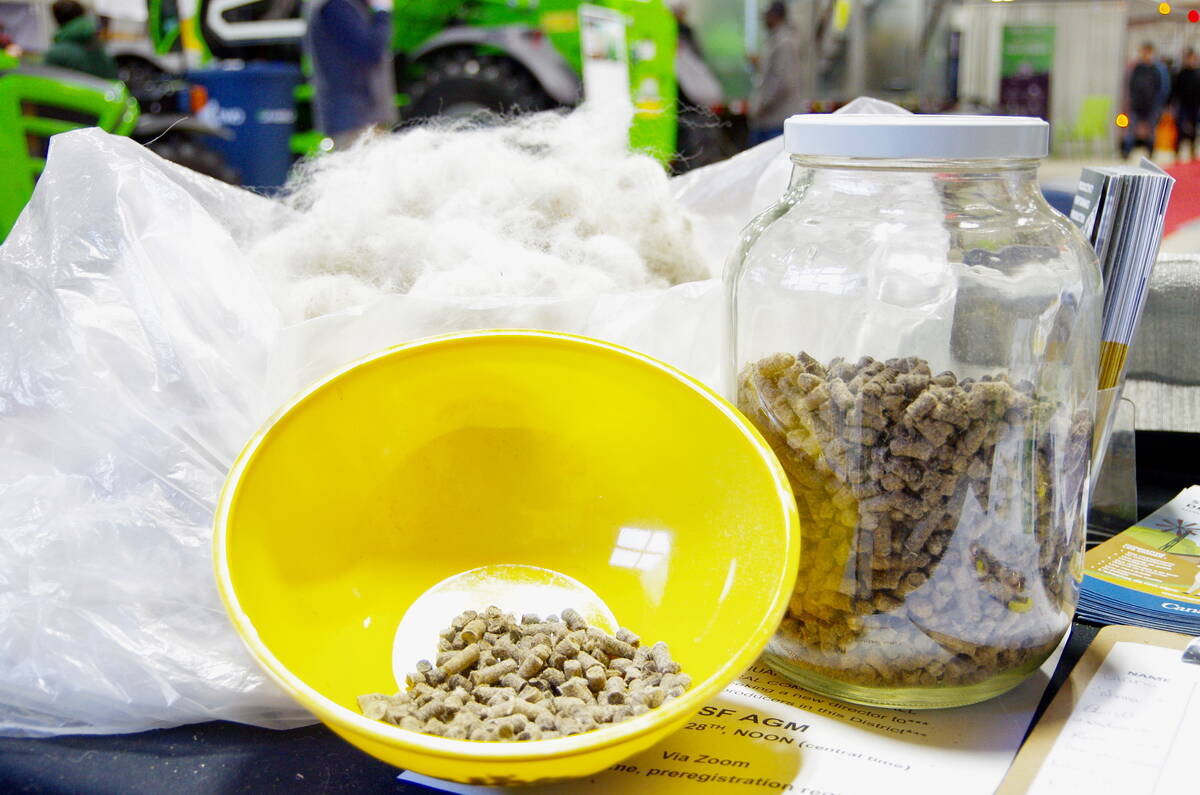
Wool pellets open new markets for Manitoba sheep farmers
Pellets from waste wool may offer new revenue for sheep farmers and a sustainable soil amendment and fertilizer for horticulture.
Tim Kennedy president and chief executive officer of the Canadian Aquaculture Industry Alliance (CAIA) says efforts are underway to have aquaculture defined as a bona fide farming enterprise and brought under the umbrella of Agriculture and Agri-Food Canada (AAFC).
As well as better promotion, the sector notes that coming under AAFC would open the doors for better stability though business risk management and support programs.
Currently aquaculture falls under the purview of Fisheries and Oceans Canada, which is a largely a regulatory body.
“What aquaculture needs is a department to champion and promote its cause as a viable agricultural enterprise,” said Kennedy.
“We need to be recognized as farmers, just like crop and livestock producers, and the potential and growth of the sector needs to be promoted, which is an important roll AAFC can play.”
Industry promise, government hurdles
Members of the aquaculture sector are optimistic about the potential of their industry, but argue that Ottawa’s current tone towards aquaculture risks holding it back.
Canada has a natural aquaculture advantage, attendees of the Calgary event heard, and could position itself as a world leader in farmed fish and seafood production.
At least one company has been trying to make its mark in that regard in Manitoba. Although right in the centre of the country, aquaculture company Sapphire Springs Inc. announced plans last year for a major Arctic char fish farming facility just outside of Winnipeg.
That fish farm site, chosen for its proximity to transportation infrastructure, cheap energy and sitting on an cold aquifer suitable for the fish species, promises to increase global Arctic char supply by 50 per cent.
Elsewhere though, particularly with B.C.’s penned salmon sectors, troubles are brewing.
The industry has taken heat from conservationists, who argue that the intense production in an open ocean environment encourages the spread of pathogens and parasites into surrounding wild waters.
In June 2024, the federal government announced a move away from open-net production. Salmon aquaculture operations have until June 30, 2029, to move to more contained forms of fish farming.
Kennedy, though, said that “If the plan for an announced ban on open-net pen salmon production on British Columbia’s coast by 2029 isn’t changed, it essentially means the end of farmed salmon production in Canada.”
He pointed to recent closures of two of major farmed salmon operations off B.C.’s coast. He described that as a major blow to the aquaculture industry.
“Those closures really curtailed fish production, so an outright ban on open-net pen salmon production will kill fish farming in Canada,” he said.
“There have been numerous studies over the years that show penned salmon production has ‘no more than minimal risk’ to the wild salmon fishery and the environment. This message needs to be delivered clearly to the federal government and the public in general.”
Wide breadth of aquaculture
Aquaculture as also more than just the stereotypical fish farm, attendees heard. The term actually refers to broad range of products that includes proteins and oils derived from seaweed, algae and other aquatic plants.
Among seafood products, Kennedy argues that farmed salmon is a relatively new enterprise, introduced over the past 45 years.
Harvesting shellfish, meanwhile, has been an industry for hundreds of years.
He also noted the start up of inland production, based in tanks and ponds.
Recent fish farming announcements in Manitoba would fall under that purview.
Canadian production ‘going backwards’
Canada’s aquaculture industry hit its peak production in 2018 with the harvest of about 200,000 tonnes of fish and seafood products. However, with the two salmon farming operations closures in B.C. — located in the Broughton Archipelago and Discovery Island — production was cut by about 40 per cent.
In 2023, total aquaculture production dropped to 145,000 tonnes (including farmed fish and shellfish). Of that total, about 80,000 tonnes was farmed salmon.
Kennedy expects the 2024 production numbers to further drop to about 130,000 tonnes.

“We have three times the capacity, yet Norway produces 20 times more farmed fish than we do.”
Tim Kennedy
Canadian Aquaculture Industry Alliance
By comparison, Norway, which pioneered penned salmon production and technology following the Second World War, produces about 1.7 million tonnes of farmed salmon and other fish annually. That’s on top of a strong wild salmon fishery.
“Norway has about one-third of coastline and ocean potential to produce farmed salmon than what Canada has,” said Kennedy. “We have three times the capacity, yet Norway produces 20 times more farmed fish than we do.”
In another example, he points to the Faroe Islands, lying halfway between the mainland of Denmark and Iceland.
“The Faroe Islands have about 1,200 kilometres of coastline and produce about 80,000 tonnes of farmed salmon, which is just about the same as what Canada produces, yet Canada has 79,000 kilometres of coastline,” said Kennedy. “We have significant potential to increase aquaculture production, yet in actual fact we are going backwards.”
Social impacts of fish farming
Kennedy argues that the farmed salmon industry provides important economic and social benefits to many small and remote coastal communities.
“Many of these remote communities are home to First Nations people and, because they are remote it can be difficult and expensive to deliver food and other supplies,” he said. “When farmed salmon production was at its peak, trucks were needed to haul the harvested salmon out, but those trucks were also used to haul in food and other goods which benefited the communities.
“As the industry has been forced to downsize, that has also affected deliveries to these remote areas. It has gone from an industry employing 7,000 people down to about 4,500 people. “
Kallie Wood, president and chief executive officer of the National Circle for Indigenous Agriculture and Food (NCIAF) said aquaculture’s story in Canada can’t be told without Indigenous people. “Aquaculture and fish farming relies on Indigenous people on all three coastlines” she said.

“There are a lot of people out there who don’t know what they are talking about.”
Kallie Wood
National Circle for Indigenous Agriculture and Food
“And when you have a close look at these operations you see that they are well run with minimal impact on the environment. There are a lot of people out there who don’t know what they are talking about. So we need to do a better job of telling our story, and make greater use of the knowledge of Indigenous people. We need to have more Indigenous voices at the table being part of the discussion.”
A report by Kenneth Green, senior fellow with the Fraser Institute, points to a study by consulting firm RIAS Inc. on behalf of the BC Salmon Farmers.
That report found that the proposed open-net ban “would result in a loss of $1.17 billion in annual economic activity; $435 million in Canada’s economic output (GDP); and 4,560 fewer full-time jobs with a combined annual payroll of approximately $259 million,” Green wrote.
“Further, RIAS found, the ban would cause losses of $437 million in spending with more than 1,400 vendors across B.C. and the elimination of a further 50,000 tonnes of farmed salmon production.”
That, in turn would be a hit to Canadian agri-food production equivalent to about 400 million meals, as well as eliminating B.C.’s top agri-food export, RIAS reported.
Fish farming, emphasis on ‘farming’
Kennedy said both the science and the economics support the value of aquaculture as part of agriculture.
“Right now we are using about one per cent of the viable aquaculture area along Canada’s coastline to produce seafood,” he said. “We could double production and, for the most part, still stay within that one per cent footprint.”
He notes that the Norwegian government has set a goal to increase its farmed salmon production by 500 per cent by 2050. He thinks Canadian industry just needs the proper support and encouragement to also grow the sector here.
“We could set a goal to increase production to 500,000 tonnes by 2050 for example,” said Kennedy. “The potential and capacity are there. It would have tremendous value in food production, create more jobs and benefit the economy and communities.”