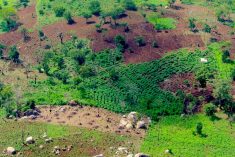
Harare | Reuters — Zimbabwe will issue 99-year leases to white farmers, according to a government circular, after new President Emmerson Mnangagwa said he would end discrimination along racial lines in agriculture.
Fewer than 400 white farmers are still operating in the southern African nation, after former president Robert Mugabe’s government evicted more than 4,000 under an often-violent land reform program.
Those who remained were issued with five-year renewable leases by the state compared to 99-year leases for black farmers, leaving their land vulnerable to expropriation by the government.
Read Also
Feed Grains Weekly: Cash prices for wheat, barley largely flat
Cash prices for feed barley and wheat continued to remain largely flat, said Susanne Leclerc of Market Master Ltd. in Edmonton.
The agriculture ministry circular to staff, seen by Reuters, says white farmers should now be issued the same 99-year leases as black farmers.
“Please be informed that the minister of Lands, Agriculture and Resettlement has directed that all remaining white farmers be issued 99-year leases instead of the five-year leases as per the previous arrangement,” said the circular, dated Jan. 19.
Land ownership is one of Zimbabwe’s most sensitive issues. Colonialists seized some of the best agricultural land and much of it remained in the hands of white farmers after independence in 1980, while many blacks were landless.
Twenty years later, Mugabe authorized the violent invasions of many white-owned farms, justifying them on the grounds that they were redressing imbalances from the colonial era.
Mugabe, 93, resigned in November after the army and his ZANU-PF party turned against him.
Earlier this month a government document showed that Zimbabwe is considering establishing a special tribunal to determine the value of compensation and how to pay it to white farmers who have lost their land since 2000.
Many white farmers challenged their evictions legally but lost. Under Zimbabwe’s constitution all agricultural land belongs to the government.
— Reporting for Reuters by MacDonald Dzirutwe.