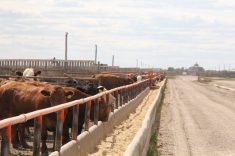
Western Canadian feeder cattle prices were steady to $2 per hundredweight higher on average in comparison to week-ago levels. Buyers appeared to be more aggressive for cattle over 800 pounds.
A large group of tan/white Charolais steers averaging 935 pounds sold for $141/cwt west of Edmonton, which is a record high for this weight category; 70 red and black steers with medium flesh averaging 700 lbs. sold for $158 northwest of Calgary. Age-verified cattle are starting to show more of a premium as supplies of cattle with birth certificates were somewhat tighter last week.
Read Also
Strong 2025 could mean complications for Canadian grain sector in 2026 says analyst
Carryover supply of many crops in Canada could complicate the market in 2026
Industry comments suggest that 95 per cent of the Alberta cattle are age-verified but only 40 per cent in Saskatchewan and Manitoba. These numbers have been stagnating over the past two years and with lower feeder cattle numbers, the market is starting to be more sensitive. Buyers were also surprised by some groups of non-age-verified cattle in Alberta this past week. In the past, I’ve seen advertisements by auction markets showing strong prices for non-age-verified cattle which is counter-productive longer-term for the cattle industry.
Alberta packers bought cattle in the range of $115-$117/cwt last week, with the stronger Canadian dollar tempering the upside. Fed cattle in Nebraska reached up to $130.50/cwt, up $2/cwt from a week ago. Live cattle futures made record highs last week with the December contract closing above $135/cwt. Strength in the deferred futures continues to lead nearby feeder cattle prices higher. The futures market appears to be incorporating a risk premium due to the uncertainty in production in the fourth quarter.
The feeder cattle market is functioning to encourage production and ration demand for the feedlot operator. Prices have to move high enough so that the feedlot operator backs away but at the same time, the cow-calf producer holds onto the heifers. Feedlots are still actively buying given the stronger live cattle futures.
— Jerry Klassen is a commodity market analyst in Winnipeg and maintains an interest in the family feedlot in southern Alberta. He writes an in-depth biweekly commentary, Canadian Feedlot and Cattle Market Analysis, for feedlot operators in Canada. He can be reached by email at [email protected] or at 204-287-8268 for questions or comments.