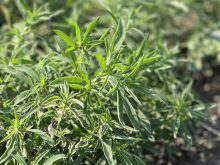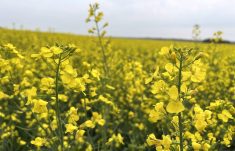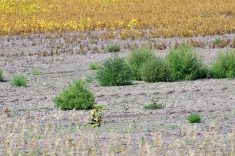

Glacier FarmMedia – Kochia is one of the fastest-spreading and most resistant weeds common in canola. The key is to control it before it sets seed, experts say, and that means striking when it’s small.
Herbicide resistant kochia has been a management headache for growers across the Prairies.
Pre-seed burnoff is the first tool in the fight against baby kochia, stressed one agronomist with the Canola Council of Canada.
Read Also
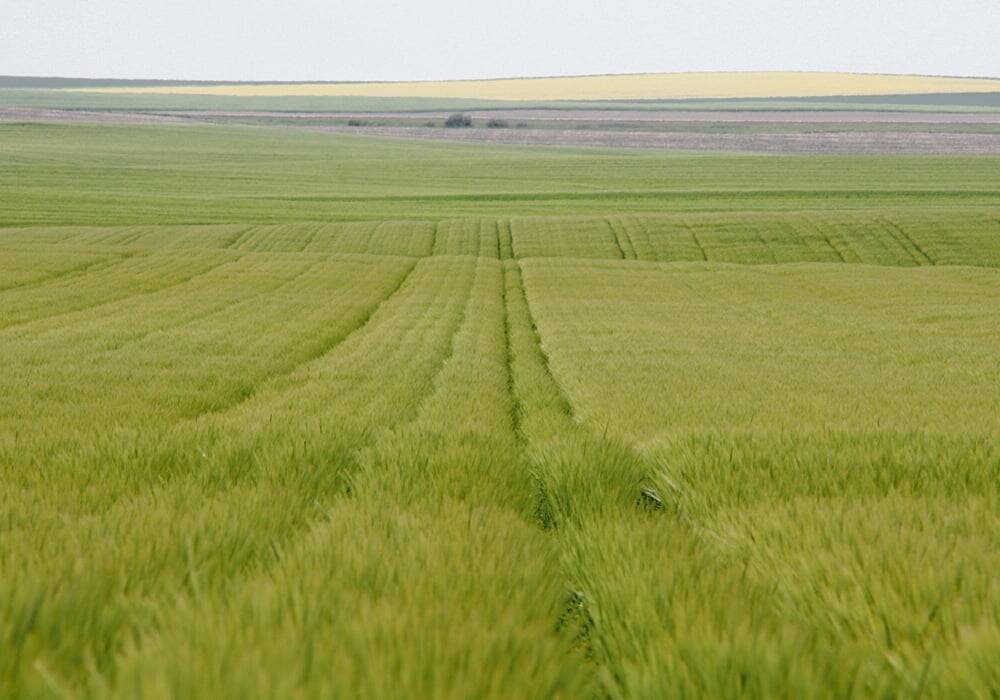
VIDEO: Manitoba farmer tests controlled traffic farming to fight soil compaction and flooding
Manitoba farmer Alex Boersch wants to improve the stability of his crop yields. He’s been experimenting with controlled equipment traffic on his fields
“Kochia is easier to control when it’s smaller, so it’s a matter of the earlier, the better to get control of it,” said Shawn Senko.
An appropriate tank mix is crucial to effective pre-seed burnoff. Glyphosate alone is not a good idea. Using two modes of action improves weed control, particularly for cleavers and kochia.
“If you’re using glyphosate, make sure you’ve got something else in there,” said Senko. According to the canola council, effective tank mix options ahead of canola include Group 6 bromoxynil and Group 27 topramezone.
Chemical choices are limited for kochia. Group 9 resistance is now so widespread in Western Canada that experts recommend producers assume any kochia in their fields already has it.
Group 2 resistance has been found all over the Prairies, while Agriculture and Agri-Food Canada has also confirmed populations of Group 4 and Group 14 resistance.
In-crop, the only herbicide option said to work on Group 2- and Group 9-resistant kochia is an early (prior to canola’s two-leaf stage) application of Liberty on Liberty Link cultivars.
“Group 10 glufosinate in Liberty will control all resistant populations as long as plants are not too large to kill at the time of spraying,” said Senko.
Producers using Roundup Ready or TruFlex canola systems may also benefit from cultivars with “stacked” systems such as a combination of TruFlex and Liberty Link.
“That way, if you have kochia, you’ve got Liberty to come back in and clean up the kochia problem.”
The first post-burnoff step is scouting for surviving kochia plants. However, wait long enough to make sure the herbicide has had time to work, said Senko.
Scouting will show which controls were effective and which weren’t, so tactics can be altered in the following year.
“There’s an option to go back in there and do something to control [kochia] this year. But you also know you’ve got resistance to whatever chemistry you were using for future years, so you’re going to have to have a different strategy next time you come in there,” he said.
If there are patches where kochia is dominant and canola is unlikely to grow, mow or hand-weed before the plants set seed.
“Mowing it out stops seeds on that patch for the season,” said Senko. “Hand-weeding could be worthwhile in areas where individual resistant [or likely resistant] plants are present.”
Seed destroyer
Although new to Western Canada, a combine-mounted weed seed destroyer can be an invaluable killer of kochia at harvest, said Senko.
These Australian-developed devices pulverize at least 90 per cent of kochia seed in chaff coming out of the combine, rendering it unable to produce new plants.
“They’re fairly new,” he said. “They’re really common in Australia due to some of their resistance issues presenting no other options for controlling some of the weeds.”
A fall application of Group 3 ethalfluralin (commonly known as Edge) can help control soil-borne kochia in fields earmarked for canola the following spring.
Although Edge can also be applied in spring before planting, fall application is usually a better option, said Senko.
“It needs some time and some moisture to activate. There is an option for spring applying but it needs to be before seeding and a lot of times we’re pretty ground down during the spring.”
Be aware that Edge application is not intended to control mature, growing kochia.
“It’s for any flushes coming after the application,” Senko said.
Growers may also want to consider long-term, non-chemical management strategies. For example, patches of high-salt soil are very kochia-friendly. Planting salt-tolerant grass may provide the competition needed to drown it out.
“Kochia is really good at handling drought and is very salt-tolerant. If you have a field where nothing else will grow, kochia can thrive, produce a lot of plants and a lot of seed that spreads over the rest of the field,” said Senko.
“You could seed kochia-infested areas to salt-tolerant perennial forage rather than continue to throw inputs at acres with no hope of profitability.”
Other options include diversifying crop rotations with early- and late-seeded crops (winter cereals and forages, for example) to kickstart early season competition, he said.
Tile drainage can help tackle salinity problems by draining water that isn’t flowing naturally.
More information on kochia control is available on the Canola Encyclopedia and Canola Watch websites, both available at canolacouncil.org.
– This article was originally published at the Alberta Farmer Express.