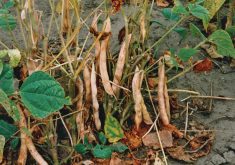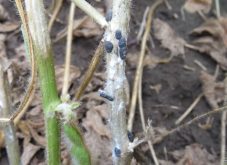

Scientists studying the two major root rot problems for pulses in Western Canada have had small victories, but good chemical control is still a ways away.
“I think it is really important to emphasize that it’s a complex issue and complex issues just take time,” said Sabine Banniza, a professor of plant pathology with the University of Saskatchewan.
Research into root rots like aphanomyces and fusarium is like studying ways to beat cancer in humans, she said. It’s a big job.
Read Also
VIDEO: Seed less canola, harvest more? Bourgault field trials say it’s possible
Bourgault field trials tested canola seeding rates as low as 1.25 pounds per acre and found individual plants grew larger with stronger roots.
“Researchers have worked on (cancer) for decades and it’s not as if we are cancer-free by now. So some of these really complex diseases in plants also require a lot of time to get a handle on them.”
Why it matters: Diseases like aphanomyces require long rotations to manage, hitting at potential pulse acres and production on the Prairies.
In the meantime, she said, researchers need producers to use all the best practices in their toolboxes — particularly effective rotations — to hold the soil-borne diseases at bay.
“They have to be more aware of rotational impacts on root rots if they have infected fields, and then act accordingly,” she said.
”I totally understand that there are always economic drivers in making decisions on what crop to grow, but maybe there should be a little bit of a question about short-term benefit versus long-term risk.”
In the win column
In one of the biggest breakthroughs of the last few years, researchers found that many species of fusarium are actually “complexes” of several fusarium species. Combined, they can cause more damage than a single species.
“We knew that aphanomyces, Fusarium avenaceum, Fusarium solani and Fusarium oxysporum are the main pathogens on … pea and lentil,” said Banniza.
Her focus is F.solani and F.oxysporum.
“There are four separate species that were thrown together in the past and called Fusarium solani,” she noted.
F.oxysporum is also a complex of various fusarium species.
The specific fusarium species might not mean much for the farmer in the field right now, but it’s invaluable information for breeding resistance, she said.
“It’s very important for us to understand whether we are dealing with one species or whether we are dealing with four species. We now have to figure out whether all of these species equally infect all of the pulse crops or not,” she added.
Wheat in the equation
Several fusarium species, particularly F.avenaceum, are also wheat diseases.
A group of scientists with Agriculture and Agri-Food Canada (AAFC) in Lethbridge is isolating F.avenaceum from wheat and then inoculating those isolates onto pea and lentil to see if the same isolates virulent on wheat are also virulent on the pulses. The concept also works the other way, with F.avenaceum from pulses giving insight into the pathogen’s behaviour on wheat.
“That is really the important information for breeding and also for agronomy, because that may influence rotations,” Banniza noted. “If you have different populations on wheat and on pea and lentil, maybe then the rotation can still have some effect on at least not increasing F.avenaceum from pea and lentil where you’ve grown wheat.”

Genetic gains on aphanomyces?
Another significant achievement has been the development of pea lines with partial resistance to aphanomyces.
Resistent varieties would be a game-changer for the crop. Historical best practices have said that, if a field is infected with aphanomyces, the farmer might need to skip seven or eight years between pea crops.
There is still a lot of work before pea genetics reach that bar, the Saskatchewan researcher said.
“It’s only last year that we were able to do the first screening in the field. They do reduce root rot, but only a little bit because they are not resistant to the fusarium species.”
Unfortunately, Banniza and her USask colleague, Tom Warkentin, found this first generation of partially resistant peas lacking in yield potential. That can be explained by the narrow focus of the project, said Banniza.
“This was a research project focused solely on resistance and not yield or lodging or any of the other traits that you want to see in an elite pea variety. You can only do that in the context of the general breeding program. This was a research project very much focused on moving the resistance into the background of our varieties.”
Banniza said there will only be a dramatic reduction in root rot once researchers find a way to combine resistance to aphanomyces, F.avenaceum, F.solani and F.oxysporum.
“That’s what Tom Warkentin is doing now. He’s started to combine the aphanomyces root rot resistance with Fusarium avenaceum resistance,” she said.
Multi-pronged attack
They’re not the only research team taking aim at aphanomyces and other root rots.
In 2016 and 2017, an AAFC Lethbridge study led by Syama Chatterton studied a variety of chemical seed treatments on pea crops at Lethbridge and Taber, Alta. None were found to be a viable solution.
A Japanese fungicide seed treatment called hymexazol, registered in the U.S. for sugar beets, turned out to be the only tested chemical to control some forms of root rot, but was deemed too expensive in the context of Western Canada’s pulse and wheat industries.
Other than that, the best chemical contenders can control root rot when combined with something else. Rancona Trio — a seed treatment registered in Canada for early season suppression of aphanomyces in lentils, peas and faba beans — is one such example.
Chatterton tested the product (a combination of carbathiin, metalaxyl and ipconazole active ingredients) in 2021, 2022 and 2023 on fields in five locations (Lacombe and Taber in Alberta and Redvers, Scott and Swift Current in Saskatchewan).
She investigated Rancona Trio on its own, as well as combined with partially aphanomyces-resistant pea germplasm from Europe.
The first two years were a bust. Sites were too dry for the moisture-loving pathogen. In the third year, though, they saw significant reduction of disease at four out of five sites, but only when the treatment was combined with the European pea germplasm. Results appeared to go beyond suppression and into active control of root rot.
“As we move towards releasing pea varieties with some partial resistance, maybe Rancona Trio will be an option to improve root rot problems,” said Banniza.

Michelle Hubbard, also a researcher with AAFC Lethbridge, has tested several products and combinations of products — including lime, gypsum and MustGrow (a mustard-based product that controls soil-borne pests and diseases in fruits and vegetable crops) — throughout Alberta and Saskatchewan. Her results have found highly variable suppression, but it’s unclear what might have happened if partial resistance was added into the picture.
Banniza hopes a five-year strategic research initiative supported by the Saskatchewan government, Research Driven Agriculture Research, the Western Grains Research Foundation and provincial pulse grower organizations will allow more chance to investigate these potential solutions.
The grower organizations include Saskatchewan Pulse Growers, Alberta Pulse Growers and Manitoba Pulse and Soybean Growers.
“Michelle will be looking at combining treatments like gypsum or lime or MustGrow and then, once we have more (pulse) lines with partial resistance, combining partial resistance with these treatments,” Banniza said
Ultimately, she doubts there will be a “single-tool solution” to aphanomyces and fusarium root rots.
“It will be a more complicated way of management that will involve resistance. It will involve, hopefully, some seed treatments or soil treatments, and so it will be more complex than just going out and liming or whatever.”
Another major component of the initiative will be a long-term rotation study across several sites in Saskatchewan. This goal is to gather data on the effects of six- to eight-year rotations.
“It’s to look at what exactly is happening over six years or eight years in these locations, because we really don’t have any hard data from Saskatchewan on that,” said Banniza.