A quantum leap in wheat yield could be on the horizon for Prairie farmers.
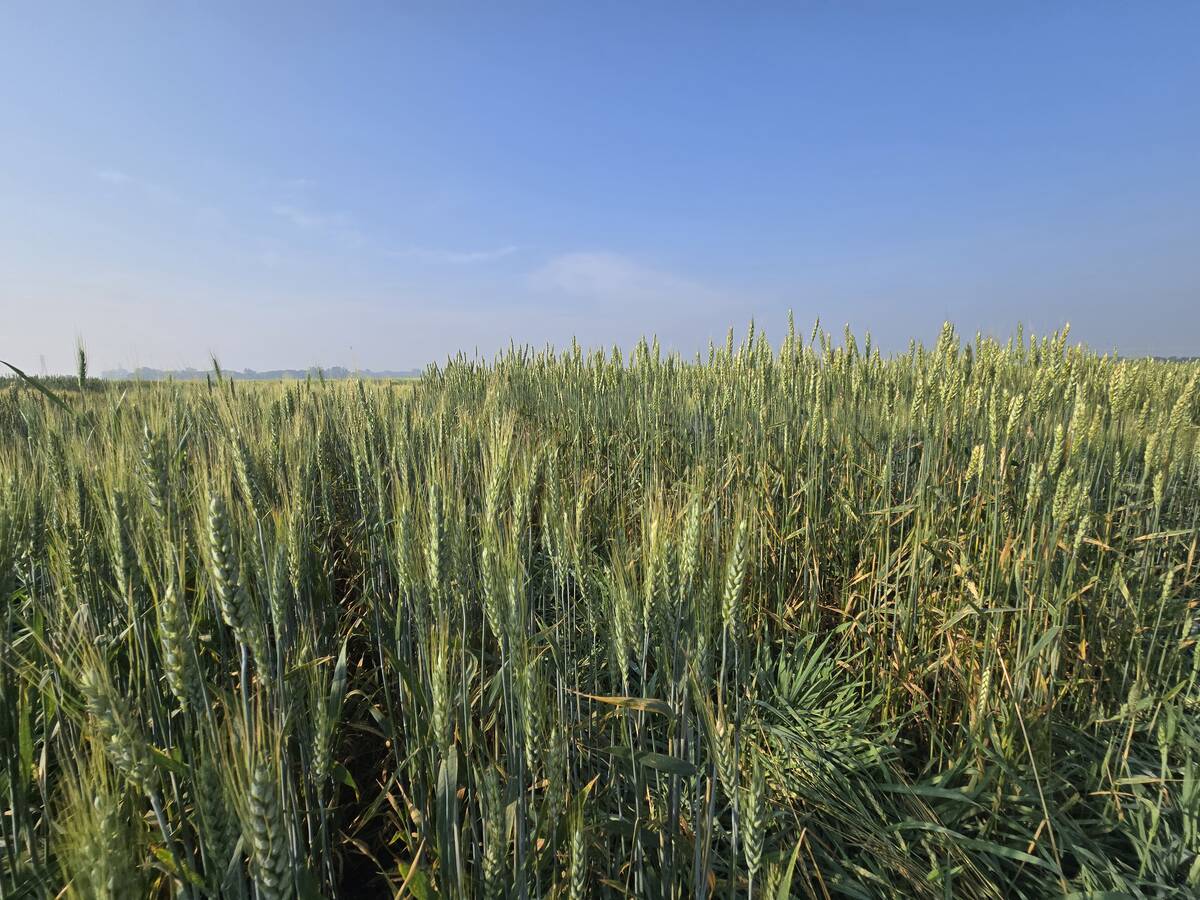
Three experimental wheat varieties developed by Agriculture and Agri-Food Canada are showing yield increases of eight to 15 per cent over AAC Brandon wheat in registration trials, with two varieties potentially reaching commercial markets within two years.
The varieties, designated BW1167, BW1170, and BW1174, are in their second year of testing at 12 locations across the Prairies as part of the Central Bread Wheat registration trial process.
Read Also

VIDEO: Seed less canola, harvest more? Bourgault field trials say it’s possible
Bourgault field trials tested canola seeding rates as low as 1.25 pounds per acre and found individual plants grew larger with stronger roots.
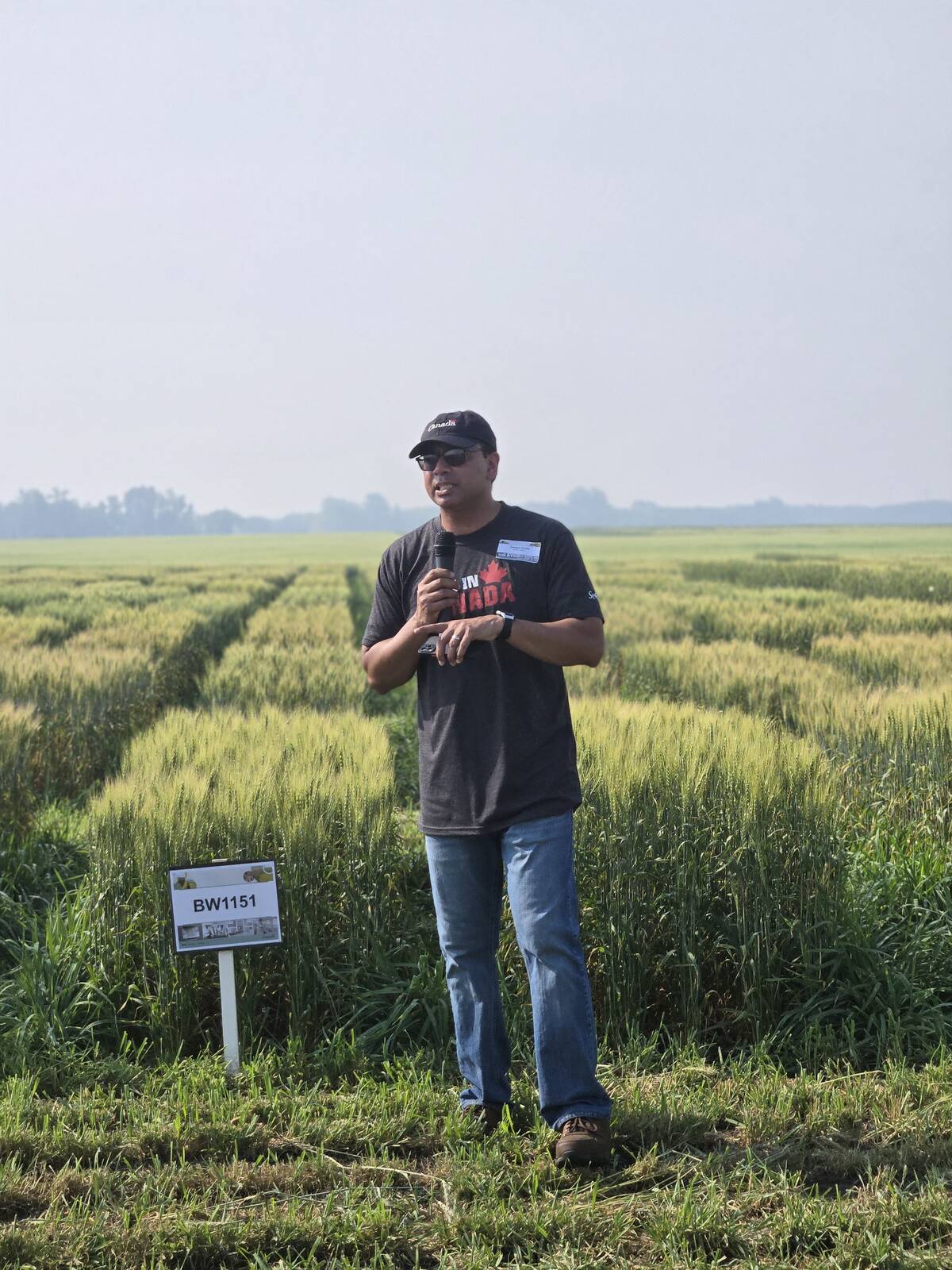
Santosh Kumar, a wheat breeder with Agriculture and Agri-Food Canada, presented the results during a field tour at research plots near Brandon on Aug. 7. The tour was part of the agency’s “Ahead by a Century” celebration marking 100 years of plant disease and breeding research in Manitoba.
WHY IT MATTERS: Three experimental wheat varieties from Agriculture and Agri-Food Canada are outperforming AAC Brandon yield by up to 15 per cent in Prairie trials, with two potentially reaching farmers within two years.
BW1167, currently in its second year of testing, is a cross between Canadian line BW1052 and North Dakota line ND820.
“It’s 15 per cent high yielding than Brandon. It has similar maturity to Brandon. It’s two centimeters taller,” Kumar said.
The variety shows strong disease resistance, including against leaf rust, stripe rust, stem rust.
BW 170, a sister line from the same cross, also shows 15 per cent higher yields than Brandon while being just a bit shorter than BW1167. Both varieties are resistant to midge, a significant pest in the region.
A third variety, BW1174, developed through double haploid technology, shows eight per cent higher yields than Brandon despite being susceptible to midge.
“Even then, eight per cent higher yielding than Brandon is a decent yield advantage,” Kumar said.
Yield comparisons come from the Central Bread Wheat registration trial, where approximately 30 entries are tested annually at 12 locations across the eastern Prairies for three years, Kumar said.
“Multiple locations are tested across the Prairies, and then data is now statistically analyzed to figure out which variety has done well every year across all locations.”
Recently released AC Rivers wheat now yields 11 per cent higher than Brandon, according to registration trial data.
Technology advances breeding timeline
Double haploid technology is changing wheat development timelines, Kumar said. Traditional breeding takes seven to 10 years to reach uniformity, while double haploid technology achieves the same result in one year.
“That’s the technology we use to create the haploids and then use a chemical called colchicine to double the genome,” Kumar said.
However, Kumar noted that double haploids now comprise only 25 to 30 per cent of his program, down from 50 per cent.
“Because of the changing environment, the climate change, disease pressure is changing. We have to now do a little bit of a wider cross,” he said.
Historical genetic resource
The tour began at the Grow Canada population, featuring 350 wheat varieties from the 1900s to 2023. Kumar described this collection as genetic resource material.
“GROW stands for Genetic Resource of Wheat for Canada,” Kumar said.
Despite their appearance, with many plants tall and showing disease symptoms, their value for drought tolerance is high, Kumar said.
“A lot of the plants that are very tall, they have very deep root system, [which] helps in drought. They have a lot of waxiness to them. Some of them are really purple in colour, and that’s where the drought loss tolerance will come, because the wax layer prohibits water loss.”
The collection serves multiple research programs, with teams from the University of British Columbia studying the population in Saskatoon and Manitoba researchers using it for pre-harvest sprouting studies.
Disease resistance priority
Kumar and other research scientists are also focused on breeding genetic disease resistance to reduce fungicide dependence.
“In our breeding program, we try to give you the genetic resistance so you don’t need fungicides,” he said.
There are five priority diseases for wheat that Kumar considers: leaf rust, stem rust, stripe rust, fusarium head blight and common bunt.
“Every variety should have an optimum level of resistance before it’s actually released as a variety,” Kumar said.
However, there is a trade-off that’s involved in stacking multiple resistance genes.
“Plants are not very efficient,” Kumar said. “If I …bring in too many traits, now it’s a drag on the plant.”
Public breeding program goals
Public breeding programs play an important role in providing farmers with choices, Kumar said.
“That’s the beauty of it. In public breeding, we do not cater for the largest acres. We want to provide options, as many options as we can so that every farmer has a choice.”
This approach produces varieties with different trait combinations, including both midge-tolerant and midge-susceptible options for farmers in different regions.
Looking ahead
BW1151, derived from the same cross that produced AAC Spike but developed through traditional breeding methods, will be ready for public release next year. This variety shows a 6.5 per cent higher yielding than Brandon, Kumar said.