WHY IT MATTERS: Soil compaction is a major problem on many farms. Controlled traffic farming — where equipment follows the same tracks across a field every pass — could be a practical solution, but few Canadian producers have tried it.
Read Also
Canada’s cereal breeding system is failing. Who fills the gap?
Agriculture Canada breeds 80 per cent of Canada’s wheat varieties. A new report says that system in no longer sustainable — and without a transition, some crops could quietly disappear from Prairie fields.
Alex Boersch likes to experiment. A couple of years ago, the Elie, Man., farmer became the first producer in Canada to try Nexat, a unique piece of machinery capable of seeding, harvesting and other field tasks. From there, he started experimenting with controlled traffic farming — the practice of routing all equipment along the same tracks across a field to minimize soil compaction.
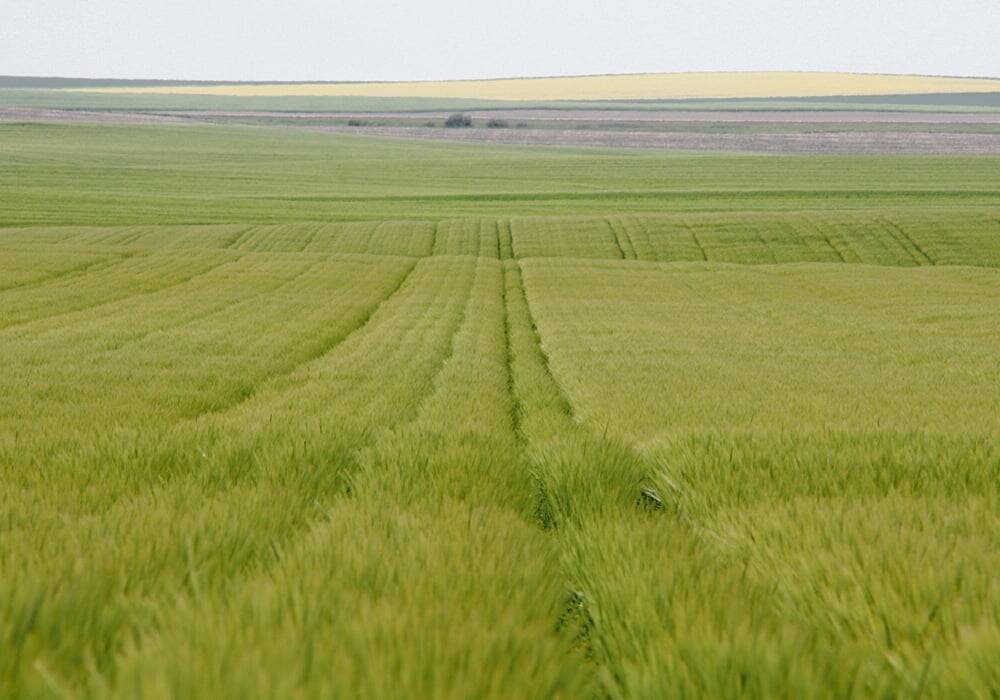
Neither experiment worked out exactly as planned. But Boersch is determined to keep going with controlled traffic because he’s convinced it can improve water infiltration and stabilize yields on his family’s heavy clay ground.
The water problem
Boersch farms with his wife, parents, sister and brother-in-law in a region of heavy clay soil about 30 kilometres west of Winnipeg. When 75 millimetres of rain falls in a day, most of that water runs off their land. Runoff from neighbouring farms compounds the problem, causing water to pond on their fields.
“We’re getting similar amounts of rainfall (as in the past), but we’re getting it in really big weather events,” Boersch said.
He tried cover crops, intercropping, long rotations and biologicals to improve water intake. None had the desired result. So he turned his attention to controlled traffic farming.
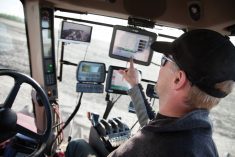
“We all have the GPS technology to do this. How can controlling your compaction be a negative?” Boersch said at St. Jean Farm Days in January.
“We know we have a hard pan in our soils at 12 to 18 inches.”
What research says about controlled traffic farming
Boersch isn’t the only prairie farmer interested in controlled traffic. Jamie Christie, who runs a 5,000-acre operation near Trochu, Alta., was part of an Alberta research project about 10 years ago that evaluated the benefits of the practice at multiple sites.
The project found that controlled traffic farming increased crop yields by 2.2 per cent on average — a modest gain. But the researchers noted other significant benefits: improved timeliness and efficiency of field operations, and new agronomic opportunities such as in-crop nitrogen application and on-row fungicide treatments.
Both Boersch and Christie shared their experiences during a panel discussion on controlled traffic farming at the St. Jean Farm Days show in January.
Why Nexat didn’t work out
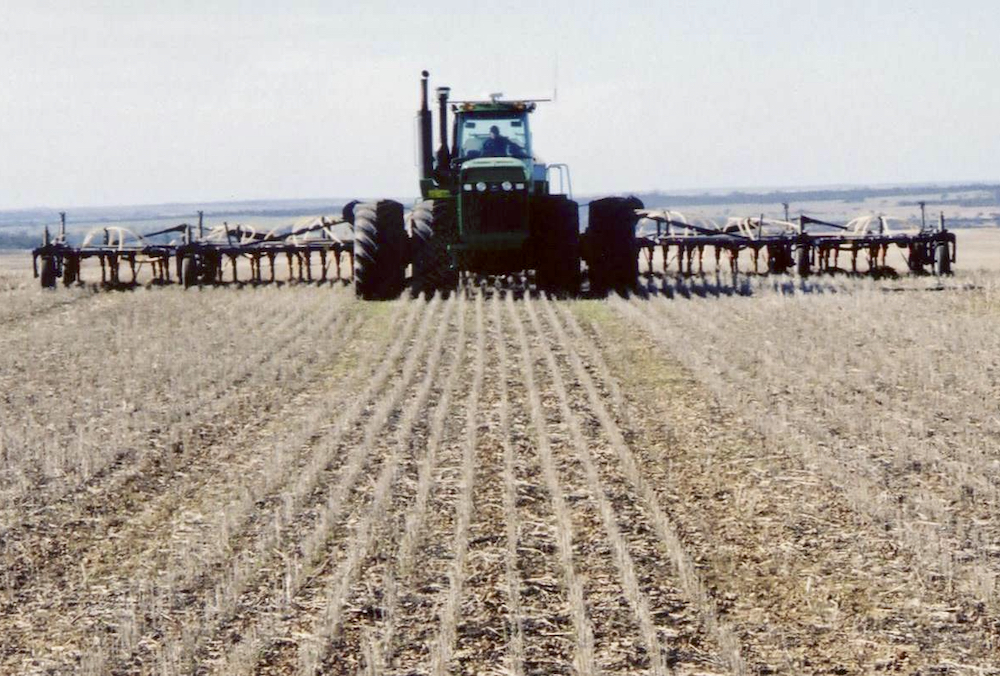
The Nexat system is purpose-built for controlled traffic. It handles seeding, spraying, harvesting and other tasks, and roughly 95 per cent of the field surface remains untouched because the machine always follows the same path.
Boersch found it worked exceptionally well for seeding. The problems came at harvest. Consistent rains in August left the land around Elie soaked, and the heavy clay couldn’t handle the weight of the machine plus a full load of grain.
“It was sinking a bit too much. … When that combine is full (of seed), this whole thing weighs 80 tons,” he said.
He shared photos of ruts 20 to 25 centimetres deep on his fields — ruts that got worse on the second pass. There are ways to remediate compacted traffic paths, but Boersch and his family decided to pursue controlled traffic farming without the Nexat.
The pivot: same concept, different gear
Instead of the Nexat, Boersch plans to achieve controlled traffic using his existing fleet — or possibly some new equipment — to match implement widths and lock in consistent 40-foot traffic lanes across his fields.
“Our ultimate goal is 40-foot controlled traffic. Right now, the only issue holding us back is we have a 60-foot seeder,” he said. “We need to shift a few different implements around.”
His initial 18-month experiment wasn’t long enough to show significant changes in soil compaction or water infiltration. Based on the research he’s reviewed, it takes several years of consistent controlled traffic to make a measurable difference.
Boersch expects to know by 2028 or 2029 whether controlled traffic farming is reducing flooding and improving water infiltration on his farm. The upfront investment is real — reconfiguring implement widths and committing to permanent traffic lanes — but so is the potential payoff: less compaction, better water management and more consistent yields on heavy clay ground.