Applications of nitrogen, phosphorous and potassium are commonplace for grain producers and play a key role for plant growth. But in recent years, new products have been claiming to provide micronutrients and are being marketed to producers who want a boost.
These products and claims were the motivation for a SaskOilseeds-funded project investigating micronutrients. The product claims come from internal research at the fertilizer companies, and are not available for the public. This project aims to fill the gap and answer questions that producers may be having about micronutrients.
WHY IT MATTERS: Micronutrients have gained more attention as research hones in on their role in plant development and new technology makes analysis more applicable and accessible for farmers.
Read Also
White mould control requires flexible timing under Prairie conditions
Fungicide timing for white mould depends on canopy development, disease risk and number of planned applications, North Dakota pathologist Michael Wunsch told growers at CropConnect 2026.
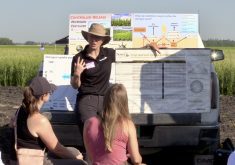
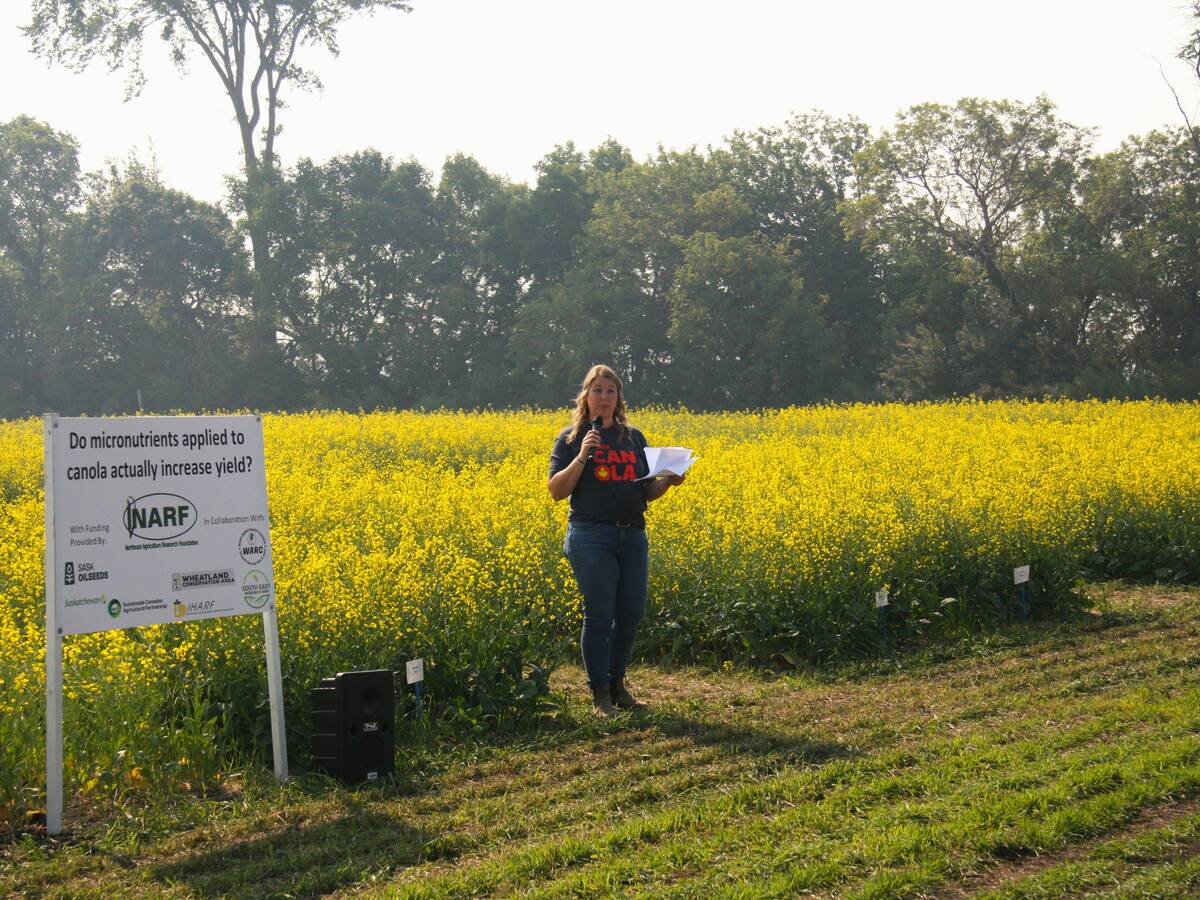
The project looks specifically at the micronutrients of boron, copper, and zinc within canola crops. Kaeley Kindrachuk, a canola extension specialist with SaskOilseeds presented the ongoing trial at the Northeast Agriculture Reseach Foundation (NARF) field day on July 23 in Melfort, Sask.
“We wanted to look at whether or not micronutrients increase yield,” she said.
“But we really wanted to demonstrate the yield and quality response of canola to in-furrow and foliar applications of different micronutrients in different parts of the province.”
Micronutrients and crop growth
NARF is one of five trial sites across Saskatchewan, with others at research farms near Scott, Swift Current, Redvers, and Indian Head. The variety of locations is also to compare results in different soil conditions, as micronutrients could be deficient in sandy soils, high organic matter soils and soils with high pH.
The choice to study these minerals comes with the important role they play regarding the plant life cycle in which each fulfills a different role.
Boron is important for plant metabolism and pollen production, and has been the most researched micronutrients in canola.
“Some of that research suggests that canola is able to utilize boron more efficiently through the leaves of the plant, rather than the roots,” Kindrachuk said.
“Boron applied to the soil may also become bound to the organic matter in the soil, making it less bio-available, or if it leaches down the soil profile, it becomes less available to plants.”

Copper has also been well researched, and it’s suggested that if soil has low copper, polyps will form on the roots. It’s also been noted that copper can have a positive effect on yield, but only when the soil was showing deficiency and if there was manganese present in the soil.
However, when it comes to zinc, very little research has been done.
Kindrachuk noted that while it’s uncommon to see a zinc deficiency in canola, if a soil’s pH is high and there’s been high rates of phosphorous applied over the years, these two factors could inhibt zinc “translocation.” This is a likely situation since, throughout Canada, there is a utilization of high rates of phosphorous.
The Melfort site is low in boron, while Indian Head is low in zinc, and Swift Current is low in zinc and boron. This was identified via spring soil sampling. Additionally, tissue samples were taken once stands were established.
Study details
This is the first year of the study, and it utilizes seven treatments. A control plot, then in-furrow application of each micronutrient and a foliar application of each.
Every plot was seeded with the variety PV660 at seven pounds per acre and target seeding rate of 160 plants per square meter on May 22, and they mid-banded nitrogen and side-banded phosphorous and sulfur.
“For the micro products, we used Granubor at one kilogram per hectare for boron, copper sulfate at two kilograms per hectare, and zinc sulfate at five kilograms per hectare.”
For foliar application, they used ALPINE MicroBolt applied at one liter per acre on the July long weekend.
While it’s tough to say what kind of results will be noted, since it’s only year one, Kindrachuk noted the plot has filled in well and is looking good following the rains that had recently hit the area.
Key results of the first year will be analyzed in later winter or early spring.