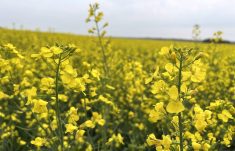
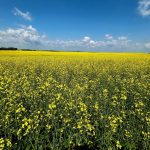
The Canola Council of Canada has joined the Honey Bee Health Coalition, a North American coalition of more than 30 organizations, in the hopes of improving pollinator numbers.
“We’re really dependent on pollinators to have seed stocks for this 20-million-acre industry, so obviously we want that relationship to continue,” said Gregory Sekulic, who represents the council at the coalition.
“In the biggest terms, I want to stress that canola and pollinators actually have a pretty fantastic relationship to begin with, they pollinate seed stock for sure… as well as contributing to yield of commodity canola as well,” he said.
Read Also
White mould control requires flexible timing under Prairie conditions
Fungicide timing for white mould depends on canopy development, disease risk and number of planned applications, North Dakota pathologist Michael Wunsch told growers at CropConnect 2026.
Commodity canola visited by pollinators like honeybees can see yield increase by as much as five to 15 per cent, he added.
The time it takes for canola to reach maturity can also be reduced by as much as four days when bees are present in the canopy.
“Bees tend to do very well on canola,” said Shelley Hoover, an Alberta-based apiculture researcher. “The crop has profuse blooms and nutritious pollen high in protein as well as fat, and with all the amino acids bees need to complete their life cycle… bees can produce quite a good honey crop off of canola.”
As a coalition member the canola council will now take part in the group’s “Bee Healthy Roadmap,” which lays out specific priorities and actions to achieve and maintain a healthy honeybee population.
Those priorities fall into the following areas: improving hive management, forage and nutrition, crop pest management, cross-industry education, outreach, and co-ordination.
Sekulic noted that seed money for the coalition was provided by Monsanto in 2013, but all members now contribute, either financially or through in-kind contributions.
The U.S.-based not-for-profit Keystone Centre now facilitates the coalition, which includes the American Beekeeping Federation, Canadian Honey Council, Ducks Unlimited, Eastern Missouri Beekeepers Association, Bayer CropScience, CropLife America, Syngenta, DuPont and others.
“It’s a pretty fair cross-section,” Sekulic said, adding that he hopes the coalition will result in goodwill and opportunities for informal discussion between members.
No one representing beekeepers in Ontario, a province where a $450-million lawsuit against Bayer and Syngenta regarding the manufacturing of neonicotinoids is pending, has joined the coalition.
Sekulic said anyone surprised to see companies like Syngenta coming together with beekeeping and commodity organizations under one umbrella, like the Honey Bee Health Coalition, may not fully understand the common goals around keeping pollinators and their ecosystems healthy.
“I would attribute that to a lot of the misinformation that’s happened about agriculture,” he said.