WINNIPEG — About 65 per cent of Canadian farmers think they’re following 4R practices.
In reality, fewer growers are meeting the standards of the nutrient stewardship program.
Less than 13 million acres were 4R compliant in 2024, said the 2024 Fertilizer Use survey from Fertilizer Canada, which was published in March.
Read Also
Selecting IDC-tolerant soybeans doesn’t reduce yield, Manitoba study confirms
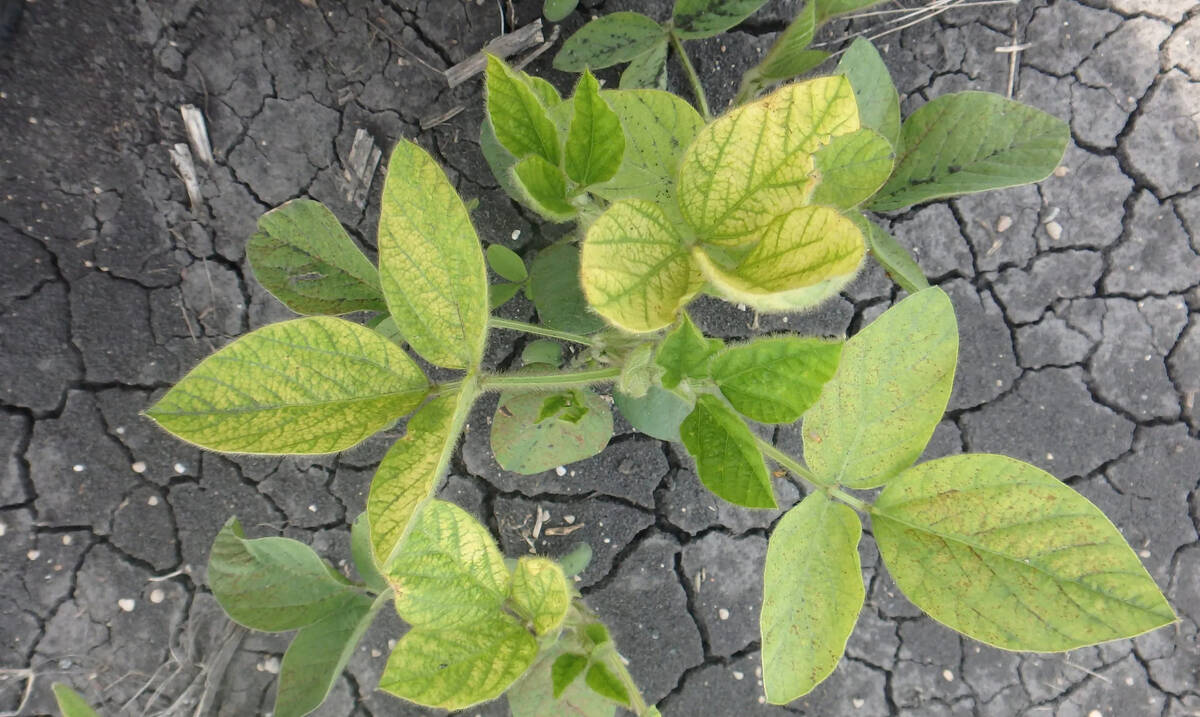
University of Manitoba research shows soybean varieties selected for iron deficiency chlorosis (IDC) tolerance protect yield in affected areas without reducing performance elsewhere in the field.
WHY IT MATTERS: Guessing at nitrogen rates costs farmers money — either through wasted fertilizer or lost yield — and puts the industry on weaker ground as federal emissions pressure builds.
The online survey, conducted from November 2024 to March 2025, asked 1,258 farmers about fertilizer use.
Many of the questions focused on the 4R program, known as Right Rate, Right Time, Right Place and Right Source.
By following 4R nutrient stewardship practices, farmers can optimize their use of fertilizer.
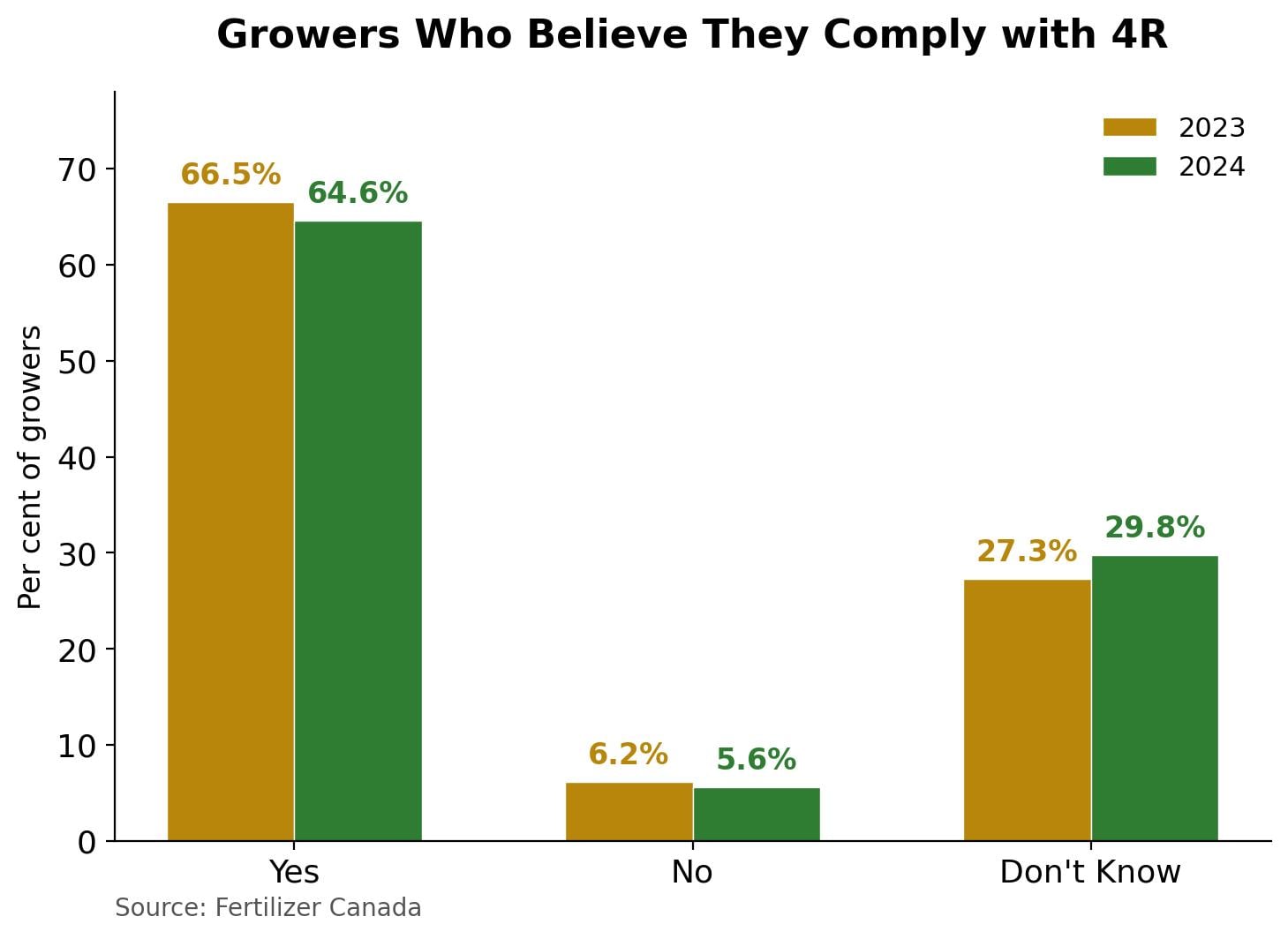
The large gap between growers who think they’re using 4R and those who are meeting the requirements is often explained by two things:
- Many growers aren’t satisfying the Right Rate criteria.
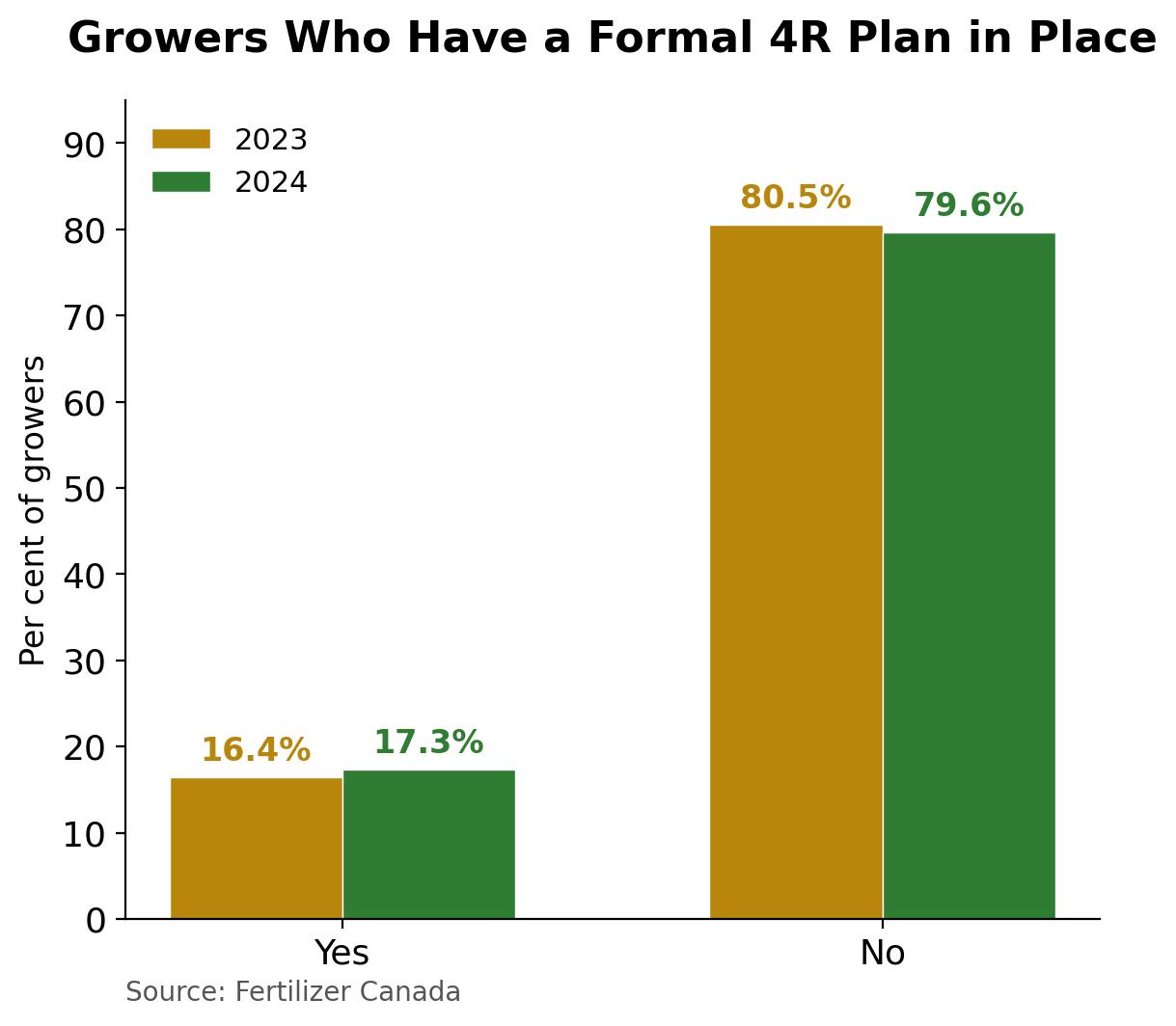
- Many farmers don’t have a formal 4R plan.
Soil testing gaps drive the shortfall
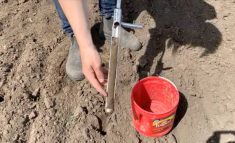
To meet the Right Rate standard, growers need to regularly test their soil for nitrogen. Without data on residual nitrogen, it comes down to guesswork when trying to apply the appropriate nitrogen rate.
However, the frequency of soil testing on Canadian farms isn’t all that frequent, the survey found:
- Sixty-one per cent of growers test their soil for nitrogen every year, every second year or once in three years.
- The remaining 39 per cent will test every four to five years, or less often or never.
Too much nitrogen on canola acres
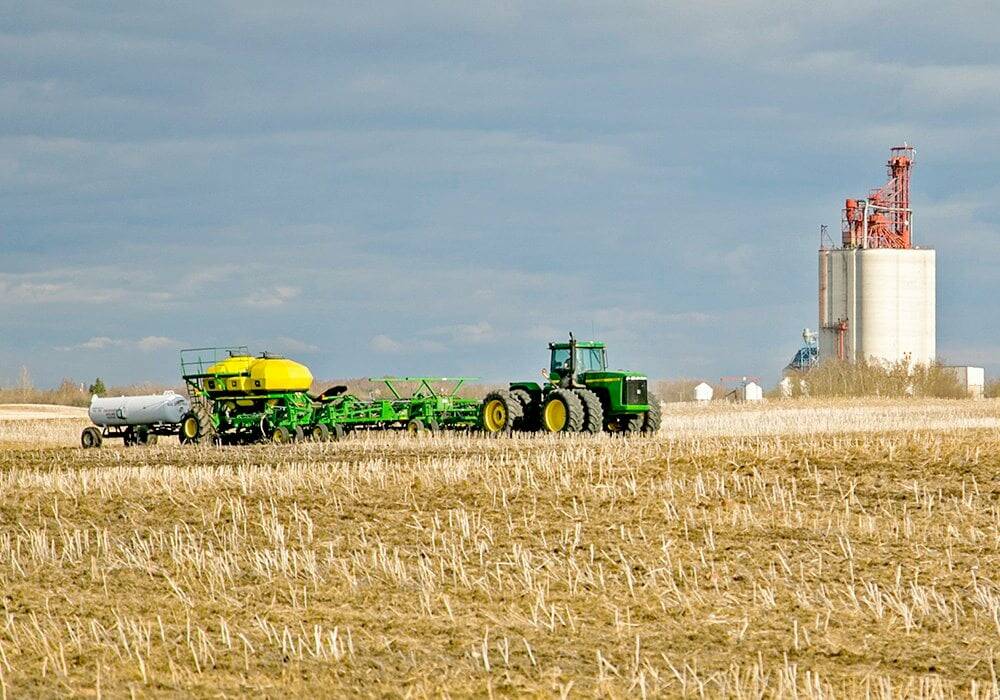
The data explains why some growers are using the wrong rate of nitrogen for a particular field. Agronomists in Saskatchewan have noticed that some canola growers are applying too much nitrogen.
They are trying to “bludgeon” the crop with fertility, said Mike Palmier, an MNP agronomist in Plenty, Sask.
“In lots of cases, I’m seeing upwards of 140 to 160 pounds of nitrogen (applied) to produce 50 bu. canola,” he said.
“That math just doesn’t add up.”
Fertilizer Canada doesn’t have field specific data on rates in order to know if farmers are applying too much nitrogen.
In an email, Fertilizer Canada said only 34 per cent of canola acres met the Right Rate criteria in 2024, which means those growers followed all the necessary steps to determine the rate.
Other farmers could be using the proper rate of nitrogen, but they “omitted one or more of the formal steps” to identify the right rate, said a Fertilizer Canada spokesperson.
So, there’s room for improvement to match nitrogen rates with crop demand and specific field conditions.
More growers turning to enhanced efficiency fetilizers
The Fertilizer Canada survey found that more growers are using enhanced efficiency fertilizers.
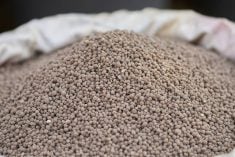
The products can cut nitrogen losses, through leaching or to the atmosphere, and reduce greenhouse gas emissions from fertilizer.
For most cereal and oilseed crops, the percentage of acres with an EEF jumped in 2024 compared to 2023.
- For feed barley: use went from 9.8 per cent to 46 per cent.
- For most other crops: the increase was three to eight per cent.
The adoption is likely related to a federal program that pays farmers for trying EEFs.
Federal dollars cover the extra cost
The On Farm Climate Action Fund provides $300 million in funding, from 2025 to 2028, to farmers who try cover crops, rotational grazing in livestock and new ways to manage nutrients.
Those payments are needed to encourage use because EEFs cost more than urea and other nitrogen fertilizers.