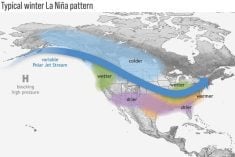
La Niña, a weather phenomenon usually linked to heavy rains and flooding in Asia-Pacific and South America and drought in Africa, seems to have reached its peak and is expected to fade between March and May, the World Meteorological Organization (WMO) said Feb. 10.
A weak to moderate La Niña pattern has cooled the tropical Pacific since around October, a considerably weaker event than in 2010-11, the United Nations agency said in a statement.
“Model forecasts and expert interpretation suggest that the La Niña is near its maximum strength and hence is likely to slowly decline over the coming months,” the WMO said.
Read Also

Student agronomy challenge coming to Assiniboine College
The Prairies’ first agronomy competition brings together post-secondary ag students for hands-on crop advising challenges at Assiniboine College in Brandon, Man.
“However, beyond May, there is some uncertainty over the expected state of the Pacific Ocean, with no particular preference for El Niño, La Niña or neutral conditions,” it said, referring to its opposite phenomenon which warms the Pacific.
There was a “wide range” in the model forecasts for the period beyond May, and even the redevelopment of La Niña cannot be ruled out, it added.
Conditions in the Pacific Ocean would be closely monitored throughout the rest of the year, it said.
Changes in sea surface temperatures in the tropical Pacific are “strongly linked to major climate fluctuations around the globe,” which can last for a year or more, according to the WMO.
La Niña periods are often associated with heavier rains across large parts of Australia, the Philippines, Indonesia and Thailand, it says. They are also generally linked to increased rainfall in southern African countries and parts of West Africa, but other factors influence climate patterns.
The La Niña will likely dissipate this spring, but farmers in the southern United States and South America will have to contend with lingering dryness as they plant corn, soybeans, cotton and coffee.
The U.S. Climate Prediction Center (CPC) said in its monthly update recently that computer models favour “a return to neutral conditions during the Northern Hemisphere spring, which are likely to continue into the summer.”