Nutrien says farmer interest is growing in its program to pay them for reducing nitrogen losses.
In 2021, the program started with 42 growers and 42,000 acres. By 2024, the program had grown to 146 growers and roughly 700,000 acres across western Canada.
WHY IT MATTERS: Farmers are increasingly being urged to be efficient with their fertilizer, both for their own bank accounts and due to sustainability pushes.
Read Also

Iran war volatility sends shock waves through agricultural markets
Here are the numbers on how badly fuel, fertilizer and grain markets have been thrown for a loop by the conflict in Iran so far.
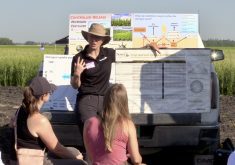
The Sustainable Nitrogen Outcomes (SNO) program will pay qualifying farmers a minimum of $2 an acre. Carlos Romero, senior sustainability manager at the Saskatoon-based fertilizer producer, said the firm was uniquely positioned to encourage stewardship throughout the nutrient supply chain.
“Nutrien is unique in the sense that we manufacture fertilizer, but we also sell a portion of that fertilizer directly to growers through our retail arm,” he said during a recent web presentation as part of Fertilizer Canada’s 4R Incentives program.
Nutrien is the largest producer of potash fertilizer and the largest global agricultural retailer, serving customers in seven countries, he noted.
While farmers never want to waste nutrients, they’re also applying them into a complex natural system that frequently does its best to strip them away. The SNO program hopes to encourage producers to look at new ways of preventing that from happening.
“We know that when farmers are applying nitrogen, a portion of that nitrogen is going to be lost as nitrous oxide emissions through the denitrification,” he said.
Qualifying for the program
The program follows a validated protocol called the nitrous oxide emissions reduction protocol (NERP), which was developed by the Alberta government in 2015 for their offset system. Nutrien’s program makes that protocol eligible in a voluntary space, in Alberta, Saskatchewan and Manitoba. To participate in the program, a grower must be a Nutrien customer and work with a Nutrien agronomist.
Nutrien leverages all those principles and frameworks at the field level, capturing information using a proprietary sustainability program called Agrible, which Nutrien has used since 2022.
“It allows us to capture everything at the field level to model, at the end of the day, the outcomes that growers are receiving based on the NERP principles. These outcomes obviously have a monetary value to growers and an environmental/corporate value to Nutrien,” said Romero.
NERP is a tier approach that measures agricultural practices based on a combination of 4R practices.
Growers can be placed at the basic, intermediate or advanced level, yielding different emissions reductions per pound of nitrogen applied in the field. The basic level is 15 per cent, the intermediate level is 25 per cent and 35 per cent is the advanced level.
“You are the pre-basic level if you don’t have a 4R agriculture infrastructure plan crafted by a designated 4R agronomist,” he said, noting have one was a prerequisite to joining the program.
Growers must have a copy of a soil test or a nutrient balance to justify the target and rate selected for each season. From that baseline growers can begin tweaking their nitrogen management, incorporating things like variable rate prescriptions and enhanced efficiency fertilizers such as nitrification inhibitors, dual inhibitors or polymer coated urea.
“You can unlock higher tiers, and reach for the advanced program,” Romero said.
Payments for the program are using $65 per tonne of carbon, but payments are equally site specific.
“It’s not going to be the same if you’re in Regina, or if you’re in a much wetter area, like Brandon, Manitoba,” he said. “The wetter the area, the higher the payment, simply because of that nitrification potential being higher,” said Romero.
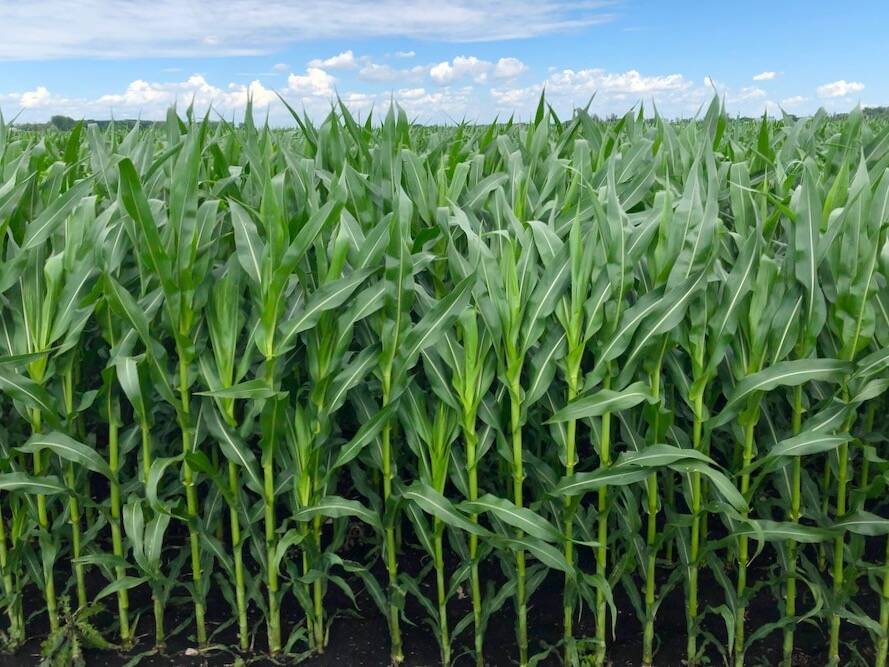
According to Nutrien’s website, Manitoba growers average incentives of $5.69 an acre for corn, $3.40 an acre for wheat and $3.31 an acre for canola.
Bang for buck
Nitrogen-hungry annual crops are the lowest hanging fruit for the incentive program, as the payments will be higher with a higher target nitrogen rate, Romero noted.
“The higher the pool of nitrogen that you have in the field, the higher the potential for these losses to happen. The mitigation potential for applying an international structure plan and all these practices in the field is going to be higher,” he said. “Keep in mind that the target nitrogen rate needs to be justified by a soil test or nutrient balance.”
Once the targeting rate has been defined with the help of an agronomist, growers can start seeing differences in payments as they jump from basic to intermediate to advanced. The program has four different steps: enrollment, in-system, harvest and processing.
“From enrollment to harvest, we work very closely with growers and our retail agronomist and then processing is internal to the sustainable ag team,” he said.
Enrollment starts mid-February and goes to early May. Enrollment is when growers and their Nutrien agronomists are crafting their 4R nitrogen stewardship plans.
Growers sign a contract to be involved in the program for a single year.
“If growers like the program, they can keep working with us. If they don’t like the program, they can walk away,” said Romero.
The contract explains the terms and conditions, data privacy, data usage and all the data and evidence growers need to close the program in a season.
“In-season and harvest are basically the core of the program,” he said.
Everything is captured under NERP field data including application data, scouting reports, pictures of equipment, fertilizer receipts and so on. The firm uses it’s proprietary Echelon Ag Tool system to collect yield maps and application maps, for both fertilizer and crop protection applications.
At the end of the season, once all the data is gathered, the sustainability teams subjects the data to internal quality control measures.
“If no flags are detected, we will notify the grower they need to hit commit. This is basically an attestation, saying that everything that happened in the field is true,” said Romero.
If issues come up, the sustainability team goes back to the grower or agronomist to rectify that data. After the grower hits commit, payment is issued in the form of a credit into the account.
Data delivered
On top of that, the grower will receive a sustainability report, providing the grower information around land use, nitrogen use and efficiency for that operation in a regional benchmark.
The Agrible platform gathers a wide range of data from each growing season.
Since Nutrien is pursuing verified carbon assets, they need to use external verification.
Carbon pricing was increased from $35 to $65 dollars a tonne.
“We increased it to mimic the federal pollution pricing that Ottawa was setting for the country,” he said.
Data for 2021 and 2022 has already been verified and 2023-2024 data are on their way.
“I should clarify that we pay growers after we have received a complete data set with all the data and the evidence. We don’t wait for verification to pay,” he said.
Last year, 72 per cent of acres in the program were at the basic level, and 28 per cent of acres were at the advanced level.
Correction note: A previous version of this story erroneously named Carlos Romero as Carlos Rivera.