What if you had a tool that instantly reduced seed and fertilizer costs by five per cent? On a 3,000-acre farm, that would save $40,000 per year.
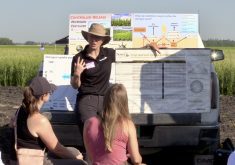
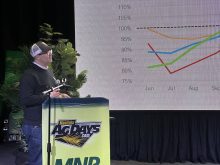
Those were the numbers presented by Jason Casselman, an agronomy specialist with the Canola Council of Canada, during an event hosted by the Simpson Centre for Food and Agricultural Policy in Edmonton in late May.
WHY IT MATTERS: Technology can make agriculture more efficient and verify sustainability claims, but adopting that technology has to make sense for farmers and their individual operations.
Read Also
White mould control requires flexible timing under Prairie conditions
Fungicide timing for white mould depends on canopy development, disease risk and number of planned applications, North Dakota pathologist Michael Wunsch told growers at CropConnect 2026.
The purpose of the event was to promote digitization in crop and beef production. Casselman’s part was to “help demystify the return on investment for precision technology,” he said.
Casselman owns a quarter section of land near Grande Prairie, Alta. Two local farmers, Mike Head and James Driedger, custom farm it for him. These two farmers also keep Casselman up to speed on tech and its return on investment.
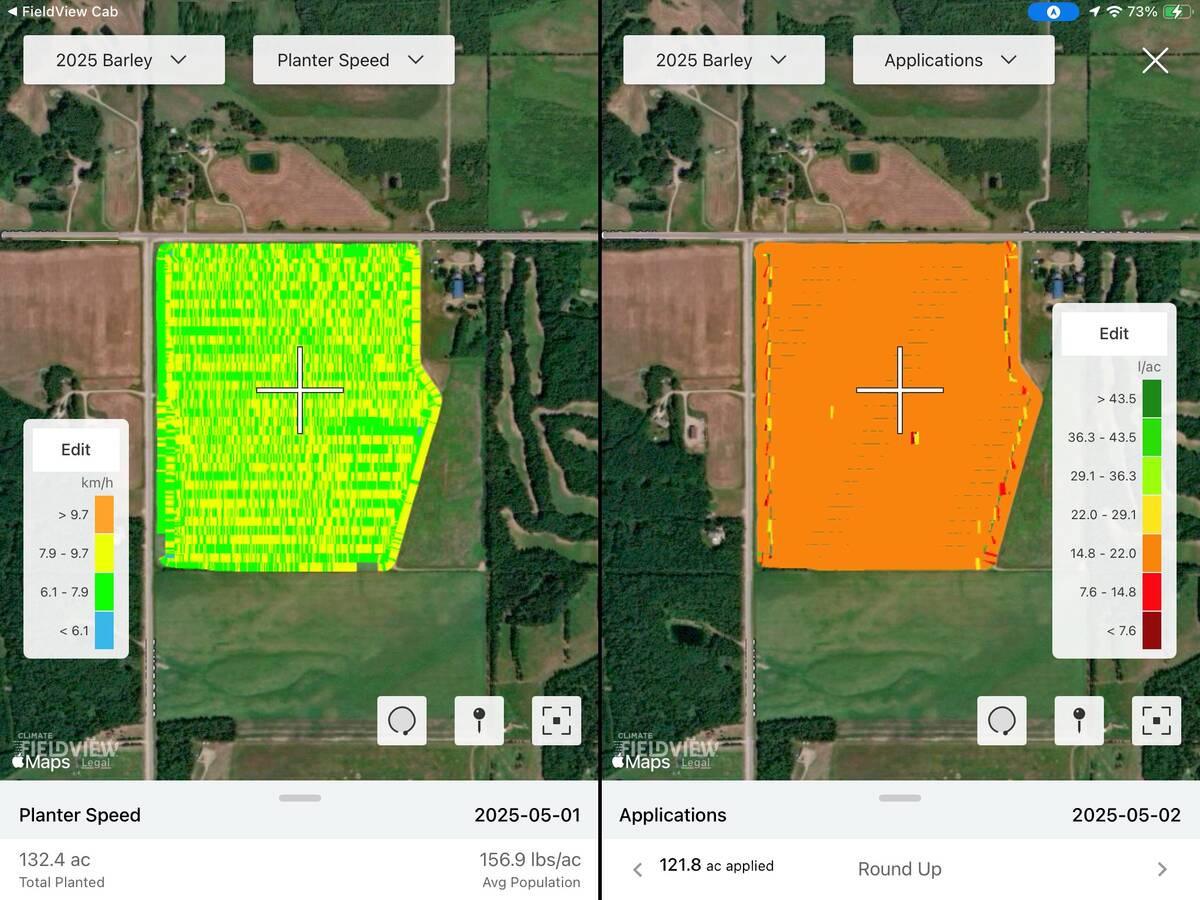
This May, for example, Casselman noted how field maps integrated into the tractor cab can help avoid the excessive cost of doubling up input application.

Head and Driedger applied pre-seed herbicide to every cropped acre on the farm this spring. That equated to 2,774 acres.
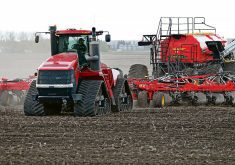
Their sprayer has section control to limit overlap to near zero. Using data from field maps, the technology automatically turns off sections (sometimes individual nozzles and openers) of a boom or seeding tool whenever those sections pass over an already covered aread.
In the case of Head and Driedger, their seeding tool was not equipped with the same section control as their sprayer was. Data from seeding showed that the equipment wracked up 2,923 acres, 149 acres (or 5.4 per cent) more than the area sprayed.
Converted to real money, Casselman told his presentation attendees, that extra 149 acres added up to thousands of dollars the farm could have saved. The three partners paid $818,440 for seed and fertilizer for the 2,923 acres. If they cut that by 5.4 per cent to cover only the 2,774 actual farmed acres, the savings would be over $44,000 per year.
“We don’t have a single square field,” Casselman said.
That means lots of odd shapes and application overlap. “Farms with big square fields may not see this same return on investment,” he acknowledged.
Section control gaining ground
Other farmers are reaching similar conclusions about the value of the technology.
Curtis de Gooijer, agronomy team lead for Bourgault, said that “since we launched our Auto Sectional Control in the 7000 series tanks, uptake has been 80-90 per cent, with current orders closer to 95 per cent uptake.”
Farm equipment retrofits
Farmers with some existing seed drills can retrofit them with section control. Bourgault, for example, offers kits for all 7000 and 9000 series carts, as well as some 8000 series. Suggested retail price on a single-shoot kit ranges from $23,000 to $29,000 and double-shoot kits run from $39,000 to $50,000, de Gooijer says.
Whatever drill or brand you have, call the dealer to ask about retrofit options.
Alonso Sawatzky works in sales and technical support for Romafa Metal Works near Arborg, Man. Romafa makes retrofit kits for John Deere 1900 and 1910 carts. The company is also working on a kit for Flexi-Coil carts.
The first step is to mount a metre housing to control flow to the distribution tower for each section of the drill. Step two is to install electronic-driven section control. This automatically opens and closes the run to each tower based on the map on the monitor. Step three is to connect section control to a monitor with a rate controller.
Growers have lots of monitor options, Sawatzky noted. The cost to install metre housing for a three-tank cart, as well as section control, runs up around $50,000.
Programs to pay for section control
After Casselman’s presentation, Mark Redmond, chief executive officer of RDAR (a producer-driven research funding organization in Alberta), told Casselman that they have a program that could help farmers pay for section control.
The Producer Research and Evaluation Project, under RDAR’s Accelerating Agricultural Innovations program, “supports producers by de-risking the evaluation of novel production practices,” he said.
Other provinces may offer similar funding, he added, but that was difficult to confirm as of press time.
Counting technology use on Canadian farms
In the fall of 2024, the Canola Council of Canada surveyed 500 canola growers across the Prairies. The survey included a question about technology used on the farm.
Eighty-five per cent of respondents said they use GPS guidance to keep each pass parallel and limit overlap on the straight stretches.
Of the survey participants, 72 per cent said they use section control on the sprayer, but only 41 per cent had it on their seeding tool.
“With some technology and precision tools, they seem like answers looking for a problem that perhaps doesn’t exist,” Casselman says. “That is not the case with section control.”
Farmers only have 40 chances to grow a crop, Casselman told listeners, paraphrasing Howard Buffet.
“If you don’t use everything available to improve results each time around, you’re giving up on opportunities.”