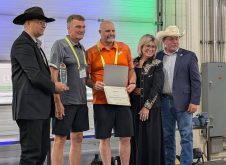

A new research project from Saskatchewan government is focusing on technology with ag tech company FarmSimple.
At the Livestock AgTech Happy Hour at Ag in Motion on July 16, 2024, Chelsey Siemens, a livestock and feed extension specialist with the province, said they are doing a research project through ADOPT (Agriculture Demonstration of Practices and Technology), looking at how FarmSimple can be used to monitor sulfate levels over the summer.
Read Also

“Major setback for global trade”: WTO suffers fresh blow after reform push hits wall
The World Trade Organization’s ministerial talks in Yaounde ended on Monday with Brazil blocking a bid by the U.S. and others to prolong a moratorium on duties for electronic transmissions.
“Using the FarmSimple solutions for water monitoring, and adding on that total dissolved solid monitoring in order to keep an eye on that water quality throughout the summer,” Siemens said. “So that’s one of the things about total dissolved solids, especially sulfate, is that it often changes over the course of the summer.”
FarmSimple was founded in 2018 and makes a water monitoring system that allows you to remotely check the water level and control critical equipment in your watering system. FarmSimple has won multiple awards for its technology, including at Canadian Western Agribition’s Animal Agtech Awards.
“We’re getting early alerts on conductivity measurements of that water. In the future, the idea would be to catch water before it goes bad, to allow them to take the lab tests to confirm,” Katlin Lang, Co-founder of FarmSimple, said at the happy hour.
Siemens said that sulfate poisoning is a large concern when it comes to water quality. She said when sulfate levels are too high, they can bind up trace minerals and can sometimes lead to polio in livestock.
She says an issue with sulfates is when cattle are consuming feed with higher sulfate levels, such as brassicas, turnips, radishes, or kochia. This can also happen with nitrates, leading to nitrate poisoning.
“I’m sure we’ve all heard about nitrate poisoning from forages,” Siemens said. “But we often have to watch out, especially if we have elevated nitrate in our forages and elevated nitrate in the water. Those two can combine together and cause nitrate poisoning in our ruminant livestock.”
Siemens said that while there are handheld monitors and testing strips, producers should get their water tested at least once a year.